
Algorithms for Adaptive Estimation of Dynamic Objects Under the
Influence of Additive Noise
Oripjon Zaripov
1a
, Jasur Sevinov
1b
, Fuzayl Odilov
1c
, Furkat Odilov
1d
and Shaxlo Zaripova
2e
1
Tashkent State Technical University, 100057, Tashkent, Uzbekistan
2
Karshi Institute of Engineering and Economics, 180100, Karshi, Uzbekistan
Keywords: Adaptive Filtering, Kalman Filter, Nonlinear Systems.
Abstract: Algorithms for adaptive evaluation of dynamic object control systems under the influence of additive noise
are considered. Algorithms of the Kalman filter are given. An adaptive filtering approach for nonlinear
systems with additive noise is also considered. The developed adaptive estimation algorithm can calculate the
square root of the covariance matrix in a simple way in such a way that positive semi-certainty is guaranteed,
which significantly increases the stability and accuracy of the filter.
1 INTRODUCTION
The Kalman filter is widely used in numerous tasks
of synthesizing and designing systems for managing
dynamic objects of various functional purposes
(Krasovsky, 1987; Zaripov & Khamrakulov, 2021).
The Kalman filter provides an unbiased estimate with
minimal variance about the state of a discrete linearly
varying dynamic system, the input and output of
which are distorted by Gaussian white noise with an
additive character. This approach was extended to
continuous dynamical systems by Kalman and Bucy
with a linear character (Leondes, 1980; Sinitsyn et al.,
2006).
The Kalman filter has one major drawback
(Ogarkov, 1990; Sinitsyn et al., 2006; Olimovich et
al., 2024). The equations used in the optimal filter
require precise knowledge of the dynamic equations
of the system and the statistics of random variables,
including the need to know the transition matrices of
the system and the covariance of disturbances such as
additive white noise. However, usually only their
estimates are available. Recently, Kalman filter
schemes (Krasovsky, 1987; Ogarkov, 1990) have
a
https://orcid.org/0000-0002-2752-4424
b
https://orcid.org/0000-0003-0881-970X
c
https://orcid.org/0009-0000-6267-4965
d
https://orcid.org/0009-0001-0727-6451
e
https://orcid.org/0009-0003-0447-7578
appeared in order to circumvent this problem. These
schemes are commonly referred to as "adaptive
filters". Various adaptive filters can be grouped
according to the principle of identifying undefined
parameters, heuristic weighting coefficients, or the
absence of correlation of residual terms.
Theoretically and practically, the synthesis of
control systems for dynamic objects very often
addresses estimation issues in which measurement
uncertainty is represented as an additive purely
random sequence or white noise. At the same time,
there are estimation problems (Zaripov et al., 2021;
Peltsverger, 2004; Kolos, 2000; Bryson et al., 1972)
when an additive Markov sequence, i.e. sequentially
correlated or non-white noise, is a more accurate
model of uncertainty in measurements.
When using systems used to control dynamic
objects, the structural and parametric data of the
controller do not have a dependence associated with
the structure and parameters of the observer. This, in
turn, makes it possible to use well-known control
laws, and in the future, the possibility of adapting
them using the evaluation contour. It should be borne
in mind that the use of the given structure will be
convenient in the event that there is a need to
Zaripov, O., Sevinov, J., Odilov, F., Odilov, F. and Zaripova, S.
Algorithms for Adaptive Estimation of Dynamic Objects Under the Influence of Additive Noise.
DOI: 10.5220/0014268300004738
Paper published under CC license (CC BY-NC-ND 4.0)
In Proceedings of the 4th International Conference on Research of Agricultural and Food Technologies (I-CRAFT 2024), pages 321-324
ISBN: 978-989-758-773-3; ISSN: 3051-7710
Proceedings Copyright © 2025 by SCITEPRESS – Science and Technology Publications, Lda.
321

modernize or adapt the existing management system.
When studying the evaluation algorithm with
relatively high performance, the qualitative indicators
of the adaptive system are not much inferior to the
non-adaptive system in terms of minimum indicators.
But even at the same time, during the period of
transients carried out in the observer, the qualitative
indicators of a closed system may have deteriorations
reaching the loss of asymptotic stability. Such
disadvantages can be eliminated by increasing the
speed of estimation algorithms in areas with large
deviations.
In general, considering the formulation of the
problem, multiple observations may contain certain
white noises, while non-white Markov-type noises
may not contain noise as a whole or be considered as
some combination of the three studied possibilities.
Following from this, in further descriptions, under the
terminology "non-white noise" we will understand
the presence of Markov-type noise or the non-
participation of noise as a whole in one or more
dimensions.
2 MATERIALS AND METHODS
Consider a linear dynamical system described by the
equation
iiiiiii
wГxAx
|1|11 +++
+=
, (1)
1111 ++++
+=
iiii
vxHz , (2)
for
,...2,1,0=i
with an initial condition
0
x and a
measurement matrix
1+i
H .
The measurement error
1+i
v is identified with the
state vector of some additional linear dynamic system
(forming filter) with a transition matrix
i
Ψ and a
perturbation vector
i
ξ
:
iiii
vv
ξ
+Ψ=
+1
for
,...2,1=i
with an initial condition
0
v .
It is assumed that perturbations {
,...2,1,0, =iw
i
}
and {
,...2,1,0, =i
i
ξ
} – are sequences of random
vectors with known correlation matrices
i
T
iii
T
ii
REQwwE == ][,][
ξξ
, where E – is the
averaging operator and "т" is the transposition
operation. These two successive equations do not
depend on each other and also do not depend on the
initial conditions
0
x ,
0
v .
With mutually uncorrelated errors {
,...2,1,0, =iv
i
}
kii
T
ii
VvvE
δ
=][
, where
ki
δ
–
is the symbol called Kronecker, is optimal in the form
of a minimum of the variance estimate
ii
x
|
ˆ
of the
state vector
i
x of the system (1), based on
measurements {
ikz
k
,...,2,1, =
} of the form (2), it
is formed according to the recurrent Kalman
algorithm [1-11]:
)
ˆ
(
ˆˆ
1|1|| −−
−+=
iiiiiiiii
xHzKxx
(3)
1|11|1|
ˆˆ
−−−−
=
iiiiii
xAx
, (4)
1
1|1|
)(
−
−−
+=
i
T
iiii
T
iiii
VHPHHPK
, (5)
T
iiiii
T
iiiiiiii
ГQГAPAP
1|11|1|1|11|1| −−−−−−−−
+=
, (6)
1||
)(
−
−=
iiiiii
PHKIP
(7)
for
,...2,1=i
, where I – is a unit matrix, and the
initial conditions for equations (4) and (6) are set,
respectively, by an a priori estimate
0|0
ˆ
x
of the initial
state vector
0
x and the correlation matrix
0|0
P
of its
error
00|00|0
ˆ
~
xxx −=
, uncorrelated with {
,...2,1,, =iw
ii
ξ
}. In this case,
ii
P
|
is a correlation
matrix of the error of the optimal estimate
ii
x
|
ˆ
of the
current state
i
x , calculated using formulas (5) – (7)
without using measurements
i
z .
To solve the estimation problem under the
influence of additive noise, the following algorithms
can be proposed (Sinitsyn et al., 2006, Zhou et al.,
2013, Zhou et al., 2015). It is assumed that the
statistical property of system noise is known.
However, in real time, the process noise covariance
matrix Q or the observation noise variance matrix R
are often unknown. In addition, these parameters may
change over time. Therefore, an adaptive Kalman
filter must be designed to adjust Q and R, where it is
important to increase the accuracy and stability of
filtration.
Thus, we assume an adaptive filtering algorithm
based on the maximum a posteriori estimate (Zhou et
al., 2013). Subsequently, the algorithm has the ability
to evaluate unknown time-varying noise. The specific
calculation process is as follows:
00
ˆ
[],
x
Ex=
00000
ˆˆ
[( )( ) ],
T
PExxxx=− −
00
ˆ
ˆ
(0), (0)QQ RR==
during initialization
0i =
.
I-CRAFT 2024 - 4th International Conference on Research of Agricultural and Food Technologies
322

|1 |1 1|1 |1 |1 1|1 |1 1
ˆ
ˆˆ
,
T
ii ii i i ii ii i i ii i
x
Ax P AP A Q
− − −− − − −− − −
==−
during iteration
1, 2,...i =
, that is, the time update.
Let's evaluate the statistical properties of
measurement noise when updating measurement
results:
|1
1|1
ˆ
,
ˆˆ
(1 ) ( ).
ii iii
TT
iiiiiiiiii
zzHx
RdRdzzHPH
−
−−
=−
=− + −
Let's estimate the value of the state, after correction
we will calculate the a posteriori variance of the state:
1
|1 |1
||1
|1
ˆ
(),
ˆˆ
,
().
TT
iiiiiiii i
ii ii i i
iiiii
KPHHPH R
xx Kz
PIKHP
−
−−
−
−
=+
=+
=−
Then we will evaluate the statistical properties of the
process noise in accordance with
1||11|1|1
ˆˆ
(1 ) ( ),
TT T
i i i i iii i ii ii i i ii
QdQdKzzKPAPA
−−−−−
=− + + −
where
1
(1 ) / (1 )
i
i
dbb
+
=− −
,
b
it is a factor of
forgetting, and
01b<<
.
Now let's consider the adaptive filtering approach
for nonlinear systems with additive noise. Both the
process equations and the measurement equations are
nonlinear according to
11
() ,
() ,
iii
iii
x
fx w
zhx v
−−
=+
=+
where
()
f
and
()h
they are non-linear functions.
3 RESULTS AND DISCUSSION
The adaptive assessment algorithm is as follows:
00
ˆ
[],
x
Ex=
{
}
00000
ˆˆ
[( )( ) ] ,
T
ScholExxxx=−−
00
ˆ
,QS=
{
}
00000
ˆ
ˆˆ
[( )( ) ] .
T
R chol E z z x z=−−
111 11 1
ˆˆ ˆ
[]
iii ii i
x
xSxS
χγγ
−−− −− −
=+ −, при
1, 2,...,i =∞
.
Let's write the time update equations as follows:
*
1
ˆ
(),
ii
f
χχ
−
=
2
() *
|1 ,
0
ˆ
ˆ
,
L
m
ii k i k
k
xW
χ
−
=
=
{
}
() *
|1 1 ,1:2 |1 1
ˆ
ˆ
ˆ
[( )],
c
ii i L ii i
SqrW xQ
χ
−−−
=−
{
}
*()
|1 |1 ,0 |1 0
ˆ
ˆ
[, , ].
c
ii ii i ii
S cholupdate S x W
χ
−−−
=−
Then we calculate the square root of the measured
noise matrix:
*
11
ˆ
ˆ
(),
ii
Zh
χ
−−
=
2
*()*
11,
0
ˆ
ˆ
,
L
m
ikik
k
zWZ
−−
=
=
**
111
ˆ
iii
zzz
−−−
=−
,
{
}
** *
11
ˆ
1,||,,
ii i i
R
cholupdate d R z d
−−
=−
(8)
{
}
*****()
1|0: 2 1
ˆ
ˆ
,,
c
iLi ik
R cholupdate R Z z d W
−−
=−−
{
}
*
ˆ
i
R
diag R=
,
where
|1 |1 |1 |1 |1 |1
ˆ
ˆˆ ˆ
[],
ii ii ii ii ii ii
xx Sx S
χγγ
−−− −− −
=+ −
|1 |1
ˆ
ˆ
(),
ii ii
Zh
χ
−−
=
2
()
|1 |1,
0
ˆ
ˆ
,
L
m
ii k ii k
k
zWZ
−−
=
=
*
11|1
ˆ
.
iiii
zzz
−− −
=−
The measurement update equations are as follows:
2
()
( ) |1, |1 |1, |1
0
ˆ
ˆ
ˆ
ˆ
()(),
L
cT
xz i k ii k ii ii k ii
k
PW xZz
χ
−−−−
=
=−−
{
}
()
() 1 | 1,1:2 | 1
ˆˆ
ˆ
(),
c
zi ii L ii i
SqrWZ zR
−−
=−
{
}
()
() () |1,0 |1 0
ˆ
ˆ
[, , ]
c
zi zi ii ii
S cholupdate S Z z W
−−
=−
,
()
() ()
()
/
,
T
xz i z i
i
zi
PS
K
S
=
|1
ˆˆ
iii ii
x
xKz
−
=+
,
()
,
izi
UKS=
() | 1
{,,1}.
zi ii
S cholupdate S U
−
=−
Let's estimate the square root of the process noise
matrix in accordance with
{
}
**
1|1
ˆ
ˆˆ
,| |,
iiiii
Q cholupdate Q x x d
−−
=−
,
{
}
***
,,
i
Q cholupdate Q U d=−
,
Algorithms for Adaptive Estimation of Dynamic Objects Under the Influence of Additive Noise
323
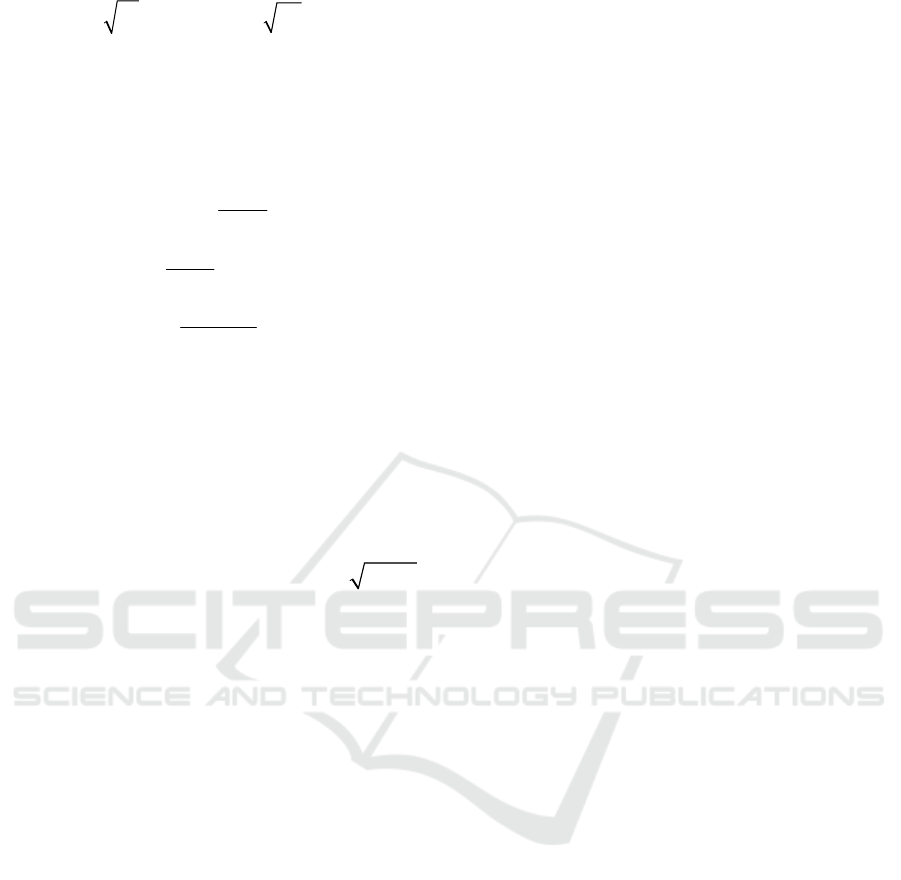
(
)
{
}
*
ˆ
,
i
Q diag diag Q=
where
1
(1 ) / (1 )
i
i
dbb
+
=− −
and
b
it is a factor
of forgetting, as a rule
01b<<
.
The weights (
()m
k
W
and
()c
k
W
) of the mean value
and covariance are given by the formula
()
0
,
m
W
L
λ
λ
=
+
() 2
0
1,
c
W
L
λ
αβ
λ
=+−+
+
() ()
1
,1,...,2,
2( )
mc
kk
WW k L
L
λ
== =
+
where
2
()L
λα κ
=+
it is a scaling parameter.
The constant
α
defines the spread of sigma points
around the average value, which is usually set to a
small positive value (for example,
4
10 1
α
−
≤≤
).
Constant
0
κ
≥
is a secondary scaling parameter.
0
β
≥
is used to account for prior knowledge of the
distribution (for Gaussian distributions, the optimal
value is
2
β
=
) [4-10]. In addition,
L
γ
λ
=+
.
Here we used three powerful linear algebra methods:
QR decomposition (
{}qr
), updating the Xoleski
coefficient (
{}cholupdate
) and efficient least
squares methods (/), which are briefly discussed in
(Sage et al., 1969, Julier et al., 1995).
4 CONCLUSIONS
Algorithms for adaptive evaluation of dynamic object
control systems under the influence of additive noise
are considered. Algorithms of the Kalman filter are
given. An adaptive filtering approach for nonlinear
systems with additive noise is also considered. The
developed adaptive estimation algorithm can
calculate the square root of the covariance matrix in a
simple way in such a way that positive semi-certainty
is guaranteed, which significantly increases the
stability and accuracy of the filter.
REFERENCES
Abidova; G., 2024. Calculation and development of
measuring amplifier with automatable and digital
comparator of ensuring switching of amplification
coefficients. AIP Conf. Proc., 3152 (1): 050003.
Bryson, A. & Yu-Shi, H., 1972. Applied theory of optimal
control. Translated from En, M.: Mir, p. 544.
Julier, S.J. & Durrant-Whyte, H., 1995. Navigation and
parameter estimation of high speed road vehicles.
Proceedings of the Robotics and Automation
Conference, Nogoya, Japan.
Kolos, M.V., Kolos, I.V., 2000. Methods of linear optimal
filtration. M.: Nauka, p. 158.
Krasovsky, A.A., 1987. Handbook of the theory of
automatic control. M.: Nauka, p. 712.
Leondes, K.T., 1980. Filtering and stochastic control in
dynamic systems. Translated from En., M.: Mir, p. 407.
Ogarkov, M.A., 1990. Methods of statistical estimation of
parameters of random processes. M.: Energoatomizdat,
p. 208.
Olimovich, Z.O., Usmonovna, S.D., Gayratovich, B.S.,
2024. adaptive posision-determination and dynamic
model properties synthesis of moving objects with
trajectory control system (In the case of multi-link
manipulators). Transactions of the Korean Institute of
Electrical Engineers, 73(3).
Peltsverger, S.B., 2004. Algorithmic support of estimation
processes in dynamic systems under conditions of
uncertainty. M.: Nauka, p. 116.
Sage, A.P. & Husa, G.W., 1969. Adaptive filtering with
unknown prior statistics. Proceedings of the Joint
Automatic Control Conference, Boulder, Colo, USA,
760–769.
Sinitsyn, I.N., 2006. Kalman and Pugachev filters.
Publishing house: Logos, p. 640.
Zaripov, O., Sevinova, D., 2023. Structural and kinematic
synthesis algorithms of adaptive position-trajectory
control systems (in the case of assembly industrial
robots). Lecture Notes in Networks and Systems, 762,
622–637.
Zaripov, O.O., Khamrakulov, U.S., 2021. Industry 4.0
Technologies: Impact on Increasing the Productivity of
Industrial Enterprises. Advances in Intelligent Systems
and Computing, 1323, 479–486.
Zaripov, O.O., Khamrakulov, U.Sh., Fayziev, S.I., Sadikov,
S.B., Mamadjanov, B.N., 2021. Algorithms for
intelligent data processing in resource management
under uncertainty and dynamic environment.
International Conference on Information Science and
Communications Technologies: Applications, Trends
and Opportunities.
Zhou, Y., Zhang, Ch., Zhang, Y., Zhang, J., 2015. A new
adaptive square-root unscented kalman filter for
nonlinear systems with additive noise. Hindawi
Publishing Corporation International Journal of
Aerospace Engineering, 9.
Zhou, Y., Zhang, Y.F., Zhang, J.Z., 2013. A new adaptive
squareroot unscented Kalman filter for nonlinear
systems. Applied Mechanics and Materials, 300-301,
623–626.
I-CRAFT 2024 - 4th International Conference on Research of Agricultural and Food Technologies
324
