
Preparation of High-Strength Details from Modified Steel Alloy
110G13L
Shukhrat Chorshanbiev
a
, Gapur Atajanov
b
, Farruh Abdullaev
c
and Ibrokhim Nasirkhujaev
d
Tashkent State Technical University, 100095, University str. 2, Tashkent, Uzbekistan
Keywords: High-Strength Steel, 110G13L Alloy, Ferromanganese Modification.
Abstract: In this article, in order to increase the friction of parts made of 110G13L modified steel (tank tracks (tracks),
plows for tractors, railway relays, various parts that work under strong impact and friction), the Faculty of
Mechanics of Tashkent State Technical University, “Casting Technologies Research work was carried out in
the laboratory of the department. Ferromanganese-85 was added as a modifier to 110G13L steel in different
amounts (0.1., 0.2., 0.3., 0.4., 0.5%) and melted in an induction melting furnace during the research. The
chemical properties, hardness and structures of the molten samples were checked in the latest modern devices,
and based on the results of the conducted research, it was found that the ductility of the steel parts increased.
1 INTRODUCTION
The scientists of the world conducted extensive
research on the possibility of changing the structure of
steel by heating and cooling the alloy, changing its
internal structure, chemical, physical and mechanical
properties, heating and cooling, and achieved results.
Today, machine-building is the main consumer of
metals produced in our country. In the machine tool
industry, in the automotive and aviation industry, in
electronics and radio engineering, many machine and
accessory parts are made from metals.
Metals used in technology are mainly divided into
two groups - ferrous and non-ferrous metals. Ferrous
metals include iron and its compounds (cast iron, steel,
ferroalloys). The remaining metals and their alloys
form the group of non-ferrous metals. Until now, iron
and its alloys, considered the main machine-building
material, are of particular importance among metals.
Iron and its alloys make up 90% of metals produced
worldwide. This is explained by the fact that ferrous
metals have important physical and mechanical
properties, as well as the fact that iron ores are widely
distributed in nature, and the production of cast iron
and steel is cheap and uncomplicated (Turakhodjayev
et al., 2020a, b; Enloe et al. 2015).
a
https://orcid.org/0009-0007-7690-7089
b
https://orcid.org/0002-0009-8137-3942
c
https://orcid.org/0000-0001-6126-4028
d
https://orcid.org/0009-0007-8527-1826
The fact that metals have the ability to melt various
elements allows the atoms of the substance
surrounding the metal to diffuse into the metal at a
high temperature, as a result of which the chemical
composition of the surface layer of the metal changes.
Diffusion of atoms into a metal is a chemical process,
but temperature plays a major role in the course of this
process, so the diffusion process cannot be considered
a purely chemical process. Such processing, which
changes the chemical composition of the surface layer
of the alloy, is called chemical-thermal processing
(Turakhodjayev et al., 2023). Types of chemical-
thermal operation are described in detail when we
study the literature of our country and foreign
scientists. In recent years, the method of changing the
structure of alloys while working under pressure is
being used more and more widely (Umidjon et al.
2023; Ya Kozlov et al. 2003).). Such processing of
alloys is called thermomechanical processing. When
the alloy is deformed, not only its external appearance
changes, but also a lump is formed in it, and this
lumped alloy is thermally treated. Therefore, it is
necessary to include thermomechanical performance
in the process of studying literature specific to our
various scientific research work of thermal
performance. (Mirbabaev, 2004).
Chorshanbiev, S., Atajanov, G., Abdullaev, F. and Nasirkhujaev, I.
Preparation of High-Strength Details from Modified Steel Alloy 110G13L.
DOI: 10.5220/0014262500004738
Paper published under CC license (CC BY-NC-ND 4.0)
In Proceedings of the 4th International Conference on Research of Agricultural and Food Technologies (I-CRAFT 2024), pages 287-293
ISBN: 978-989-758-773-3; ISSN: 3051-7710
Proceedings Copyright © 2025 by SCITEPRESS – Science and Technology Publications, Lda.
287
In the scientific research centers of many
developed countries, special attention is paid to the
development of competitive techniques and
technologies in order to increase the mechanical
properties of modified steels of the 110G13L brand.
The leading scientists of the world, that is, Chinese
scientist Li Huayun, Yuan Li conducted research on
the topic "Effect of modifiers on the microstructure of
high manganese steel". A modifier with potassium and
sodium elements was selected for the experiment
(Wang et al. 2019). As a result of the research, they
found that it can reduce austenite grains and
intercrystalline carbides, reduce the amount of pearlite
in the microstructure of cast steel. British scientist
Kuanshun Luo and Chinese scientist Jingshi Ju
conducted research on the topic of "Crack resistance
and crack mechanisms of high-manganese austenitic
Gadfield steel by dry friction" (Turakhodjaev et al.,
2020; Turakhodjaev et al., 2023
; Najafabadi, et al.2014). Vietnamese scientists
Duvong Nam Nguyen and May Khan Pfamom and
Japanese scientist Duvong-Nguyen Nguyen jointly
conducted a study on the topic "Effect of rare earth
metals on the structure and mechanical properties of
high-manganese steel under impact loads" and
reported that the mechanical properties were improved
through the thermal treatment regime.
Gustav Tressi and Bianca Venturelli, scientists
from the University of Sao Paulo, Brazil, conducted a
study on "The effect of manganese content on the
corrosion resistance and impact toughness of Gadfield
steel." They modeled the process using Thermo-calc
software to estimate the ranges of temperature phase
changes and determine the casting parameters of the
steel. All five steel variant castings were melted
(1450-1500 °C) in induction furnaces with argon and
several results were obtained (Yang et al., 2023; Nodir
et. al. 2022).
2 METHODS
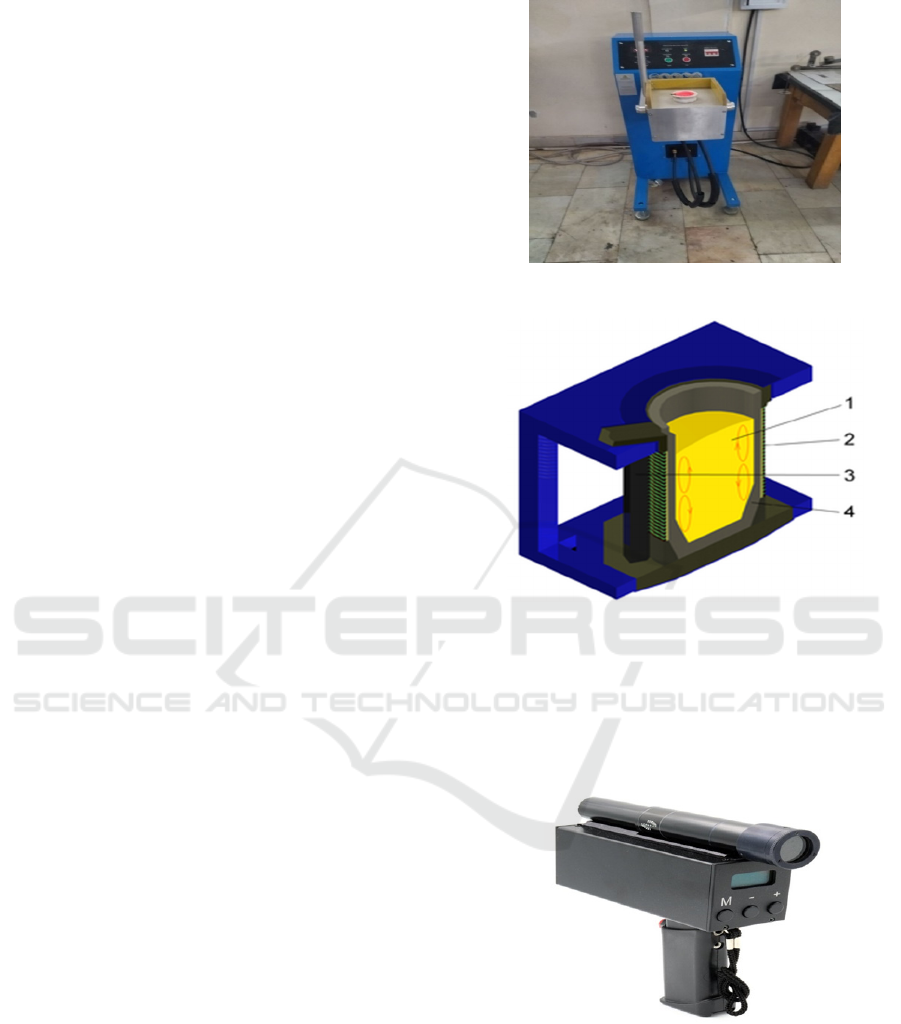
Induction melting of 110G13L modified steel alloy in
laboratory conditions of Tashkent State Technical
University, Faculty of Mechanics, "Foundry
Technologies" department (INDUCTION MELTING
MACHINE, Model: BF-TB2) was carried out in the
furnace.
In the first stage of the research, 1 kg of
110G13L steel slag was loaded at 20
0
C and liquefied
at a temperature of 1250-1300
0
C. Then
ferromanganese-85 in the amount of 0.2% was loaded
into the liquid metal and the temperature in the
induction furnace was raised to 1410
0
C.
Figure 1: Induction Melting Furnace (Model: BF-TB2).
Figure 2: Induction Melting Furnace (Model: BF-TB2)
To determine the hardness of the obtained sample,
the liquid alloy taken from the furnace was poured
into a sand-clay mold at 1390-1410
0
C. The
temperature of the liquid alloy was measured on a
Kelvin PLTs 3000 device.
Figure 3: Kelvin PLTs 3000 equipment for measuring the
temperature of a liquid alloy (Nodir et al., 2022).
3 RESULTS AND DISCUSSION
As a result of the research carried out in an induction
furnace with the addition of 0.1% ferromanganese-85
as a modifier to 110G13L steel, the following
I-CRAFT 2024 - 4th International Conference on Research of Agricultural and Food Technologies
288
indicators were obtained: the hardness of the surface
parts of the sample according to HRB was 95.7 and
97.9, the hardness of the central part was 98.6,
according to HRB average was 97.4, HB-217.8
according to Brinell.
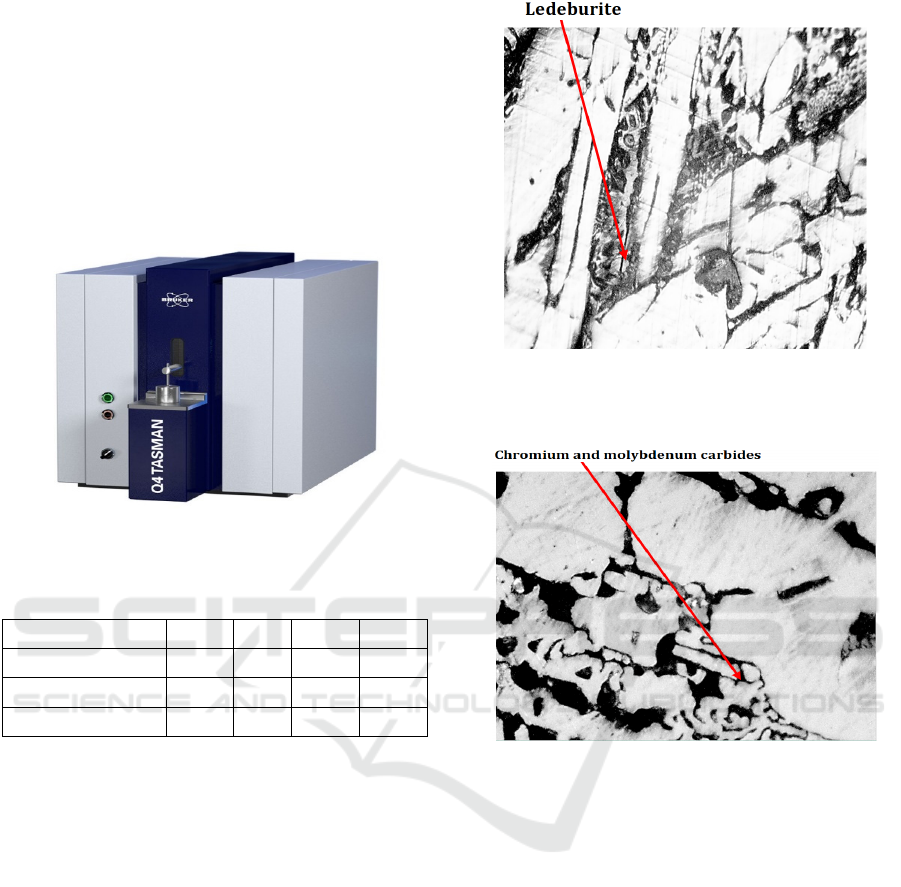
Chemical properties were checked on the "Q4
TASMAN Bruker" device in the center of "INNO"
Innovative Educational and Production Technopark
on the territory of Tashkent State Technical
University.
Figure 4: Kelvin PLTs 3000 equipment for measuring the
temperature of a liquid alloy (Nodir et al., 2022).
Table 1: Chemical composition of steel, weight – %
Name of material C Si Mr P
FeMn - 85 1.15 0.50 11.55 0.056
Name of material S Cr Ni Mo
FeMn - 85 0.018 0.41 0.057 0.35
The hardness of the samples prepared in the
mechanical workshop was determined by the TR-
5018 PAS Tochline lathe, using a metallographic
microscope at the MISIS branch of the Russian State
"National Research and Technology University".
Received of results conclusion from that for
comparison, in unmodified eutectic steel, primary
molybdenum and chromium crystals up to 10 μm
wide and 70 μm long have the dimensions shown in
the above images. The mechanical properties and heat
resistance of the alloy are partially improved.
The second stage of the study was carried out in
an induction furnace with the addition of 0.2%
ferromanganese-85 as a modifier to 110G13L steel.
Figure 5: The results of structures obtained when adding
0.1% ferromanganese as a modifier to 110G13L steel, 1
x100 view.
Figure 6: The results of structures obtained when adding
0.1% ferromanganese as a modifier to 110G13L steel, 2
x400 view.
The following indicators were obtained: hardness of
the surface parts of the sample according to HRB was
96 and 97.7, hardness in the central part was 100.9,
HRB The average was 98.2, according to Brinell HB-
228.
When studying its structure and chemical
properties, the following results were obtained.
Received of results conclusion from that is that
small dispersion carbides of chromium and
molybdenum can be seen in ledeburite layers. It
reduces the size of molybdenum and chromium grains
to 3-4 microns in width and 40-45 microns in length
(Karimov et al., 2021; Mardonov et al. 2023).
Preparation of High-Strength Details from Modified Steel Alloy 110G13L
289
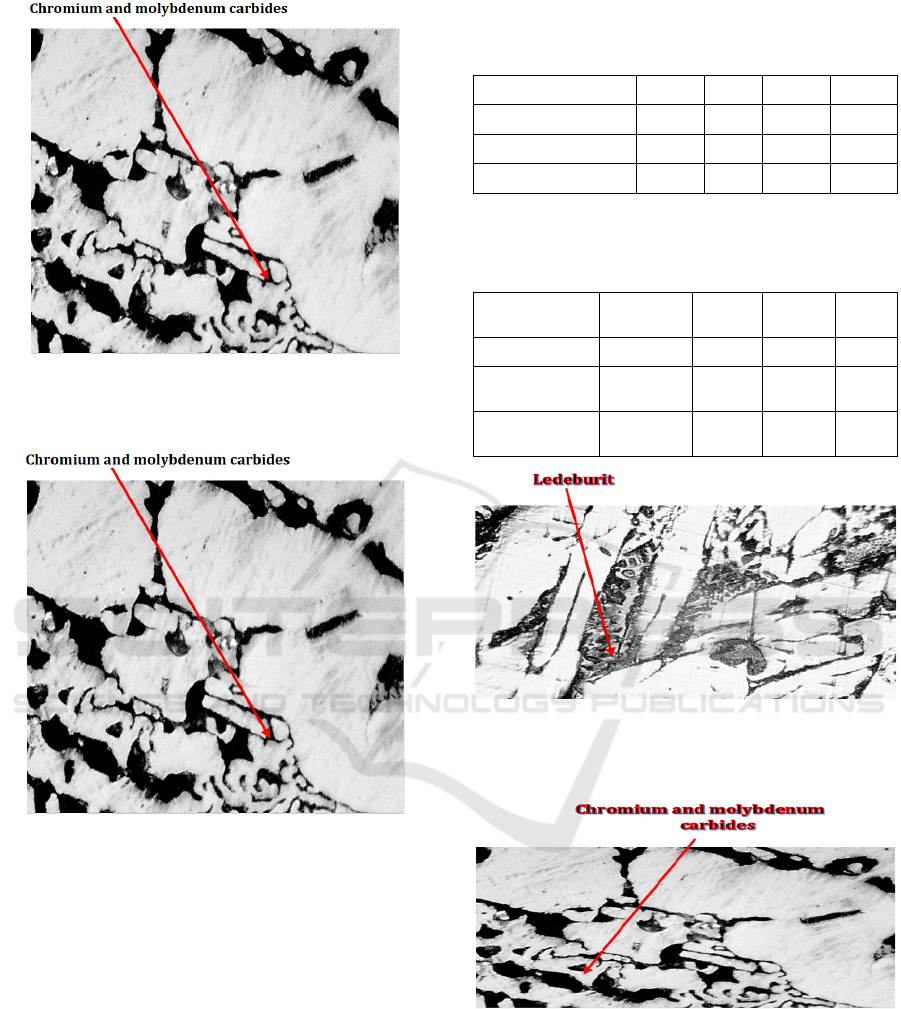
Figure 7: The results of structures obtained when adding
0.2% ferromanganese as a modifier to 110G13L steel, 1
x100 view.
Figure 8: The results of structures obtained when adding
0.2% ferromanganese as a modifier to 110G13L steel, 2
x400 view.
Based on the results presented above, the
following conclusions can be drawn: when 0.1% -
0.2% ferromanganese was added as a modifier to the
composition of 110G13L steel , the hardness of the
surface and central parts of the alloy was found as
follows, i.e., when 0.1% ferromanganese was added,
the hardness was HB -217.8 and adding 0.2% made
HB-228. This explains the small amount of
ferromanganese added as a modifier and the chemical
reactions formed in the alloy did not take place at the
same rate.
Table 2: Results of chemical properties obtained when
adding 0.2% ferromanganese as a modifier to 110G13L
steel are in %.
Name of material C Si Mr P
FeMn - 85 1.15 0.50 11.55 0.056
Name of material S Cr Ni Mo
FeMn - 85 0.018 0.41 0.057 0.35
Table 3: Results of chemical properties obtained when
adding 0.3% ferromanganese as a modifier to 110G13L
steel are in %.
Name of
material
C Si Mr P
FeMn - 85 1.15 0.50 11.55 0.056
Name of
material
S Cr Ni Mo
FeMn -
85
0.018 0.41 0.057 0.35
Figure 9: The results of structures obtained when adding
0.3% ferromanganese as a modifier to 110G13L steel, 1
x100 view.
Figure 10: The results of structures obtained when adding
0.3% ferromanganese as a modifier to 110G13L steel, 2
x400 view.
The third stage of the study was carried out in an
induction furnace with the addition of 0.3% of
ferromanganese-85 as a modifier to 110G13L steel.
The following indicators were obtained: the surface
hardness of the sample was 103.9 and 104.1, and the
hardness in the central part was 105.3 , averaged
I-CRAFT 2024 - 4th International Conference on Research of Agricultural and Food Technologies
290
104.4 on HRB , HB-269 on Brinell.When studying its
chemical properties and structure, the following
results were obtained.
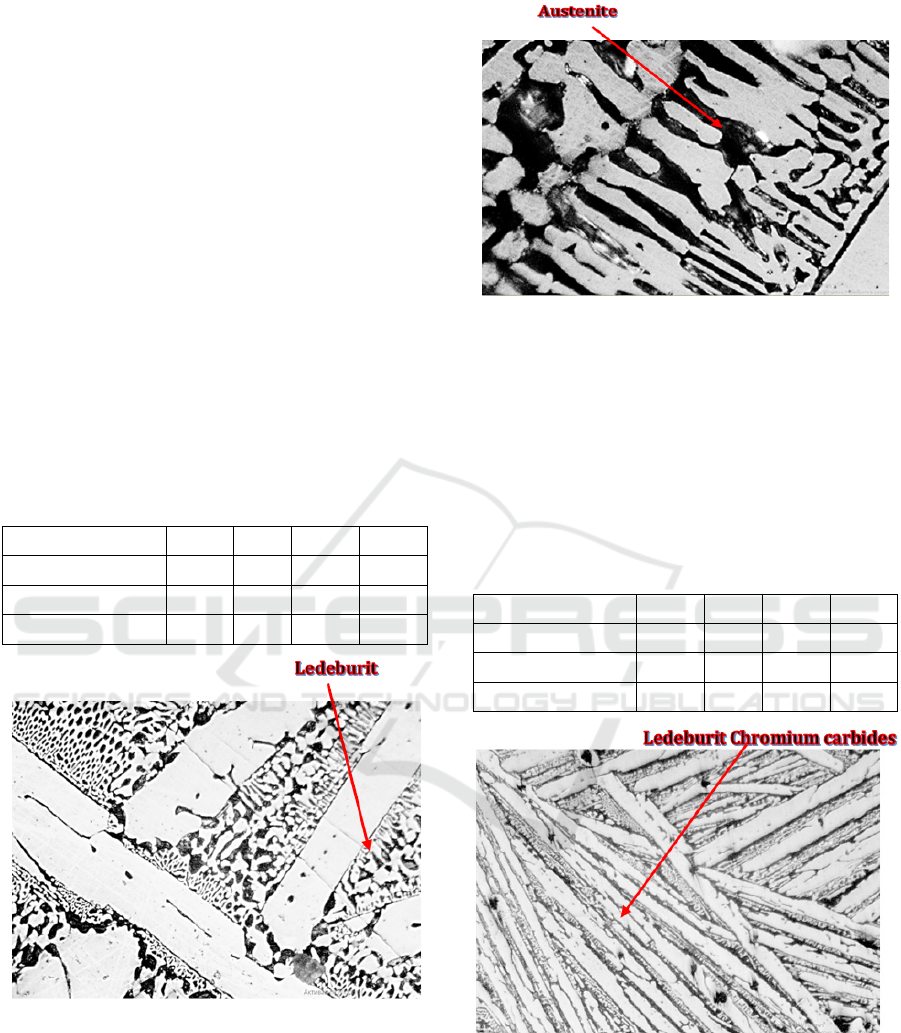
The microstructure of the sample shows that the
columnar crystals are located on the upper ledeburite
base, and the rounded crystals are chromium and
molybdenum carbides among the ledeburite crystals.
The effect of molybdenum (Fig. 7) was not
noticeable, the heat resistance of the alloy may have
increased.
The fourth stage of the research was carried out in
an induction furnace with the addition of 0.4%
ferromanganese-85 as a modifier to 110G13L steel.
The following indicators were obtained: the surface
hardness of the sample was 108.8 and 109.7, and the
hardness in the central part was 113.4, averaged 110.6
on HRB, HB-311 on Brinell.
When studying its chemical properties and
structure, the following results were obtained.
Table 4: Results of chemical properties obtained when
adding 0.4% ferromanganese as a modifier to 110G13L
steel are in %.
Name of material C Si Mr P
FeMn - 85 1.15 0.50 11.55 0.056
Name of material S Cr Ni Mo
FeMn - 85 0.018 0.41 0.057 0.35
Figure 11: The results of structures obtained when adding
0.4% ferromanganese as a modifier to 110G13L steel, 1
x100 view.
Figure 12: The results of structures obtained when adding
0.4% ferromanganese as a modifier to 110G13L steel, 2
x400 view.
Don't look at it microstructure high in ledeburit
main of austenite big columnar are crystals . The size
of the crystals is 37 micrometers wide and 30
micrometers long. Figure 8 shows the quasi-dendritic
structure of ledeburite grains (Valuev et al., 2012).
Table 5: Results of chemical properties obtained when
adding 0.5% ferromanganese as a modifier to 110G13L
steel.
Name of material C Si Mr P
FeMn - 85 1.15 0.50 11.55 0.056
Name of material S Cr Ni Mo
FeMn - 85 0.018 0.41 0.057 0.35
Figure 13: The results of structures obtained when adding
0.5% ferromanganese as a modifier to 110G13L steel, 1
x100 view.
The fifth stage of the research was carried out in
an induction furnace with the addition of 0.5%
ferromanganese-85 as a modifier to 110G13L steel.
The following indicators were obtained: the surface
hardness of the sample was 111.1 and 112.5, and the
Preparation of High-Strength Details from Modified Steel Alloy 110G13L
291
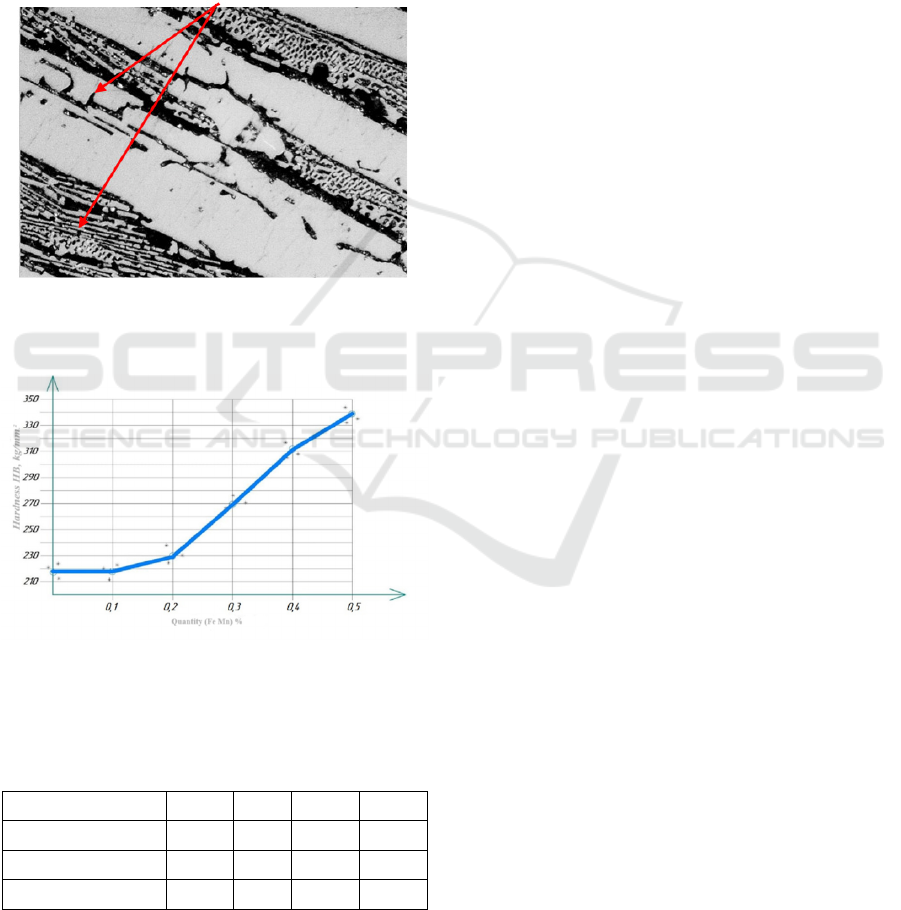
hardness in the central part was 113.8 , averaged
112.4 on HRB , HB-339 on Brinell.
When studying its chemical properties and
structure, the following results were obtained.
The microstructure of the sample - in the form of
primary crystals of high ledeburite. Crystals are 2-3
micrometers wide and 35-40 micrometers long.
The effect of chromium was manifested in
changing the sizes of ledeburite grains, they became
thinner and longer. A small amount of chromium
carbides is present in the ledeburite mass.
Figure 14: The results of structures obtained when adding
0.5% ferromanganese as a modifier to 110G13L steel 2
x400 view.
Figure 15: The highest hardness of 110G13L steel
according to GOST is HB-217-229. 217.8 HB when 0.1%
ferromanganese is added to the composition; 228 HB at
0.2%; 269 HB at 0.3% ; 311 HB at 0.4%; 339 HB at 0.5%.
Table 6: Hardness results.
Name of material C Si Mr P
FeMn - 85 1.15 0.50 11.55 0.056
Name of material S Cr Ni Mo
FeMn - 85 0.018 0.41 0.057 0.35
4 CONCLUSIONS
As a result of theoretical and practical research on the
development of high-strength parts from modified
110G13L steel alloy, the following recommendations
were developed:
1. Load ori musta h shortage to the composition
have the details get for It is recommended to add
ferromanganese in the amount of 0.4-0.5% as a
modifier to 110G13L steel .
2. ferromanganese was added as a modifier to
110G13L steel in the amount of 0.4%, HRB-
110.6 and NV-311 were measured according to
Brinell .
3. ferromanganese was added as a modifier to
110G13L steel in the amount of 0.5%, HRB-
112.4 and NV-339 were measured according to
Brinell .
4. ferromanganese was added as a modifier to
110G13L steel in the amount of 0.4%, it was
increased by 26.4%.
5. When 0.5% ferromanganese was added as a
modifier to 110G13L steel, it was increased by
32.4 %.
REFERENCES
Enloe C M, Fındley K O, Speer A J G. (2015). Austenite
grain growth and precipitate evolution in a carburizing
steel with combined niobium and molybdenum
additions. Metall. Mater. Trans. A, 2015, 46(A): 5308–
5328.
Karimov, K., Turakhodjaev, N., Akhmedov, A., &
Chorshanbiev, S. (2021). Mathematical model for
producing machine parts. E3S Web of Conferences,
264, 04078.
https://doi.org/10.1051/e3sconf/202126404078
Mardonov, U., Meliboyev, Y., & Shaozimova, U. S. (2023).
Effect of Static Magnetic and Pulsated Electromagnetic
Fields On the Dynamic and Kinematic Viscosity of
Metal Cutting Fluids. International Journal of
Integrated Engineering, 15(1), pp: 203-212. doi:
https://doi.org/10.30880/ijie.2023.15.01.018
Mirbabaev. V.A (2004). Technology of structural materials.
Tashkent ." Uzbekistan ". 148, 157, 162.
Najafabadi, V.N.; Amini, K.; Alamdarlo, M.B. (2014).
Investigating the Effect of Titanium Addition on the
Wear Resistance of HadfieldSteel. Metall. Res.
Technol. 2014, 111, 375–382
Nodir, T., Sarvar, T., Kamaldjan, K., Shirinkhon, T.,
Shavkat, A., & Mukhammadali, A. (2022). The effect
of lithium content on the mass of the part when alloyed
with lithium aluminum. International Journal of
Mechatronics and Applied Mechanics, 52–56.
https://doi.org/10.17683/ijomam/issue11.7
I-CRAFT 2024 - 4th International Conference on Research of Agricultural and Food Technologies
292

Turakhodjayev N., Chorshanbiyev S.H., Sadikova N.,
Chorshanbiyev K. (2020)a. Journal of critical reviews.
“Ways to increase the strength of shaftgear teeth
working in a highly abrasive grinding environment”.
Journal of Critical Review, No. 103, Section 4,
Roosevelt Rd, Da'an District, Taipei City, Taiwan.
Turakhodjaev N., Chorshanbiev S.H., Kamalov
J.,Yuldashev., Egamshukurov J. (2020)b. Journal of
critical reviews. “Ways to increase the strength of the
surface of the parts”. Journal of Critical Review, No.
103, Section 4, Roosevelt Rd, Da'an District, Taipei
City, Taiwan.
Turakhodjaev, N., Chorshanbiev, S.H., Tadjiev. N. (2023).
Development of Machined Durable Parts of Modified
110G13L Brand Steel. Journal of Educational
Discoveries and Lifelong Learning.Eurasian Scientific
Herald. Eurasian Scientific Bulletin. Pp: 21 - 25.
Umidjon, M., Jeltukhin, A., Meliboyev, Y., & Azamat, B.
(2023). Effect of Magnetized Cutting Fluids on Metal
Cutting Process. In Lecture Notes in Networks and
Systems: Vol. 534 LNNS. https://doi.org/10.1007/978-
3-031-15944-2_9
Wang, XJ., Sun, XJ., Song, C. Chen H., Tong, S.,Han W.,
Pan F., (2019). Grain Size-Dependent Mechanical
Properties of a High-Manganese Austenitic Steel. Acta
Metall. Sin. (Engl. Lett.) 32, 746–754 (2019).
https://doi.org/10.1007/s40195-018-0828-z
Valuev, D.V., Danilov, V.I. (2012). Reasons for negative
formation of structures in carbon steelprocessing of
pressure, J. 7th International Forum on Strategic
Technology (IFOST – 2012): Proceedings: in 2 vol.,
Tomsk, TPU Press. 2 (2012) 151–154.
Yang, Z., Ji, P., Wu, R., Wang, Y., Turakhodjaev, N., &
Kudratkhon, B. (2023). Microstructure, mechanical
properties and corrosion resistance of friction stir
welded joint of Al-Mg-Mn-Zr-Er alloy. International
Journal of Materials Research, 114(1), 65–76.
https://doi.org/10.1515/ijmr-2021-8485
Ya Kozlov, L.V.M. Kolokolchev, K.N.Vdovik, E.B.Ten,
L.B.Dolgopolova, A.A.Filippenkov (2003). Production
of steel castings, textbook edited by L. Ya. Kozlov.,
Moscow, Misis, 357 p.
Preparation of High-Strength Details from Modified Steel Alloy 110G13L
293
