
Pneumatic Feed Mechanism for Precise Seeding of Peanut Seeds
Feruza Alimova
1a
, Boikov Vladimir Petrovich
2b
, Jdanovich Cheslav Iosifovich
2c
1
Tashkent State Technical University, Mechanical Engineering Department, 100057 Tashkent, Uzbekistan
2
Belarusian National Technical University, Minsk, Republic of Belarus
Keywords: Pneumatic Mechanism, Peanut Seeding, Precision Sowing.
Abstract: The article presents the results of research work on the development of sowing machines that ensure high-
quality implementation of the technological operation of sowing peanut seeds. The results of research on the
development of a pneumatic feed mechanism with optimal parameters for precise sowing of peanut seeds in
a dotted method, taking into account the peculiarities of the soil and climatic conditions of Uzbekistan, are
presented. An improved design of a feed mechanism, including a sowing disc that combines the functions of
turning the mass of seeds in the seed chamber, clearly capturing seeds by dosing elements, removing seeds
from the seed chamber and transporting them to the unloading zone has been proposed. This design solution
helps to minimize the process of seed damage, improve the process of capturing and holding seeds in the cells
of the sowing disk, which improves the accuracy of their dotted sowing into the cluster and sustainable
accurate sowing of peanut seeds according to the given seed consumption. The rational parameters of the
sowing disk of a pneumatic feed mechanism, ensuring sowing of peanuts with uniform distribution of seeds-
18% and seed consumption - 60 kg/ha are presented.
1 INTRODUCTION
At the present stage of development of agricultural
production, one of the main tasks of the agricultural
policy of the Republic of Uzbekistan is the need to
produce various oilseeds, including peanuts, which
are valuable raw materials for the confectionery,
medical and technical industries. In Uzbekistan,
peanut crops occupy about 7 thousand hectares. The
soil and climatic conditions of Uzbekistan make it
possible to grow peanuts in almost all areas with a
yield of 27...30 c/ha (Program for researching
scientific priorities of agriculture, global, regional
and territorial
scheduled for 2022-2026, 2021).
The sowing scheme should provide a nutritional
area in rainfed conditions - 70x(25-30), in irrigated
conditions - 70x(10-15) cm. In continuous plantings,
the distance between bunch-type plants can be 30 x
60 cm or 15 x 75 cm; for shoot types, more space is
allowed (Yang et al., 2022), (Feruza et al., 2024).
Peanuts are often sown together with other species.
a
https://orcid.org/0000-0003-1463-6969
b
https://orcid.org/0000-0003-2561-0270
c
https://orcid.org/0000-0002-3165-7625
The most common sowing method is wide-row
with row spacing of 70 cm. For this, corn or cotton
seeders are used. Peanuts can be cultivated using the
checkrowing method according to a 70x70 cm pattern
with 6-8 plants in one hill. This method has the
advantage of increasing productivity and reducing
labor costs for caring for crops by 1.5-2.0 times.
One of the most important conditions for
obtaining high peanut yields is high-quality sowing of
seeds and the technology for its implementation,
carried out in a short agrotechnical time frame.
Currently, in world practice, the creation of seeding
aggregates with high productivity and adapted to
specific soil and climatic conditions is carried out in
the main directions: increasing the level of versatility
of seeders and the use of improved pneumatic
precision seeding devices (Alimova et al., 2023),
(Maojian et al., 2022). So, for example, in seeders that
operate at high speeds, a pneumatic seed dispenser is
widely used, which provides dotted single-grain
seeding of uncalibrated seeds and is highly resistant
to vibrations (Wan et al., 2020), (Xiao et al., 2014).
To improve the movement of seeds, activate the
Alimova, F., Petrovich, B. V. and Iosifovich, J. C.
Pneumatic Feed Mechanism for Precise Seeding of Peanut Seeds.
DOI: 10.5220/0014262400004738
Paper published under CC license (CC BY-NC-ND 4.0)
In Proceedings of the 4th International Conference on Research of Agricultural and Food Technologies (I-CRAFT 2024), pages 281-286
ISBN: 978-989-758-773-3; ISSN: 3051-7710
Proceedings Copyright © 2025 by SCITEPRESS – Science and Technology Publications, Lda.
281

supply of seeds to the collection zones and transport
them to the dumping site, use a brush-type seed
supply device, flexible belt type seed feeder,
compartment type section feeder (Yudao et al., 2020),
(Yang 2016). When filling the intake chamber of the
device with seeds, to speed up the suction process and
prevent clogging of the sampling holes, the “suck
before and blow after” model is used, which mainly
consists of a combination seed dispenser with air
suction, three-position switch, seed waste collection
device, vacuum fan, and so on (Liao et al., 2004). The
inexpediency of widespread use of expensive foreign-
made seeders is associated with the specifics of the
republic's fields for peanut crops, which have small
areas. The use of wide-cut sowing aggregates in such
conditions is impossible.
However, the existing models of domestic seeders
today do not fully meet the agrotechnical
requirements for uniform sowing of seeds and at the
same time lead to high costs. In this regard, it is very
important to develop a sowing apparatus that is highly
accurately adapted to the specific soil and climatic
conditions of Uzbekistan. Due to the fact that in the
republic the seed material is a mixture of seeds of
different varieties and calibers, the possibility of
precise sowing with mechanical devices is practically
excluded. In pneumatic devices, when installing disks
with medium-sized holes and the presence of large
seeds, sowing stops, when installing disks with large
holes for large seeds, the holes are quickly clogged
with medium seeds, and small ones pass through the
holes and are thrown out by the exhauster onto the
field surface.
Analysis of the results of preliminary studies of
the operation of these seeders for sowing peanut seeds
showed increased crushing and damage to seeds,
clogging of sowing elements with seed material,
uneven sowing, which leads to additional labor costs:
replanting, thinning and excessive consumption of
seed material.
The analysis showed that in most cases, the
physical and mechanical properties of seeds of
complex shapes (peanuts, sunflower) significantly
limit the range of types of sowing devices capable of
ensuring the stability of the process of dosing and
distribution of seed material, which indicates the need
to create new types of working bodies to ensure high-
quality single selection and seed distribution. Based
on the analysis, the design of a universal sowing
apparatus has been developed, intended for single
selection of peanut seeds having a complex shape (Yu
et al., 2014). Purpose of the study - increasing the
uniformity and stability of seed distribution in a row
based on improving the technological process of
dotted sowing of peanut seeds with minimal crushing
through the development and improvement of the
design of the sowing apparatus, as well as the
justification of its parameters and operating modes
(Liu et al., 2016).
2 MATERIALS AND METHODS
Based on an analysis of the results of research and
development work on the mechanization of sowing
various seeds of agricultural crops, the type and
design of the apparatus for sowing peanut seeds was
selected, and the direction of theoretical and
experimental research was determined. The general
methodology included conducting exploratory
experiments, developing theoretical premises,
experimental studies in laboratory and field
conditions, and economic evaluation of research
results. The studies were carried out in the Central
Asian region under the conditions of the sharply
continental climate of the Republic of Uzbekistan on
typical gray soils. The sowing rate of husked seeds is
50-80 kg/ha. The optimal plant density is 100-120
thousand/ha. The sowing depth is 6-8 cm and depends
on the moisture content and granulometric
composition of the soil.
In accordance with the purpose of the work, the
task of the research was to study the physical and
mechanical properties of peanut seeds of zoned
varieties. The Uzbek Crop Research Institute
(UzNIIR) is studying peanut samples from the
International Crop Research Institute for the Semi-
Arid Tropics (ICRISAT). As a result of the study, two
varieties of peanuts were zoned: “Salomat” and
“Mumtoz”. The Mumtoz variety is zoned for main
sowing, and the Salomat variety is zoned for both
main and re-sowing in the south of Uzbekistan
(Kashkadarya and Surkhandarya regions). In
addition, the Tashkent-112 variety, belonging to the
Valencia group and the Kibray-4 peanut variety,
belonging to the Virginia group, are currently
cultivated in Uzbekistan.
When determining the physical and mechanical
characteristics of peanut seeds, a developed
methodology was used to determine the
damageability and shear stress of seeds, and
instruments were also used to measure pressure and
air flow speed. In the process of experimental
research, a universal laboratory bench, experimental
samples of the apparatus, and a field installation were
used.
In the process of research, the basic laws of higher
mathematics, theoretical mechanics, laws and rules of
I-CRAFT 2024 - 4th International Conference on Research of Agricultural and Food Technologies
282
mathematical statistics, methods of mathematical
planning of experiments and strain gauges, as well as
methods given in existing regulatory documents
(GOST 20915-11, GOST 31345-2017, UzDst
319:2017, RD Uz 63.03-98, GOST R 53056-2008).
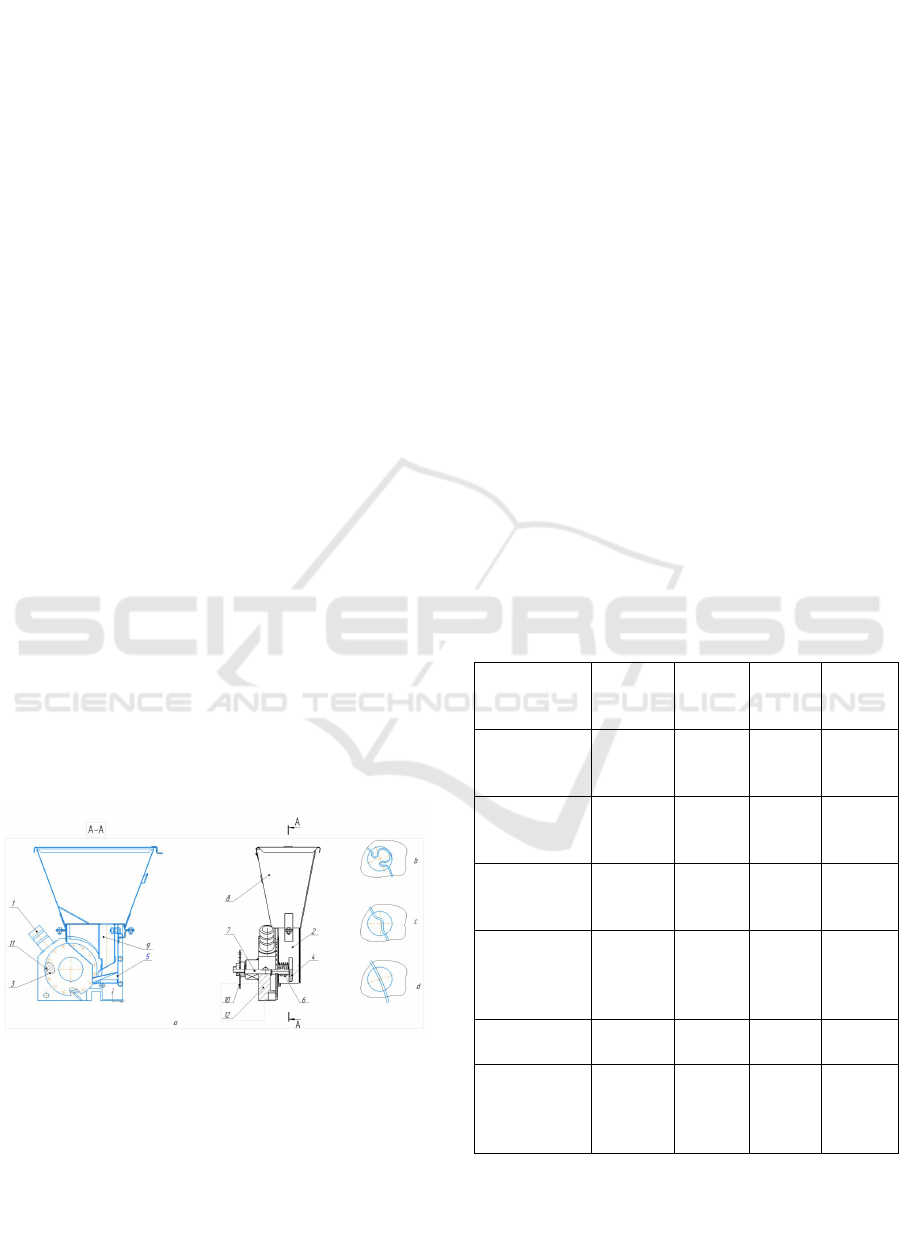
Structure and Working Principle of Pneumatic
Feed Mechanism. The pneumatic sowing apparatus
has a housing combined with the shell of the vacuum
chamber and a sowing disk tightly adjacent to it, a
seed hopper located above the intake chamber as
shown in Figure 1. A cutter for excess seeds is
installed in the upper part of the intake chamber.
Inside the intake chamber there is a dispenser with a
dosing window. The intake chamber fits tightly to the
housing of the sowing device, combined with the
shell of the vacuum chamber and the sowing disk.
The sowing disc is secured to the shaft using a
clamping washer and a bolt. In order to create the
minimum required column of seeds in the seed
capture zone, a groove is made on the dispenser,
which allows the dispenser to be installed at a
different angle to the sowing disk using a lock. A tight
fit of the sowing disk to the housing of the apparatus,
combined with the shell of the vacuum chamber, is
achieved using a spring, thereby ensuring tight
contact between the sowing disk and the shell of the
vacuum chamber. According to the design, in order to
minimize the contact of easily damaged seeds with
the sharp edges of the rotating disk, in the proposed
sowing device, between the housing of the device,
combined with the shell of the vacuum chamber and
the intake chamber, a locking plate is installed, equal
in thickness to the sowing disk.
Figure 1: a-General view of pneumatic feed mechanism:
1-suker; 2-intake chamber; 3-sowing disk; 4-washer; 5-
locking plate; 6-spring; 7- shaft; 8- seed hopper; 9-
dispenser; 10-sprokit; 11- hole; b- hole with Ω-shaped
jumper, c- hole with S-shaped jumper, d- hole with straight-
shaped jumper.
Due to the fact that peanut seeds have a complex
shape and vary in weight and size, the disk cells must
ensure precise suction with a minimum of damage,
excluding slaughter in the cells and gaps during
sowing. For this purpose, the disk cells are made in
the form of holes of increased diameter with jumpers.
3 RESULTS AND DISCUSSION
An analysis of existing technologies and the technical
means used in their implementation is made. Data are
presented on the possibility of sowing peanut seeds in
a dotted manner using existing pneumatic sowing
devices. The technical characteristics of dotted
pneumatic seeders used today in the fields of our
Republic are considered. To find the type of sowing
device for sowing peanut seeds, tests were carried out
on the pneumatic devices of the SPP-8FS (Russia),
SMH-4-04-01 (Uzbekistan), TC-M 4150 (Russia),
SUPN-6(8)M (Russia) seeders. The tests were carried
out on a laboratory bench, the specified operating
mode corresponded to a seeder speed of 6 km/h.
Disks for sowing corn with cells with a diameter of
5.0 mm were used. The results are shown in Table 1.
Table 1: Results of laboratory tests of pneumatic sowing
devices for sowing peanut seeds of the Tashkent-112
Indicators SUPN-
6(8)M
SPP-
8FS
SMH
-4-04-
01
TC-M
4150
Weigh
t
of
sown
seeds,
g
412.3 407.8 203.9 404.7
Weigh
t
of
whole
seeds, g/%
390.0/
94.6
377.1/
92.5
186.2/
91.3
389,3/
96.2
Mass of
crushed
seeds,
g
/%
10.3/
2.5
12.35
/3.0
6.93/
3.4
7.7/1.9
Mass of
seeds with
damaged
shell, g/%
12.0/
2.9
18.3/
4.5
10.81/
5.3
7.7/1.9
Total
damage, %
5.4 7.5 8.7 3.8
Seed
sowing
rate, M
ср
,
p
cs/
m
6.7 8.7 6.6 7.3
Based on the test results, it can be concluded that
the operation of the above devices does not meet the
initial requirements for sowing peanuts: seeding rate
Pneumatic Feed Mechanism for Precise Seeding of Peanut Seeds
283
- 9...12 pieces / m (140...170 thousand pieces / ha),
crushing - no more than 2%.
Key-Parameter Selection and Seeding Process
Analysis. Selection of key parameters and
determination of the optimal diameter of the sampling
holes on the seeding disc
The required vacuum ΔР in the chamber is
determined by the formula
ΔР ≥
р
×
×
× × ×
,
where 𝑑
is the diameter of the hole; 𝑄
- seed
weight; φ - coefficient of friction of the seed in the
cell; 𝑚
р
- average seed weight; 𝑘
- rarefaction
coefficient.
Suction force F
pr
acting on the seed taking into
account Newton’s classical formula:
F
pr
= 𝑘
а
× f × ɣ ×
(
)
,
where 𝑘
а
is the aerodynamic coefficient; ɣ - specific
gravity of air; f is the cross-sectional area of the seed;
𝑉
,𝑉
- air and seed movement speeds; g is the
acceleration of free fall.
𝑘
а
=
𝐹
ΔР × 𝑆
The suction force is expressed through the area of the
hole S and the vacuum ΔP.
P = k × 𝛥Р×𝑆,
where k is a proportionality coefficient that takes into
account the total effects of various factors.
Analysis of the above formulas shows that the suction
force depends on the speed of movement of the seeds,
the magnitude of the vacuum, the size of the seeds and
the cross-sectional area of the hole. The excess of this
force over the force of weight and centrifugal force
contributes to the reliable capture of seeds by the
holes on the disk, holding them in the hole until the
hole with the seed arrives in the position of dropping
into the groove formed by the opener. Focusing on
sowing large peanut seeds as a first approximation,
the diameter of the hole on the disk should be at least
7.5 mm.
Force Analysis of Seed Fixation on the Disk Hole.
To ensure accurate sowing of peanut seeds that vary
in size and weight, a jumper must be installed in the
disc holes, which at the same time increases
resistance and reduces air flow speed. The seed, fixed
to the hole of the disk in the seed chamber, must be
accurately transported to the discharge point
(between the cheeks of the opener) and must not leave
it during movement. One of the decisive factors when
choosing speed modes of operation of the device is
the permissible angular speed of the disk at which the
seed does not leave the hole. The theoretical analysis
carried out made it possible to select the range of
permissible angular velocities of the disk when
working with seeds with the highest and lowest
weight force, depending on the vacuum force in the
hole R
v
as shown in Figure 2. The dependence is
parabolic in nature and for a vacuum force P
v
= 0.055
N, the permissible angular velocity should not exceed
24 rad/s
Selection of the Cell of the Seeding Disk. To
reliably capture very large and heavy peanut seeds by
the cell of the sowing disk, it is necessary to have a
large diameter, into which, however, small seeds will
freely pass and medium-sized seeds will jam.
Therefore, in the experimental apparatus, the sowing
disk cells are made in the form of holes of increased
diameter with jumpers. For experimental testing and
selection of the jumper shape, disks were made with
holes of different diameters and different jumper
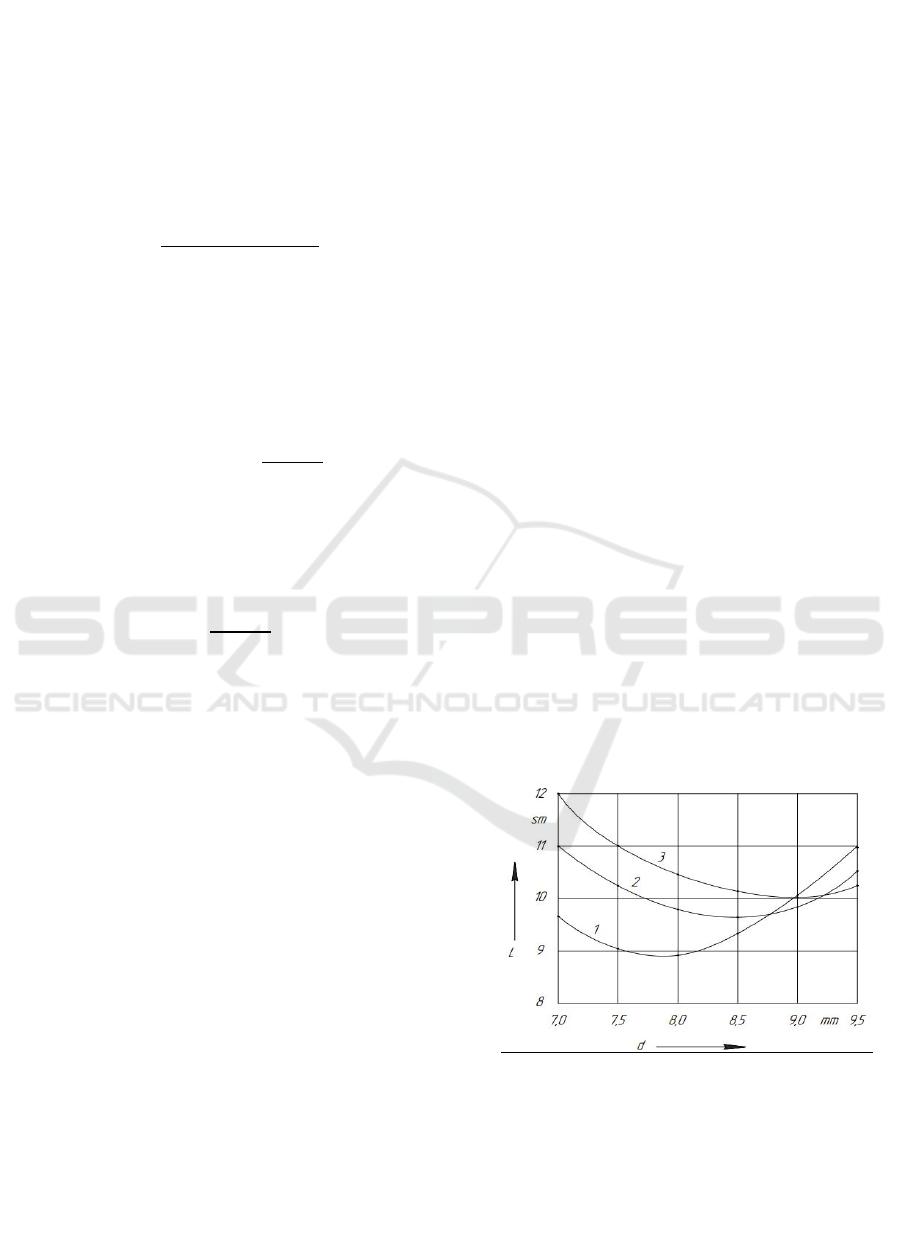
shapes (straight, S-shaped and Ω-shaped). According
to the research results as shown in Figure 3, the most
stable interval between seeds was obtained with holes
with diameters of 7.5...9.5 mm with an Ω-shaped
jumper. The analysis of the study of the influence of
jumpers on the crushing of peanut seeds when
working with experimental disks is no more than
0.6%, which satisfies the initial requirements.
Figure 2: Permissible angular speed of the disk ω depending
on the force of pressing the seed to the cell: 1 - for seeds
weighing 0.0037 N; 2 - for seeds weighing 0.0058 N
I-CRAFT 2024 - 4th International Conference on Research of Agricultural and Food Technologies
284
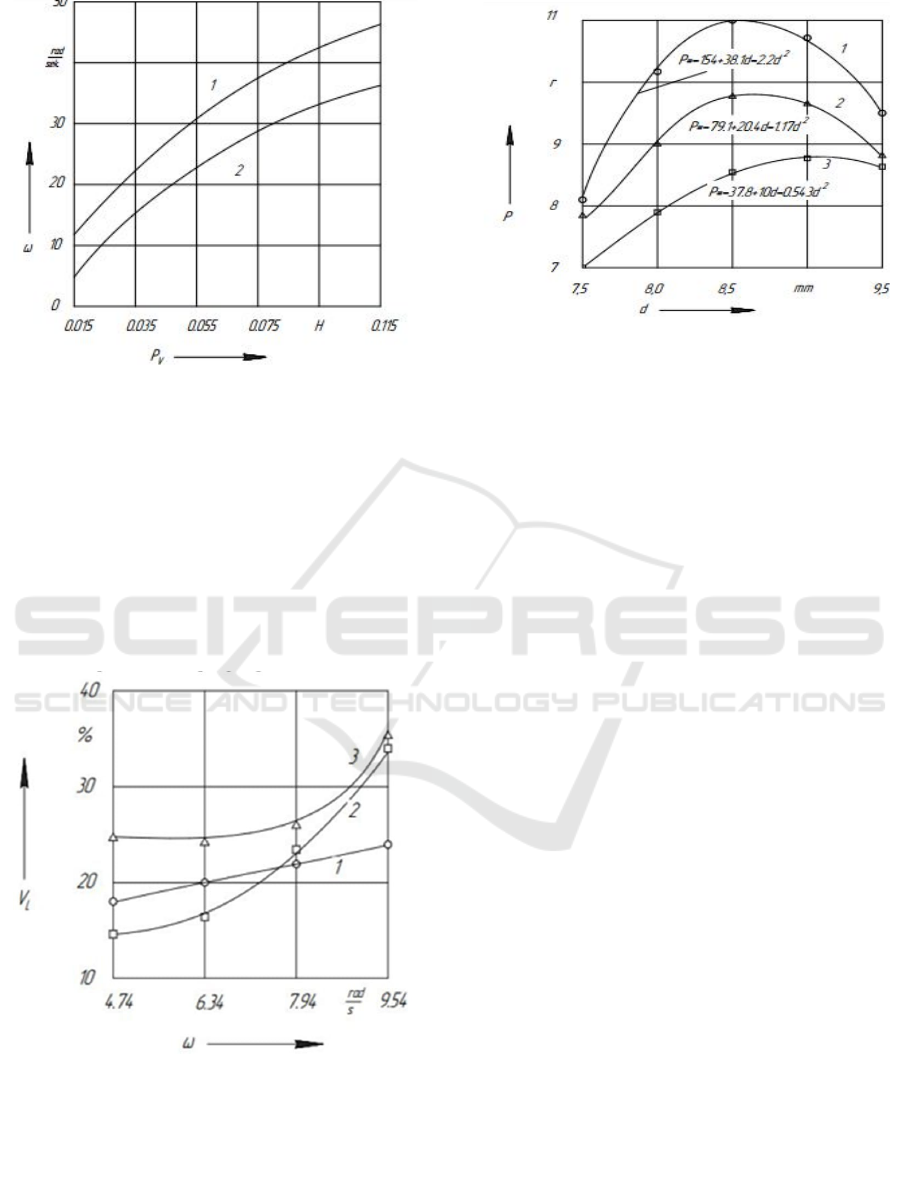
Figure 3: Changing the interval between seeds in a row (L)
depending on the diameter of the hole (d): 1- with Ω-shaped
jumper; 2-with S-shaped jumper; 3-with a straight jumper
The influence of the rotation frequency of a disk
with different cells on the interval between seeds in a
row during operation of the apparatus under study
was studied. According to the experimental results as
shown in Figure 4, as the disk rotation speed
increases, the seeding uniformity decreases. Thus,
cells were accepted for further work - holes with a
diameter of 7.5...9.5 mm with Ω-shaped and S-shaped
jumpers.
Figure 4: Change in the coefficient of variation of the
interval between seeds in a row (V
L
) depending on the
rotation speed of the sowing disk (ω) with cells: 1 - with an
Ω-shaped jumper; 2-with S-shaped jumper; 3 -with straight
shaped jumper
Figure 5: Change in the force of pressing a peanut seed P to
flat disk cells of various diameters when the seed is
positioned: 1 - with a spheroidal end; 2 - sharp end; 3 - flat
4 CONCLUSIONS
1. A promising direction has been identified for
increasing the efficiency of the process of precise
sowing of seeds of complex shapes. In accordance
with the chosen direction, the technological and
design parameters of the dotted seeding apparatus
have been developed and justified. Patterns of
changes in the quality indicators of the precision
seeding process were obtained depending on the
parameters of the sowing disk cells and the
kinematic operating modes of the apparatus.
2. Based on the research, a sowing apparatus has
been developed that provides dotted sowing of
peanut seeds. The obtained analytical
dependencies and theoretical conclusions can be
used by design organizations and research
institutions when creating new designs of seeding
devices for precision seeders.
3 The most suitable for precise sowing of peanut
seeds is a vacuum pneumatic device with a sowing
disk having cells in the form of holes with a
transverse Ω-shaped jumper, which ensures
trouble-free operation of the device with
uniformity of seed distribution V = 18% and seed
consumption of 60 kg/ha. Seeding disk
parameters: angular speed - 4.8….5.2 rad/s;
thickness - 4 mm; number of cells - 16 pcs; cell
diameter - 8.5 mm.
Pneumatic Feed Mechanism for Precise Seeding of Peanut Seeds
285

REFERENCES
BIO Web of Conferences , 01026 (2024) I-CRAFT-2023
85 https://doi.org/10.1051/bioconf/202485 01026
F A Alimova, M T Saidova and B Sh Primkulov (2023)
Pneumatic feed mechanism for accurate sowing of bare
cotton seeds AEGIS-III-2023 IOP Conf. Series: Earth
and Environmental Science 1231 (2023) 012012 IOP
Publishing doi:10.1088/1755-1315/1231/1/012012
https://scholar.google.com/scholar?oi=bibs&hl=ru&cit
es=4322034996561925007&as_sdt=5
Feruza Alimova, Mukhayyokhon Saidova, Bekzod
Primqulov, and Tunahan Erdem (2024) Optimization of
the parameters of the pneumatic feed mechanism for
precise clustered sowing
https://scholar.google.com/scholar?oi=bibs&cluster=1316
6930500057174961&btnI=1&hl=ru
Liao, Q.; Deng, Z.; Huang, H.(2004) Application of the
high speed photography checking the precision
metering performances. Trans. J. Huazhong Agric.
Univ. 2004, 22, 570–573.
Liu, H.; Xu, X.; Liu, J.; Wang, C. Working characteristics
of vertical shallow-basin type seed-metering device
based on high-speed photography and virtual
simulation. Trans. CSAE 2016, 32, 13–19.
Maojian Wei, Peisong Diao, Wenjun Wang (2022) Design
and experiment of the seed delivery device with a
rotating brush wheel for precision seeder. Scientific
Paper • Eng. agríc. 42 https://doi.org/10.1590/1809-
4430-Eng.Agric.v42n6e20220089/2022
https://www.researchgate.net/publication/365809234
“Program for researching scientific priorities of agriculture,
global, regional and territorial scheduled for 2022-
2026” approved by the Cabinet of Ministers on April
24. 2021 -1 in conditions of typical irrigated gray soils
of the Tashkent region pp 16
Wan, S.; Zhang, J.; Zhang, Z.(2020) A major change in
peanut planting technology: Single seed precision
sowing. Trans. Chin. J. Oil Crops 2020, 42, 927–933.
Xiao Lian Lü, Zhi Chao Hu, Hui Juan Zhang, Wei Wang
(2014) https://doi.org/10.4028/www.scien
tific.net/AMR.945-949.330 Design and Research of the
Air-Suction Peanut Precision Dibbler, Advances in
Manufacturing Science and Engineering V. Advanced
Materials Research (Volumes 945-949). June 2014
330-334p
Yang Xiang, Jianming Kang, Chunyan Zhang, Qiangji
Peng, Ningning Zhang and Xiaoyu Wang (2022)
Analysis and Optimization Test of the Peanut Seeding
Process with an Air-Suction Roller Dibbler. Agriculture
2022, 12(11), 1942; https://doi
.org/10.3390/agriculture12111942 Submission
received: 25 October 2022 / Revised: 15 November
2022 / Accepted: 16 November 2022 / Published: 17
November 2022
Yang, L.; Yan, B.; Zhang, D.; Zhang, T.; Wang, Y.; Cui,
T.(2016) Research Progress on Precision Planting
Technology of Maize. Trans. Chin. Soc. Agric. Mach.
2016, 47, 38–48.
Yu, J.; Ding, Y.; Liao, Y.; Cong, J.; Liao, Q.(2014) High-
speed photography analysis of dropping trajectory on
pneumatic metering device for rapeseed. Trans. J.
Huazhong Agric. Univ. 2014, 33, 103–108.
Yudao Li, Zhanhua Song, Fade Li, Yinfa Yan and others.
Design and Test of Combined Air Suction Cotton Breed
Seeder.Journal of Engineering. 2020(29):1-
11DOI:10.1155/2020/7598164
I-CRAFT 2024 - 4th International Conference on Research of Agricultural and Food Technologies
286
