Effects of Different Mulching Methods on Soil Agro-Physical
Characteristics and Cotton Yield
Shavkat Akhmurzaev
a
, Sokhib Islamov
b
, Baxram Azizov
c
, Gulistan Abdalova
d
and Sherzod Hikmatov
e
Tashkent State Agrarian University, 100140, University str. 2, Tashkent, Uzbekistan
Keywords: Cotton Mulching, Soil Properties, Yield Improvement.
Abstract: In world cotton cultivation, in addition to fundamental practices for saving and improving soil fertility,
improving water-physical characteristics (soil tillage, fertilization, and crop rotation and others), various
mulching methods and technologies are being utilized to enhance soil characteristics. In Uzbekistan, the
effectiveness of mulching with polyethylene film, coal dust, K-4 polymer, petroleum residues, and oil-
impregnated black paper has been studied. These experiments are aimed at improving the soil layer,
conserving water, improving the efficiency of applied fertilizers, and enhancing the water-physical state of
soil, which are considered urgent issues of today
.
1 INTRODUCTION
Among the most important water-physical
characteristics of soil, especially for cotton
germination, are soil moisture, soil temperature,
porosity, bulk density, and water permeability.
According to S.N. Rijov, the lower limit of soil
moisture during cotton sowing should be no less than
17.0% for clayey soils, 15.0% for heavy sandy soils,
13.0% for medium sandy soils, 11.0% for light sandy
soils, and 9.0% for sandy soils. Excessive soil
moisture at the time of sowing can lead to seed rot.
According to S.K.Isaev, mulching with
polyethylene films increases soil moisture by 2.7-
4.8%.
Soil temperature is a crucial factor in the growth
of plants, significantly affecting seed germination,
growth, and development. Low soil temperatures can
cause seed rot due to excess moisture, while high
temperatures can lead to dryness due to insufficient
moisture.
Experiments conducted by B.I.Niyazaliev in typical
sierozem soil conditions showed that using manure (2
a
https://orcid.org/0000-0001-8593-1450
b
https://orcid.org/0009-0003-2669-0973
c
https://orcid.org/0009-0007-9132-9459
d
https://orcid.org/0000-0001-8593-1450
e
https://orcid.org/0000-0001-8593-1450
t/ha) as mulch increased soil temperature by 0.5°C in
the 0-5 cm layer (Akhmurzaev, 2018; Ryzhov, 1957;
Isaev, 2002).
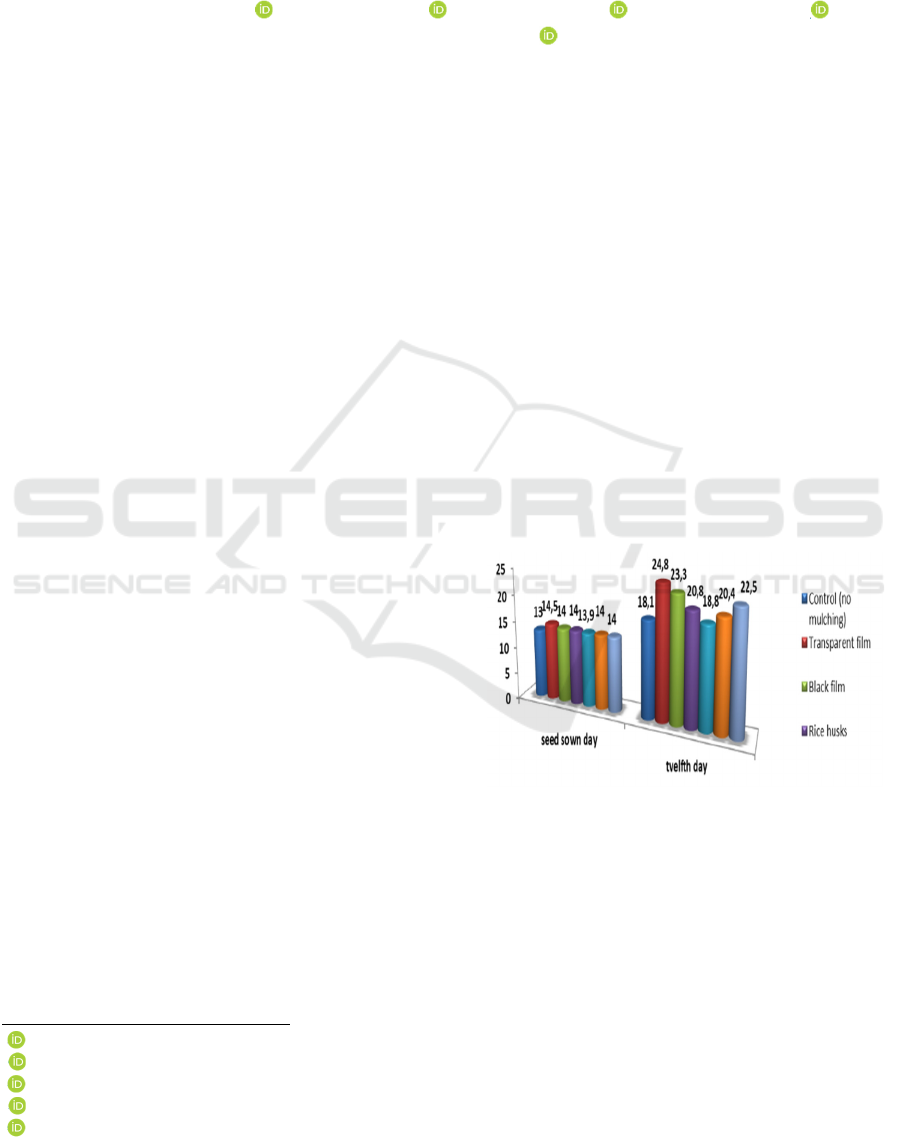
Figure 1: Effect of mulching methods on soil temperature.
2 MATERIALS AND METHODS
Field experiments were conducted in the conditions
of typical sierozem soils of Tashkent province. In the
experiment, depilated cotton seeds of the medium
Akhmurzaev, S., Islamov, S., Azizov, B., Abdalova, G. and Hikmatov, S.
Effects of Different Mulching Methods on Soil Agro-Physical Characteristics and Cotton Yield.
DOI: 10.5220/0014261400004738
Paper published under CC license (CC BY-NC-ND 4.0)
In Proceedings of the 4th International Conference on Research of Agricultural and Food Technologies (I-CRAFT 2024), pages 269-273
ISBN: 978-989-758-773-3; ISSN: 3051-7710
Proceedings Copyright © 2025 by SCITEPRESS – Science and Technology Publications, Lda.
269

fiber Namangan-77 variety were sown in the 90x10-
1 scheme.
The following norms and types of mineral
fertilizers were used in the experiments. N-200 kg/ha,
P
2
O
5
– 140 kg/ha, K
2
O – 100 kg/ha; ammonium
nitrate (N-34%), ammophos (N-12, P
2
O
5
– 46%),
potassium chloride (K
2
O-56%).
Mulch materials: transparent film 50,0 kg per
hectare, black film 50,0 kg, rice husk 8-10 t/ha, wheat
straw - 8-10 t/ha, SAG pereparation-1,0 and MT
pereparation-20 kg/ha was used.
Calculations were carried out during phenological
observations in June, July, August and early
September. The methods written in the book
“Methods of field and vegetation experiments with
cotton under irrigation conditions”, “Methods of
conducting field experiments”, agrochemical and
agro-physical characteristics of the soil “Methods of
agrochemical and agro-physical analysis of soils and
plants of Central Asia” were used for conducting
phenological observations.
In our conducted experiments, where has shown
that mulching with different materials (black and
white polyethylene films; wheat straw and rice husks;
polymers like SAG and MT preparations) positively
impacts soil moisture and temperature (Niyozaliev,
1987;Allanov et al., 2009).
3 RESULTS AND DISCUSSION
According to the data, on the day of cotton sowing,
soil moisture and temperature in the 0-5, 5-10, and
10-20 cm layers were almost the same in all variants.
After 6 days, when the cotton seeds were just
beginning to germinate, it was found that in the
control variant, soil moisture were 14.0%, 16.0%, and
17.0% in the respective layers, in contrast, when used
transparent film in second variant, these indicators
were determined 1.0%, 1.9%, and 1.0% higher.
The variant with black film utilized soil moisture
was 0.9%, 0.6%, and 0.4% higher during this period.
The increase in moisture with transparent film was
closer to that of black film, indicating that the
difference between them was minimal and had little
significance for the development of the plant roots or
above-ground parts.
In the variants where mulching was done with rice
husks and wheat straw, soil moisture in the layers
were 14.8% 14.7%, 16.2%-16.2%, and 17.4%-17.3%,
respectively. These were 0.8%-0.7%, 0.2%-0.2%,
and 0.4%-0.3% higher compared to the control.
However, these indicators were 0.1%-0.2%, 1.7%-
1.8%, and 0.6%-1.0% lower than those in the
polyethylene film variants.
In the variant using the SAG polymer preparation,
soil moisture was 15.2%, 16.4%, and 17.8%, with
similar results observed with the MT polymer
preparation.
12 days after sow, the moisture was 12.9%,
13.2%, and 14.0% in the 0-5, 5-10, and 10-20 cm
layers (compared to dry soil), respectively. In
mulched variants, the moisture levels were higher.
Particularly, the variant mulched with transparent
film showed 2.0% higher moisture compared to the
control and 0.1%-1.1% higher compared to the
experimental variants.
If we classify the mulching materials based on
their effect on soil moisture, polyethylene films (both
transparent and black) take the first position, followed
by polymers (SAG and MT preparations), and finally
plant residues like rice husks and wheat straw.
According to the observations, it was found that
there is a significant difference in the temperature
change of the soil temperature of the mulch materials.
In the control option, the average soil temperature on
the day of sowing the seeds in the 0-10 cm layer of
the soil was 13.0
o
C, and in all options (2-7 var) where
mulching methods were used, similar indicators were
obtained. This situation indicates that the mulch
material has no effect on the soil temperature.
However, after 6 days, it was found that the soil
temperature increased not only in the studied options,
but also in the control. This is definitely related to the
increase in air temperature.
On the 6th day of research, in the control variant,
the temperature in the 0-10 cm layers of the soil was
on average 15
0
C, or it was observed that it increased
by 2
0
C from the day of sowing.
In option (2) where a transparent film was used,
the average soil temperature was 21.2
o
C, which was
6.2
o
C higher than the control. When black film was
used, these indicators were slightly lower and equaled
19.6
o
C. The temperature of the soil increased towards
the research period, and after 12 days after sowing the
seed, the temperature in the above variants was on
average 24.8 and 23.3
0
С.
I-CRAFT 2024 - 4th International Conference on Research of Agricultural and Food Technologies
270

Table 1: Effects of applied mulch materials on cotton growth and development.
In options (4-5) where rice husks and wheat straw
were used as mulch, the average temperature was
20.8-18.8
0
C 12 days after sowing. These indicators
were 5.2-2.7
0
C higher than those of the control
variant, but 6.0-4.0
0
C lower than those of the film
variants.
On the 12th day, the soil temperature was 20.4 0C
in the case of the SAG preparation, and 22.5
0
C or 2.3
and 4.4 0C higher when the MT preparation was used.
It was found that in the options using polymer
preparations (SAG and MT), all indicators were
slightly lower than those in the options using
polyethylene films, and higher than those in plant
residues.
First of all, it is worth saying that the rate of
germination of cotton seedlings depends on soil
temperature, moisture level and other physical
properties. The earlier the seed is planted, the more
positive the effect of our applied mulch materials will
be.
In our observations, in the control variant, 6 days
after sowing the seeds, the seedlings were 5.4 pieces
or 28.3% sprouted per meter, when transparent and
black films were used as mulch, this indicator was 7.4
and 6.7 pieces or 38.9 and 35.4%. These indicators
are 2.0 and 1.7 units or 10.6 and 7.1% more than the
control. In the options using rice husk and wheat
straw, the germination of seedlings during this period
was 6.5-6.1 units or 34.3-32.1%, compared to the
control by 1.1-0.7 units or 6.0-3.8 % more, but due to
the effect of polyethylene films; It was found to be
0.9; 0.2-1.3; 0.6 units i.e. 4.6; 1.1-6.8; 2.2% less. In
the options where SAG and MT preparations from
polymers were used, seed germination at 1 p/meter
was 6.3 and 6.7 grains, 33.4 and 35.6%. These
indicators are 1-3% higher than the effect of plant
residues, but 3-4% less than polyethylene films.
On the 10th day of research, 12.4-65.4% sprouts
sprouted per 1 p/meter in the control option, while in
the options with transparent and black films, these
indicators were happened 15.4-15.2 and 81.3-80.5%.
15.9 and 14.9% more germination of cotton
seedlings was observed under the influence of
polyethylene films compared to the control. It should
be noted that the effects of transparent and black films
on the germination rate of seedlings were found to be
close to each other.
In variants using rice husk and wheat straw as
mulch, these indicators were 15.0-14.8 units and
79.2-78.1%, compared to the control by 2.6-2.4 units
or 13.8-12.7 % more, but compared to polyethylene
films, they were 0.4-0.2 and 0.6; 0.4 pieces or 2.1;
1.1; 0.6; 0.4% less.
The variants using polymers (SAG and MT)
obtained data slightly lower than the aforementioned
polyethylene films, but higher than the effects of plant
residues. After 12 days after sowing, 99.0% of
seedlings emerged in control and 100.0% in all other
variants.
So, it was determined that the effect of mulch
materials on the germination of cotton seedlings
depends primarily on weather (soil) temperature, soil
Number
of options
Experimental Variants
Main stem
height, cm
Number of
productive
b
ranches,
p
cs
Number of bolls,
pcs
Including
opened ones,
%
1.08 1.08 1.08 1.09 1.09
1 Control
(
no mulchin
g
)
90,7 10,4 8,1 8,4 22,5
2
Mulching with
trans
p
arent fil
m
103,5 13,0 9,4 10,9 45,4
3
Mulching with black
fil
m
101,2 12,1 9,3 9,5 43,2
4
Mulching with rice
husks
95,7 11,0 8,4 8,6 30,5
5
Mulching with wheat
straw
95,1 10,9 8,3 8,5 26,2
6
Mulching with SAG
p
reparation
94,3 11,0 8,5 8,7 26,5
7
Mulching with MT
p
reparation
97,4 11,3 8,7 9,1 34,9
Effects of Different Mulching Methods on Soil Agro-Physical Characteristics and Cotton Yield
271

moisture and other physical properties, as well as on
the timing of seeding.
All applied mulch materials generally had a
positive effect on the water-physical properties of the
soil, as a result of which it was observed that cotton
growth was higher than the control.
According to the data of August 1 observations,
the height of the cotton main stem in the control was
90.7 cm, 10.4 branches, the number of bolls on
September 1 was 8.4, including 22.5% of the opened
ones. In the case where a transparent film was used,
these indicators were proportionally 103.5 cm, 13.0;
10.9 pieces and equal to 45.4%, compared to the
control, 12.8 cm; 2.6 and 2.5 pieces and 22.9% more.
In the variant where black film was used as mulch,
the height of the main stem was 101.2 cm, the number
of productive branches was 12.1, and the number of
bolls was 9.5, and the opened ones were 43.2%. These
indicators were proportionally 11.5 cm, 1.7 and 1.1
grains and 20.7% more, but 2.3 cm, 0.9 and 1.4 grains
and 2.2% less than the indicators of transparent film.
It should be noted that because the transparent
film transmitted light directly to the surface of the
soil, the temperature of the soil was slightly higher
under its influence than that of the black film. As a
result, sprout germination was accelerated and it was
found that it had a favorable effect on the
development of cotton.
In the option (4) where rice husk was used from plant
residues, the above indicators were proportionally
95.7 cm, 11.0 and 8.6 pieces and 30.5 %. These
numbers are 5.0 cm, 0.6 and 0.2 and 8.0% higher than
the control, and were lower than the indicators of the
polyethylene films, especially the number of open
bolls was 14.9% and 12.7%. The parameters of the
variant using rice husk were 0.6 cm, 0.1 and 0.1 grains
and 4.3% higher than those of wheat straw. In other
words, the effect of plant residues on the growth and
development of cotton was almost the same.
Among the used polymers, it was found that the
effect of the MT preparation on the growth and
development of cotton was better than that of the
SAG preparation. In this case, in the variant where
MT was used, the height of the main stem was 97.4
cm on August 1, the yield branches were 11.3, and the
number of bolls (on September 1) was 9.1, including
34.9% of the opened ones, SAG preparation
indicators are proportionally less than these by 3.1
cm, 0.3 and 0.4 units and 8.4%.
Therefore, regardless of the types of mulch
materials used, it was found that cotton has a positive
effect on growth and development. Better results
were obtained when polyethylene films (transparent
and black) were used, followed by polymers and
finally when plant residues were used.
Thus, it is necessary to use mulching methods to
grow cotton crop in early and higher periods than
cotton. In order to increase their effectiveness, it is
necessary to sow the seed earlier.
The effectiveness of any agronomic practice used
in experiments is evaluated by its effect on cotton
yield. In addition, the main goal of all scientific
research is focused on early and high-quality
cultivation of the cotton crop. Therefore, in our
experiments, the effect of mulching methods on
cotton yield was determined depending on the period
of seed planting.
According to the results of the observations, the
average cotton yield in the control option was 26.9
c/ha in 3 years. In the case of using a transparent film,
this indicator was equal to 32.8 c/ha, and an average
of 5.9 c/ha additional cotton yield was obtained
compared to the control. Under the effect of the black
film, the additional cotton yield was 4.0 c/ha, which
was 1.9 c/ha less than the indicator of the transparent
film. The average yield of cotton under the influence
of rice husk was 28.8 c/ha and when wheat straw was
applied, it was 28.7 c/ha. These indicators were
certainly less than the effect of polyethylene films.
The average cotton yield was 28.9 c/ha in three
years in which SAG preparation was used from
polymers, and 2.0 c/ha additional yield was obtained
from the control. Under the influence of the
preparation MT, these indicators were equal to 29.9
and 3.0 c/ha. Therefore, 1.0 c/ha additional yield of
polymers was obtained under the influence of MT
preparation compared to SAG preparation.
Due to the increase in soil temperature and
humidity due to the effect of polyethylene films,
cotton sprouts were completely recovered and
optimal conditions for their growth were created. 1.9
and 1.1 c/ha less cotton yield was obtained due to
black film compared to transparent film. This
condition can be attributed to the fact that soil
moisture increases under the influence of a black film,
but its temperature is lower than that of a transparent
one. Similar data were obtained from plant residues
(rice husk and wheat straw).
It was determined that the cotton yield obtained
from these effects is economically preferable, even if
it is less than others.
A relatively high yield of cotton was obtained
from polymers under the influence of the MT
preparation, and the additional yield was 3.0 c/ha. The
next one is taken by the preparation SAG.
I-CRAFT 2024 - 4th International Conference on Research of Agricultural and Food Technologies
272

4 CONCLUSIONS
In conclusion, all the used mulching materials had an
acceptable effect on increasing the cotton yield,
besides, they are resource-saving factors in
maintaining soil fertility and moisture.
REFERENCES
Akhmurzaev, Sh.I., 2018. Effect of mulching methods and
date on growth, development and yield of cotton. (in
conditions of meadow alluvial soils of Tashkent
region). PhD dissertation. Tashkent.
Ryzhov, S.N., 1957. Irrigation regime and technique for
watering cotton. - Tashkent: Academy of Sciences of
the UzSSR, 32-38.
Isaev, S.Kh., 2002. Salt, nutrient dynamics and film harvest
time in a cotton field maintained under transparent
polyethylene film. Candidate of Agricultural Sciences.
Dis.- Tashkent, p. 160.
Niyozaliev, B.I., 1987. Efficiency of a new method of
mulching cotton crops: Candidate of Agricultural
Sciences. Dis. - Tashkent: SoyuzNIXI, p. 128.
Allanov, Kh., Sheraliev, Kh., Ulugov, Ch., Ahmurzayev,
Sh., Sottorov, O., Khaitov, B., & Park, K.W., 2019.
Integrated Effects of Mulching Treatment and Nitrogen
Fertilization on Cotton Performance under Dryland
Agriculture. Communications in Soil Science and Plant
Analysis, 50(15), 1907–1918.
Effects of Different Mulching Methods on Soil Agro-Physical Characteristics and Cotton Yield
273
