
Results of Sorting Rice Seeds in an Energy-Saving Electric Sorting
Device
Bakhodir Tagaev
a
and Nematjon Akramov
b
Scientific-Research Institute of Agricultural Mechanization, Samarkand str. 41, Yangiyul dis., Tashkent reg., Uzbekistan
Keywords: Electric Sorting, Rice Seeds, Seed Quality.
Abstract: This article discusses the design of an energy and resource-saving electric sorting device, its circuit diagram,
operating principle, definition of operating modes, designed for sorting rice seeds and obtaining seeds with
high quality, similar biological properties, high fertility and potential yield in laboratory and field conditions,
in addition informations on experimental studies on the selection of rice seeds, the study of the physical and
mechanical properties of selected rice seeds, as well as the results of determining their fertility in laboratory
and field conditions. The energy and resource-saving electric sorter can be used in rice seed preparation
technological systems, rice clusters and farms.
1 INTRODUCTION
It is known that the quality indicators of seeds
prepared for planting, along with other agrotechnical
measures, play a very important role in obtaining a
bountiful harvest of agricultural crops. After all, the
uniform and smooth germination of seedlings,
subsequent growth, ripening of the crop and, finally,
rice yield directly depend on the quality indicators of
seeds prepared for planting. Therefore, improving the
quality indicators of rice seeds prepared for planting
is one of the urgent tasks today.
The quality of rice seeds can be improved by
various methods, including selective breeding. It is
known from scientific sources that in order to obtain
high-quality seeds of agricultural crops that are close
to each other in biological properties, with high
fertility and potential yield in laboratory and field
conditions, it is necessary to sort them according to
all important physical and mechanical properties
(Rosaboev, 2015; Tagaev & Akramov, 2024). Sorting
crop seeds in an electric field fully meets this
requirement. Because the electric field affects the
seeds with directed electric field strengths of varying
magnitudes, taking into account all their important
physical and mechanical properties. As a result, in an
electric field, crop seeds are sorted according to all
a
https://orcid.org/0009-0005-3639-4771
b
https://orcid.org/0000-0003-3128-2124
important physical and mechanical properties,
namely: weight, geometric dimensions, density,
electrical resistance, dielectric absorption and other
similar important properties.
2 MATERIALS AND METHODS
Considering the above, as a result of research and
design work carried out within the framework of the
State Scientific and Technical Program in recent years
at the Research Institute of Agricultural
Mechanization, an energy and resource-saving
electric sorting device was created that improves the
quality indicators of agricultural crops, including
seeds rice (Patent, 2022a). The essence of an energy-
and resource-saving electric sorting device that
improves the quality indicators of rice seeds is that
the electric field on the surface of the working
elements is created in two different conditions, that is,
as a result of friction, two dielectric materials appear
between the support electrodes, rotating against each
other, and opposing coils wound into grooves directed
in a two-way spiral toward the dielectric drum. As a
result, the seeds are exposed to the total electric field
strength, which increases the accuracy of their sorting
into seed and technical fractions.
222
Tagaev, B. and Akramov, N.
Results of Sorting Rice Seeds in an Energy-Saving Electric Sorting Device.
DOI: 10.5220/0014245000004738
Paper published under CC license (CC BY-NC-ND 4.0)
In Proceedings of the 4th International Conference on Research of Agricultural and Food Technologies (I-CRAFT 2024), pages 222-228
ISBN: 978-989-758-773-3; ISSN: 3051-7710
Proceedings Copyright © 2025 by SCITEPRESS – Science and Technology Publications, Lda.
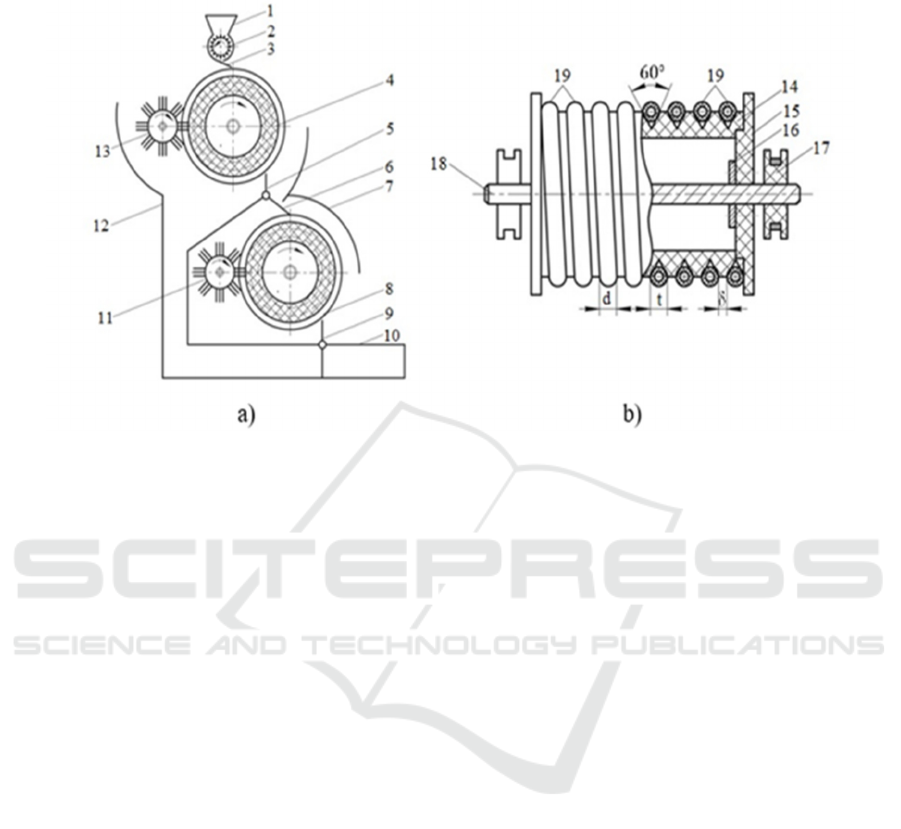
The figure shows a schematic diagram and
working element of an energy- and resource-saving
electric sorting device that improves the quality
indicators of rice seeds.
Figure 1: Schematic diagram (a) and working body (b) of an energy and resource-saving electric sorting device that improves
the quality indicators of rice seeds:1-loading hopper; 2-provider; 3, 6-pull-out board; 4, 8-working body; 5, 9-dividing plane;
7, 12 - protective walls; 10-reception hopper; 11, 13 - separating brushes; 14- polyethylene pipe; 15-sided discs; 6-flanges;
17 current transmitters; 18-shaft; 19-opposite electrodes.
The working bodies of the energy- and resource-
saving electric sorting device, which improves the
quality indicators of rice seeds, are made of
polyethylene pipe 14, and two-lane helical grooves
with a depth angle “γ”, width “t1” and distance equal
to “δ1”, directed towards the surface of the working
body located above and surrounded by electrodes of
the opposite direction with a diameter d 1 close to the
thickness of a rice seed. On the surface of the
working body located below, two-lane helical
grooves are made with a depth angle “γ”, width “t2 ”
and the distance between them, directed towards “δ2
” and electrodes with the opposite direction c wind
diameter d 2 around them, then is close to the width
of a rice seed . A polyethylene pipe 14 with double-
sided helical grooves is fixed to the shaft 18 using side
disks 15 and flanges 16 made of dielectric material.
Electrodes of opposite sign 19 are connected to a high
voltage source through a current sensor 17.
The operating principle of an energy and
resource-saving electric sorting device that improves
the quality indicators of rice seeds is as follows. When
it is connected to the network using an electric motor
and gearbox, feeder 2, working bodies 4 and 8,
separating brushes 11 and 13 are rotated. At this time,
rice seeds to be sorted are delivered from loading
hopper 1 to the surface of working body 4 at the same
speed through the feeder 2 and the sliding board 3.
The seeds, falling on the surface of the rotating
working body 4, are placed between the electrodes 19
in the opposite direction in terms of their thickness.
In addition to the force of the electric field, seeds are
also affected by centrifugal force, gravity, inertia,
reaction forces and friction. Depending on the mutual
relationship of the acting forces, depending on their
physical and mechanical properties, rice seeds are cut
from the surface of the working body 4 at different
angles, high-quality seeds fall on the surface of the
lower working body 8, and low-quality seeds are cut
off when turning at large angles or are separated using
brushes 11. Technical fraction 10 enters the receiving
hopper.
Rice seeds, cut from the surface of the upper
working body 4 and falling onto the surface of the
lower working body 8, are placed between electrodes
19 with opposite directions and the sorting process is
repeated. Rice seeds, sorted by thickness, width and
other important properties, are cut from the surface of
the lower working body 8, separated into the seed
fraction of the receiving hopper 10, placed in bags
and sent for sowing. Seeds adhering to the surface of
the working body 8 are cut at large angles or separated
with a brush and fall into the technical fraction of the
receiving hopper 10. In this sequence, the
technological process of sorting rice seeds continues
in an energy and resource-saving electric sorting
Results of Sorting Rice Seeds in an Energy-Saving Electric Sorting Device
223
device (Tukhtakuziev & Rasuljonov, 2020; Patent,
2022b; Abdullaev et al., 2023; Tukhtakuziev et al.,
2023; Alimova et al., 2024a; Alimova et al., 2024b).
The force of the electric field with great force
attracts rice seeds to the surface of the working
bodies, which allows, firstly, to increase the accuracy
of their separation into seed and technical fractions,
and secondly, to increase the efficiency of the device.
3 RESULTS AND DISCUSSION
Good results have been obtained in experimental
studies on the selection of rice seeds.
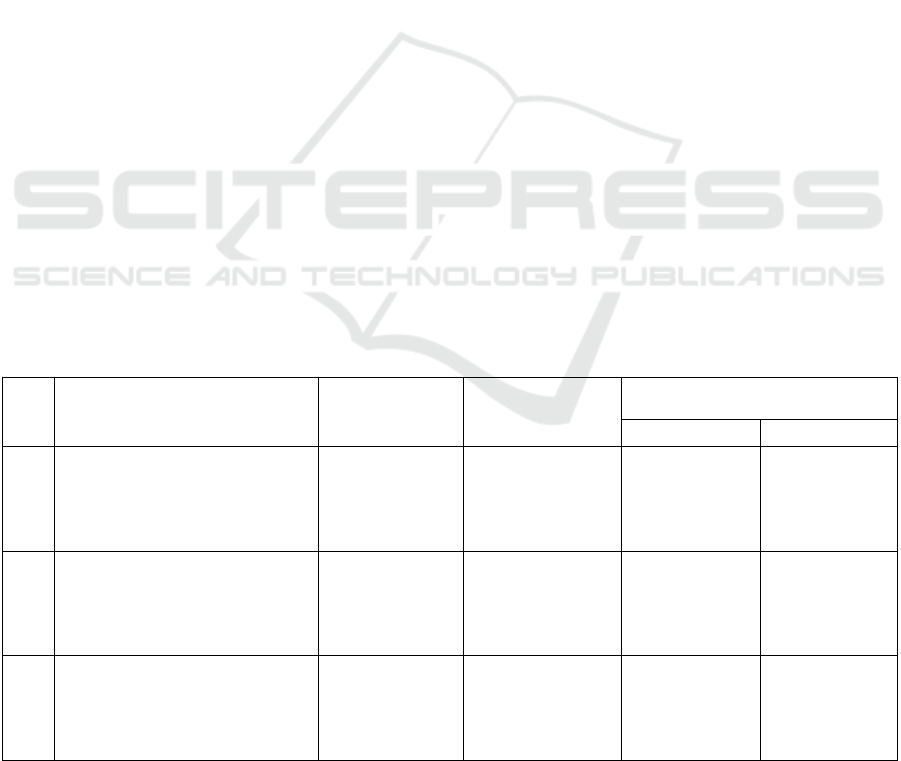
In Table 1, the diameter of the working body of an
energy-resource-saving electric sorting device that
improves the quality indicators of rice seeds is D =
350 mm, the voltage applied to the electrodes with
opposite signs is U = 1500 V, and the number of
revolutions of the working body is n = 40; The results
of the selection of rice seeds at 50 and 60 min -1 are
presented.
As can be seen from the results presented in Table
1, the diameter of the working bodies and the voltage
applied to the electrodes in the opposite direction do
not change, and with a change in the number of
revolutions, the sorted rice seeds are divided into
fractions and the mass of 1000 seeds changes.
In particular, if the number of revolutions of the
working body is n=40 min -1, the mass of 1000 grains
of rice containing 74.6% rice seeds, divided into the
seed fraction, will be 31.24 grams, which is 3.07
grams more than control, then the number of
revolutions of the working body n = 60 min -1, the
mass of 1000 grains of rice with 93.6% seeds divided
into the seed fraction was 29.26 grams, which
increased by 1.09 grams compared to the control.
That is, with an increase in the number of revolutions
of the working parts of the energy and resource-
saving electric sorting device, which increases the
quality indicators of rice seeds, the separation of
sorted rice seeds into a seed fraction was observed.
increases, and the mass of 1000 seeds decreases.
A different picture was observed in the technical
faction. With an increase in the number of revolutions
of the working bodies, the number of rice seeds
separated into the technical fraction and the mass of
1000 seeds in it decreased. In particular, at the number
of revolutions of the working bodies n=40 min -1, the
mass of 1000 grains of 25.4% barley seeds, divided
into a technical fraction, is 19.15 grams, which is
reduced by 9.59 grams compared to the control, the
number of revolutions of the worker organ n= 60 min
-1, the weight of 1000 grains of 6.4% rice seeds,
divided into the technical fraction, was 12.23 grams,
which decreased by 15.94 grams compared to the
control. With an increase in the number of revolutions
of the working bodies, the number of seeds separated
into the technical fraction, and a decrease in the mass
of 1000 seeds in it, low-quality and light rice seeds
are mixed into the seed fraction.
Table 1: Results of sorting rice seeds at different speeds of the working body.
№
The number of revolutions of the
working body and the name of the
fractions
Share-large
separation, %
Weight of 1000
seeds, g
Control the difference is in the
b
aton
G %
1 P = 40 min
-1
Control
After sorting:
- seed fraction
-technical faction
100.0
74.6
25.4
28.17
31.24
19.15
-
+3.07
-9.59
-
+10.80
-33.9
2 P = 50 min
-1
Control
After sorting:
- seed fraction
-technical faction
100.0
84.5
14.5
28.17
30.92
14.09
-
+2.75
-14.08
-
+9.76
-49.98
3 P = 60 min
-1
Control
After sorting:
- seed fraction
-faction of technicians
100.0
93.6
6.4
28.17
29.26
12.23
-
+1.09
-15.94
-
+3.87
-56.59
I-CRAFT 2024 - 4th International Conference on Research of Agricultural and Food Technologies
224

Table 2: The result of sorting rice seeds in a pilot copy of an energy and resource-saving electric sorting device.
№ Voltage value and faction name Fractionation, % Weight of 1000 seeds, g
Difference compared to control
G %
1 U =1000 V
Control
After sorting:
- seed fraction
-technical faction
100.0
90.79
9.21
27.78
29.18
13.95
-
+ 1.4
- 13.83
-
+5.04
- 49.78
2 U = 1 50 0 V
Control
After sorting:
- seed fraction
-technical faction
100.0
80.92
19.08
27.78
30.43
17.06
-
+2.65
- 10.72
-
+ 9.54
- 38.59
3 U = 2000 V
Control
After sorting:
- seed fraction
-technical fraction
100.0
68.37
31.63
27.78
31.90
19.42
-
+4.12
-8.36
-
+14.83
-30.09
Based on the analysis of the results obtained, we
can come to the following conclusion: from the point
of view of manufacturability, the diameter of the
working bodies D= 350 mm, the magnitude of the
voltage applied to the electrodes in the opposite
direction is the most optimal operating mode for the
precise separation of rice seeds into seed and
technical fractions in energy and a resource-saving
electric sorting device. Achieved at U = 1500 V and
an equal number of revolutions of the working body.
up to n = 50 min -1. In this mode, the weight of 1000
grains of 84.5% of rice seeds, divided into the seed
fraction, was 30.92 grams, which increased by 2.75
grams compared to the control.
Table 2 presents the results of sorting rice seeds in
a pilot version of an energy- and resource-saving
electric sorter. Experimental studies: diameter of the
working parts of the electrosorting device D = 350
mm, speed n = 50 min, electric field strength E =
6∙105 V/m and voltage applied to the electrodes with
the opposite direction U = 1000, carried out at 1500
and 2000 V.
From the results presented in Table 2, it is clear
that with a change in the voltage applied to the
opposite electrodes, there is a division of rice seeds
into fractions and a change in the mass of 1000 seeds.
Specifically, if the magnitude of the voltage applied
to the electrodes in the opposite direction is U = 1000
V, the weight of 1000 grains of 90.79% rice seeds
divided into the seed fraction will be 29.18 grams,
which is increased by 1.4 grams. Compared to the
control, at U = 2000 At equal V, the weight of 1000
grains of rice with 68.37% seeds divided into the seed
fraction was 31.90 grams, which increased by 4.12
grams compared to the control.
In the technical fraction, with an increase in the
voltage applied to the electrodes in the opposite
direction, an increase in the delamination of rice seeds
into it and an increase in the mass of 1000 seeds were
observed. In particular, with a voltage applied to the
electrodes equal to U = 1000 V, the mass of 1000
grains of 9.21 percent rice seeds, divided into a
technical fraction, is 13.95 grams, which is reduced
by 13.83 grams compared to the control., at U =2000
V. The weight of 1000 grains of 31.63% rice seeds,
divided into the technical fraction, was 19.42 grams,
which decreased by 8.36 grams compared to the
control.
U = 1500 V to electrodes in the opposite direction.
in an experimental copy of an energy- and resource-
saving electric sorting device. With this strain size,
the weight of 1000 rice seeds, divided into a seed
fraction of 80.92%, was 30.43 grams, which
increased by 2.65 grams compared to the control.
Experimental study on rice seed sorting found that
since the original seeds contain various impurities, as
well as broken and very small seeds, we propose to
sort these seeds after pneumatic or mechanical sorting
using energy and resource-saving electrical
equipment. sorter.
In table Figure 3 presents the results of a study
of the mass of 1000 rice seeds sorted in the original
and prototype of an energy- and resource-saving
electric sorting device.
From the results presented in Table 3, it is clear
that the mass of 1000 seeds of the first initial rice with
mass, standard deviation σ = 0,81 grams and
coefficient of variation V = 2.92 %, m = 27.78 grams,
after sorting in In a prototype of an electric sorting
device, the seed mass of 1000 fractionated rice seeds
Results of Sorting Rice Seeds in an Energy-Saving Electric Sorting Device
225
at σ = 0.36 grams and V = 1.18 % was m = 30.43
grams, compared to the control Δ m = 2.65 grams
increased.
Table 3: Results of the study of the mass of 1000 rice seeds.
Seeds and
faction name
Weight
of 1000
seeds,
g
Standard
deviation σ
,
g
Coefficient
of variation
- enti V , %
Rice seeds:
- control
- seed
fraction
27.78
30.43
0.81
0.36
2.92
1.18
Analysis of the results presented in Table 3 shows
that in a prototype of an energy- and resource-saving
electric sorting device, when sorting rice seeds, with
an increase in weight by 1000 seeds, seeds of similar
weight are obtained. This is clearly visible from the
coefficients of variation in the mass of 1000 rice seeds
in the control and seed fractions. The value of the
coefficient of variation decreased by 2.5 times
compared to the control in the variant with division
into the seed fraction.
Thus, as the weight of rice grains increases when
sorted in an energy and resource-saving electric
sorter, they become closer to each other.
In table 4 presents the results of a study of the
geometric dimensions of rice seeds sorted in the
original and prototype of an energy- and resource-
saving electric sorting device.
From the results presented in Table 4, it is clear
that there were some changes in the geometric
dimensions of rice seeds when they were sorted in an
energy- and resource-saving electric separator.
The geometric dimensions of rice seeds - length,
width and thickness - in the control variant and after
sorting in an energy- and resource-saving electric
separator are equal to a = 8.59 mm, b = 3.68 mm and
c = 2.09 mm . device, in the version with the
separation of seeds into fractions a = 8.76 mm, b =
3.69 mm and c = 2.24 mm.
Table 4: Results of a study of the geometric dimensions of
rice seeds.
Seeds and
faction
name
Geometric
dimensions
a, b, c, m
m
Medium
square σ,
m
m
Variation
coefficients
V, %
Rice seed:
- Control
8.59
3.68
2.09
0.61
0.25
0.31
7.09
6.92
14.64
- seed
faction
8.76
3.69
2.24
0.58
0.22
0.11
6.59
5.88
4.72
Analysis of the results presented in Table 4 shows
that when sorting rice seeds in an energy- and
resource-saving electric sorting device, the geometric
dimension’s increase, and the geometric dimensions
of the seeds come closer to each other. Thus, it was
noticed that the coefficients of variation in the
geometric dimensions of seeds divided into the seed
fraction were reduced compared to the control.
Table 5 presents the results of a study of the
sphericity coefficient of rice seeds sorted in a primary
and energy- and resource-saving electric sorting
device.
Table 5: Results of the study of the coefficient of sphericity
of rice seeds.
Seeds and
faction
name
Sphericity
coefficient
Standard
deviation
σ, m
m
Coefficient
of variation
V, %
Rice seed:
- Control
0.43
0.03
7.13
- seed
faction
0.43 0.03 7.04
Table 6: The result of determining the germination of rice
seeds in laboratory conditions.
Seeds and
faction
name
Fertilizer
application
in
laboratory
conditions,
%
Standard
deviation
σ, mm
Coefficient
of variation
V, %
Rice seed:
- Control
0.43
0.03
7.13
- seed
faction
0.43 0.03 7.04
From the results presented in Table 5, it can be
seen that the sphericity coefficients did not change
when sorting rice seeds in an energy and resource-
saving electric sorter. We can come to the following
conclusion: rice seeds are sorted according to all their
sizes, length, width and thickness in an energy and
resource saving electric sorting device. Consequently,
the sphericity coefficient of seeds divided into the
seed fraction after sorting does not change compared
to the control.
In table 6 presents the results of determining the
germination of rice seeds sorted in laboratory
conditions using an initial and energy and resource-
saving electric sorting device.
From the results presented in Table 6, it is clear
that after sorting rice seeds in an energy and resource-
saving electric sorter, in the version with separation
into the seed fraction, the accuracy in laboratory
conditions was higher than in control. The purity of
I-CRAFT 2024 - 4th International Conference on Research of Agricultural and Food Technologies
226

rice seeds in laboratory conditions was 91.25% for the
control variant, and 94.0% for the seed fraction,
which is 3.75% higher than the control.
Analysis of the results presented in Table 6 shows
that when sorting rice seeds in an energy- and
resource-saving electric separator, not only the
quality in the laboratory increases, but also the quality
of the seeds separated into seed fractions in the
laboratory. conditions are close to each other. This is
also evidenced by the coefficients of variation in the
quality of rice seeds, divided into control and seed
fractions, in laboratory conditions.
Thus, sorting rice seeds in an energy- and
resource-saving electric sorter not only produces
seeds with high fertility in vitro, but also seeds with
similar fertility in vitro. Table 7 presents the results of
determining the germination of rice seeds sorted
under field conditions in the original and energy- and
resource-saving electric sorting device.
Table 7: The result of determining the germination of rice
seeds in laboratory conditions.
Seeds and
faction
name
Fertilizer
application
in
laboratory
conditions,
%
Standard
deviation
σ, mm
Coefficient
of variation
V, %
Rice seed:
- Control
61.50
1.00
1.63
- seed
faction
72.50 3.11 4.29
Table 7, it is clear that sorting rice seeds in an
energy and resource-saving electric sorter allows not
only to obtain seeds with high fertility in laboratory
conditions, but also in field conditions. Fertilization
of rice seeds under field conditions was 61.5% in the
control, 72.5% in the seed fraction after sorting,
which was 11.0% higher than the control.
From the results presented in Table 7, it is also
clear that sorting rice seeds in an energy- and
resource-saving electric sorting device not only
increases their field fertility, but also makes it
possible to obtain seeds with similar field fertility.
This is evidenced by the coefficients of variation in
the germination of rice seeds in the control variant
and those allocated to the seed fraction under field
conditions.
Thus, sorting rice seeds in an energy- and
resource-saving electric sorting device produces
seeds with high and similar field fertility.
Analysis of the results presented in Tables 6 and 7
shows that sorting rice seeds in an energy- and
resource-saving electric sorter makes it possible to
obtain seeds with high and close germination in
laboratory and field conditions.
A study of the physical and mechanical properties
of rice seeds sorted in an energy- and resource-saving
electric separator showed that not only in weight, but
also in density, geometric dimensions and biological
properties, they are close to each other, have high
fertility and potential yield. in laboratory and field
conditions. It can be concluded that sorting rice seeds
in an energy and resource-saving electric sorter
creates the basis for growing a rich harvest from
them.
Further research and development should be
aimed at developing a prototype energy- and
resource-saving electric sorter, as well as
experimental studies on seed sorting of other crops.
4 CONCLUSIONS
1. The use of devices used in practice based on the
pneumomechanical method of sorting rice
seeds does not allow obtaining seeds of the
required level, since they are sorted according
to one important characteristic.
2. Creation of an electric field between electrodes
of the opposite direction on the surface of the
upper and lower working bodies of an energy-
and resource-saving electric sorting device due
to the attraction of rice seeds to it by a large
electric field force, high-quality rice seeds with
similar biological properties, laboratory and
providing good seeds with high fertility and
potential yield in field conditions.
3. It is necessary to carry out further research
work to improve a prototype of an energy- and
resource-saving electric sorting device, as well
as to conduct experimental studies on sorting
seeds of other agricultural crops.
REFERENCES
Abdullaev, M., Akramov, N., Mirzaeva, G., & Tursunov,
M., 2023. Effectiveness of using electrochemically
activated water with an acidic medium in breeding grain
moth (cytotroga cerealella oliv) in biolaboratories. E3S
Web of Conferences, 452, 01046.
https://doi.org/10.1051/e3sconf/202345201046.
Alimova, F., Saidova, M., Boboniyozov, E., & Mirzayev,
B., 2024b. Analysis of the state of mechanized sowing
of rice in seedlings. BIO Web of Conferences, 85,
01032. https://doi.org/10.1051/bioconf/20248501032.
Alimova, F., Saidova, M., Primqulov, B., & Erdem, T.,
2024a. Optimization of the parameters of the pneumatic
Results of Sorting Rice Seeds in an Energy-Saving Electric Sorting Device
227

feed mechanism for precise clustered sowing. BIO Web
of Conferences, 85, 01026.
https://doi.org/10.1051/bioconf/20248501026
Patent, 2022a. Patent of the Republic of Uzbekistan No.
IAP 6674. Device for sorting seeds of agricultural
crops. A.T. Rosaboev et al., Bulletin. – No. 1.
Patent, 2022b. Patent of the Republic of Uzbekistan No.
IAP 06833. Universal dielectric device for sorting seeds
of agricultural crops. A.T. Rosaboev et al., Bulletin. –
No. 4.
Rosaboev, A.T., 2015. Elektr saralagich kurilmasini
takomilashtirish natizhasi. Energy va Resourcestezhash
Muammolari, 3, 205-209.
Tagaev, B.K. & Akramov N.N., 2024. Theoretical study of
the process of sorting rice seeds under the influence of
an electric field. International Journal of Advanced
Research in Science, Engineering and Technology,
11(4), 21639-21644.
Tukhtakuziev, A., & Rasuljonov, A.R., 2020. Ensuring the
stability of the processing depth of suspended soil
mounted machines. IOP Conference Series: Earth and
Environmental Science, 614(1), 012156. DOI:
10.1088/1755-1315/614/1/012156.
Tukhtakuziev, A., Rasuljonov, A. R., Turkmenov, H. I.,
Irgashev, A. A., & Barlibaev, S., 2023. Ensuring the
stability of the suspended chisel-cultivator processing
depth. E3S Web of Conferences, 390, 01038.
https://doi.org/10.1051/e3sconf/202339001038.
I-CRAFT 2024 - 4th International Conference on Research of Agricultural and Food Technologies
228
