
The Composition and Status of Fish Species in the Current
Conditions of Tuzkan Lake
Dilora Dekhkonova
1a
and Mukhayyo Atamuratova
2b
1
Tashkent State Agrarian University, 100140, University Street 2, Qibray Area, Tashkent, Uzbekistan
2
Institute of Zoology of the Akademy of Sciences of the Republic of Uzbekistan,
100053, Bogishamol District, Tashkent, Uzbekistan
Keywords: Ichthyofauna, Tuzkan Lake, Pikeperch.
Abstract: In the article, the geographic location, physical-chemical condition, and ichthyofaunistic characteristics of
Lake Tuzkаn, identification of existing fish species using the detector. Biological characteristics of
representatives of Tuzkan lake ichthyofauna. The current composition of fish species in Lake Tuzkan, their
condition, the most common types of hunting importance, especially the plastic and meristic characteristics
of the pikeperch fish (Sander lucioperca L), analysis by classical and modern methods, the pikeperch fish
information on age size indicators is provided. The types and systematic status of the fish caught in the
conducted research hunts, as well as industrially caught by the fishing brigades, were taken and their
characteristics were determined using the available identifiers and the available identifier literature. Meristic
indicators of fish were determined by counting and measuring plastic indicators. Collection, processing, and
analysis of materials were carried out following generally accepted ichthyological methods. In the general
biological analysis of the fish, their total length (TL) was measured with an accuracy of 0.1 cm, and standard
length (SL) (to the point where the scales ended) was measured with an accuracy of 0.1 mm. The total body
weight (W, g) was measured to the nearest 1 gram, and the species of fish present in Lake Tuzkan were
determined.
1 INTRODUCTION
Supplying the population with food, preservation of
biodiversity and effective use of natural resources are
considered as the main problems in the world. In
order to effectively use water resources, special
attention is paid to the research work on increasing
the fish productivity of water bodies, including the
study of the species composition of hunting
ichthyofauna for fishing. Also, in a number of
developed European, North American, and Far
Eastern countries, existing fish species in water
bodies for recreational fishing are regularly
monitored.
Fishing and pasture aquaculture in inland water
bodies differ from the experience of developed
countries in other regions, including Uzbekistan, due
to differences in climate, location of water bodies,
physical and chemical characteristics, and also the
a
https://orcid.org/0000-0002-8361-124X
b
https://orcid.org/0000-0001-9084-2110
composition of ichthyofauna is unique. Therefore, it
is necessary to carry out comprehensive research in
each area. To increase the volume of fishing in the
Tuzkan water basin, it is important to study the
existing species in the area and their current
ichthyofaunistic features in order to preserve
biodiversity..
The successful organization of fishing in natural
water bodies is closely related to the state of its
ichthyofauna and its population. Therefore, it is
important to determine the status of fish stocks in
natural water bodies and to conduct scientific
research on non-game fish and game fish, which
depend on biodiversity, ecological balance and the
survival of predatory fish. Obtaining information
about the current state of the number of species,
sexual maturity, and its reproduction is considered
one of the urgent tasks of research in the field of
ichthyology and fisheries (Dekhkonova, 2023).
Dekhkonova, D. and Atamuratova, M.
The Composition and Status of Fish Species in the Current Conditions of Tuzkan Lake.
DOI: 10.5220/0014242900004738
Paper published under CC license (CC BY-NC-ND 4.0)
In Proceedings of the 4th International Conference on Research of Agricultural and Food Technologies (I-CRAFT 2024), pages 197-200
ISBN: 978-989-758-773-3; ISSN: 3051-7710
Proceedings Copyright © 2025 by SCITEPRESS – Science and Technology Publications, Lda.
197
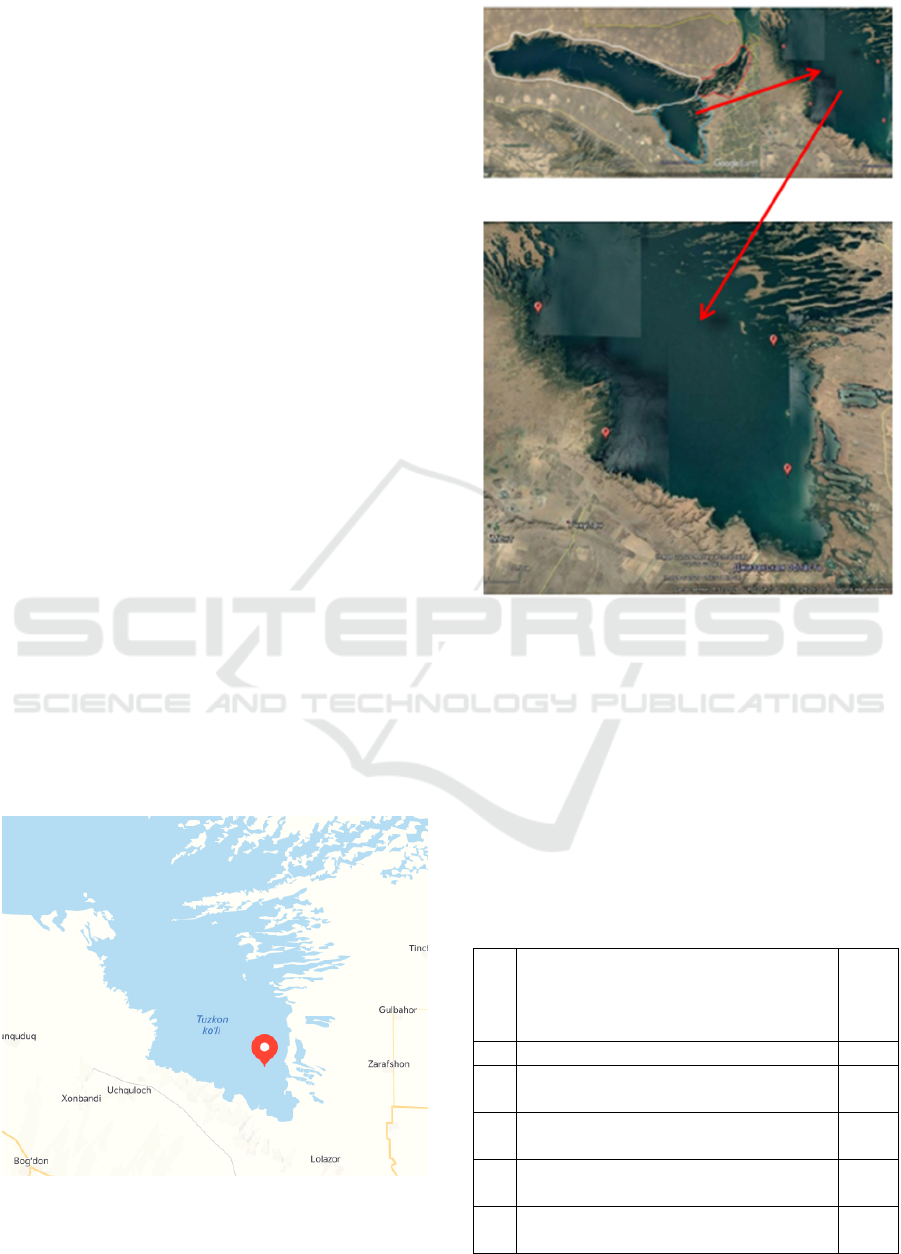
Until 1969, Tuzkon Lake was brackish water with
a very high salinity (90 g/l) and dried up at the end of
summer due to the melting of snow and spring
rainwater. In 1969, Lake Tuzkon was connected to
Aydarkol through a narrow channel and was
constantly flooded. Today, the area of theLake
Tuzkon is 413 km
2
, its length is 34 km, and its water
volume is 1.07 km
3
(Dekhkonova, 2023). (Figure 1).
2 MATERIALS AND METHODS
Research work was carried out in Tuzakan Lake
during 2020-2022. The fish caught in the conducted
research hunts, as well as industrially caught by
fishing crews, were taken and their types were
identified using the existing identification and
identification literature and the monograph "Fishes of
Uzbekistan" (Yuldashov et al., 2018) by T.Salikhov,
M.Yuldashov, B.Kamilov using their characteristic
features. and clarifications were made to the
systematic situation (Salikhov et al., 2001). Meristic
characters of fish were determined by counting and
by measuring plastic characters (Pravdinб 1966).
Collection, processing and analysis of materials
were carried out in accordance with generally
accepted ichthyological methods. In the general
biological analysis of the fish, their total length (TL)
was measured with an accuracy of 0.1 cm, and
standard length (SL) (to the point where the scales
ended) was measured with an accuracy of 0.1 mm.
The total body weight (W, g) was measured to the
nearest 1 gram, and the species of fish present in
Tuzkan Lake were determined. (Table 1).
Figure 1: The geographical location of Tuzkan Lake[9].
Figure 2: Location of sampling sites in the Tuzkan Lake.
Research conducted in Tuzkan Lake revealed that
the only obligate predatory fish is pikeperch in this
water body. It was important to know the biological,
morpho-ecological characteristics of the pikeperch
fish in order to determine the reason why it can
survive in this water body. But since this study is very
large, we will mention some of them. A total of 190
pikeperch fish of different sizes were analyzed in
Tuzkon Lake. (table 2)
Table 1: The current state of fish species composition in
Tuzkan Lake.
№ Fish species
Tuz
kan
Lak
e
1. Roach fish - Rutilus aralensis Ber
g
. +
2.
Common rudd - Scardinius
er
y
throphthalmus (L)
+
3.
Grass carp – Ctenopharyngodon
idella (Val)
+
4.
Aral asp fish – Aspius aspius
iblioides Kessle
r
+
5.
Turkestan gudgeon – Gobio gobio
lepidolaemus K.
+
I-CRAFT 2024 - 4th International Conference on Research of Agricultural and Food Technologies
198

6.
Samarkand Capoeta capoeta -
Varicorhinus capoeto heratensis st.
+
7.
Aral shemaia – Chalcalburnus
chalcoides aralensis
+
8. Sabrefish
–
Pelecus cultratus L. +
9.
Prussian carp –Carassius auratus
g
ibelio
+
10. Common carp
–
C
y
prinus ca
r
pio L +
11.
Silver carp - Hypophthalmichthys
molitrix
+
12.
Mosquito fish - Gambusia affinis
holbrookii (Jir)
+
13. Pikeperch - Sander lucioperca L +
14. Gob
y
fish - Neo
g
obius Jl
j
in +
Total 14
Table 2: The number of samples collected for the study of
pikeperch fish in Lake Tuzkon
№
Study of biological
characterist
Number
(pieces)
1 Morpholo
g
ic characteris
t
40
2 A
g
e of
g
row 100
3 sexual maturit
y
25
4
ndicators of fertility, the
size offish e
gg
si
25
Total 190
The studied lake basin is quite large, and this lake
may have one or more populations of pikeperch fish.
This needs to be determined because it is a very
important aspect in managing the commercial fishing
of a fish species of important fishery value. For the
methodical solution of this problem, it is important to
give the classification of the pikeperch fish in each
water basin, to compare them with each other and
later with the data from other areas of the area where
the pikeperch fish is distributed (Dekhkonova, 2023).
The meristic characteristics of pikeperch fish were
determined by counting (Dekhkonova, 2022).
Table 3 shows the indicators of the meristic
characteristics of the group of pikeperch fish in this
lake.
Table 3.
Age
group
Back-calculated standard length
according age group, cm
N,
pie
ces
SL
1
SL
2
SL
3
SL
4
SL
5
SL
6
1
23,
9
17
2 26
42,
8
38
3
24,
8
43,
3
53 18
4
28,
4
51
64,
3
70,
3
12
5
22,
9
38,
5
55 62
69,
5
7
6
26,
4
42,
2
53,
9
63.
8
75,
3
78,
4
8
Mean SLi
(cm)
24
44,
2
55,
8
66,
4
73,
3
78,
4
Annual
incremen
t
(cm/year)
24
20,
2
11,
6
10,
6
6,9 5,1
When analyzing the obtained meristic characters, it
was found that the most variable character is the
number of scales on the lateral lines. (Figure 4)
Table 4: Indexes of plastic morphological characteristics of
the pike perch in Tuzkon Lake (n - 40 speciments)
Morphological
characteristics
Min Max. Mean + S
x
Absolute length of
the fish, m
m
239 784 515,2±6,5
Standard length of
fish bod
y
, m
m
235 780 450±5,9
Total weight of fish
b
od
y
,
g
300 6030 1125,4±42
Lateral line 87 103 96,7±0,6
I D rays. s.
13 15 13,8±0,1
II D rays s.
2 3 2,2±0,1
II D rays b.
19 23 21,2±0,1
А rays. s.
2 3 2,5±0,1
А rays. b.
11 13 11,7±0,1
Gill rakers
64 198 121,0±0,1
Pyloric cecum
11 13 11,6±0,1
Figure 4: Variants formed by the number of scales on the
lateral line of the fish
The Composition and Status of Fish Species in the Current Conditions of Tuzkan Lake
199

Pikeperch fish is one of the important catchting
species, so they do not live to the state of natural
aging, that is, they are caught as a result of
commercial fishing. in the Tuzkon lake. The scales of
pikeperch fish uses as the main recording structure in
determining their age (Chugunova, 1959). (Table 4)
Table 4. The mean stanard length determined by
back-calculation method according to age groups of
the pike perch (males and females combined) (2020-
2022 y. 100 pieces)
The result of the obtained data can be analyzed
using the showing graph. (Fig. 5)
Figure 5: Growth rate of pikeperch fish in the Tuzkan Lake,
2020-2022 y
3 RESULTS AND DISCUSSION
We made an ichthyological analysis of the current
state of Tuzkan Lake. According to the results, 14
types of fish species were found in Lake Tuzkan, and
the composition of the species was clarified. In recent
years, the increase in the salinity level of Tuzkan
Lake and the receding of the water level and the
appearance of many islets did not fail to affect the
ichthyofauna in its composition, and therefore the
number of fish species in recent years decrease was
observed.
Research conducted in Lake Tuzkan revealed that
the only obligate predatory fish is the pikeperch fish
in this water basin. The length of the pikeperch fish
samples taken from Tuzkon Lake was 23.9-78.4 cm,
the total weight of the body was 300-6030 g. Fish up
to 6+ years old were found in the samples collected
from Tuzkon Lake. The samples collected from this
reservoir were composed of fish up to 6+. According
to the data presented in Table 4, the growth rate was
very high in the first year of life, and it was also high
in the second year. In the following years, it gradually
decreased
4 CONCLUSIONS
This can be concluded from the research results.
Continuous monitoring of the ichthyofauna is very
important for effective organization of fishing.
Analyzing the available fish species in Tuzkan Lake,
the common and only obligate predator species that is
important for hunting in this water body is the white
sla fish. According to the analysis of the results of the
conducted research, the pikeperch fish in Tuzkon lake
grows faster than in other water bodies where it
reproduces naturally (Makhmurov et al., 2024). It is
necessary not only to protect the species studied in
Tuzkan Lake, but also to develop ways of their
effective use.
REFERENCES
Chugunova N.I. Guide to studying the age and growth of
fish. Methodological manual on ichthyology - Moscow,
1959. - P.17--78.
Dekhkonova D.R Morpho-ecological characteristics of the
pikeperch (Sander lucioperca L) fish in the Aydar-
Arnasoy lake system. // Abstract of the dissertation
written for the degree of Doctor of Philosophy (PhD) in
Biological Sciences. - Tashkent. 2023. -5p..
Dekhkonova D.R. Morpho-ecological characteristics of the
pikeperch (Sander lucioperca L) fish in the Aydar-
Arnasoy lake system. // Dissertation written for
obtaining the degree of Doctor of Philosophy (PhD) in
Biological Sciences. - Tashkent. 2023. -14- 15b, 108b
Dekhkonova D.R, Sobirov J.J, Yuldashov M.A., Kamilov,
B.G., Biological characteristics of pike perch (Sander
lucioperca) from Aiydar-Arnasay lake system in middle
stream of syrdarya river in Uzbekistan // Egyptian
Journal of Aquatic Biology & Fisheries – Cairo, 2022 –
Vol. 26(6): – 1187 – 1197 (2022)
www.ejabf.journals.ekb.eg
Makhmurov I.B., Dekhqonova D.R. “Ichthyofauna of
Aydar-Arnasoy lake system and its importance in
fisheries” Uzbekiston agrar fani xabarnomasi 1/2(13)
Toshkent. 2024. – 124p
Pravdin I.F. Guide to the Study of Fish (Mainly
Freshwater). // 4th ed. - M.: Food Industry, 1966. - P.67-
69, 110-119, 110-222, 163-222, 269-371, 370-371.
Salikhov T.V., Kamilov B.G., Atadzhanov A.K. Fish of
Uzbekistan (determiner). // - Tashkent: ChinorENK,
2001. – P. 150–152
Yuldashov M.А., Salikhov T.V., Kamilov B.G. “Fishes of
Uzbekiston”. monograph, GOLD PRINT, – Toshkent.
2018.– p.161–162.
www.wikipedia.org
0
20
40
60
80
100
1234567
TL, mm
Age
I-CRAFT 2024 - 4th International Conference on Research of Agricultural and Food Technologies
200
