
Features of the Use of Ozone for Long-Term Storage of Agricultural
Products
Iroda Tadjibekova
a
and Dilnoza Pirmatova
b
Tashkent State Agrarian University, 100140, University str. 2, Tashkent, Uzbekistan
Keywords: Ozone Storage, Agricultural Product Preservation, Disinfection.
Abstract: Improving the efficiency of storage of agricultural products is one of the most important tasks of modern
science. There are many methods widely used today, but one of the most effective is the use of ozone. Ozone
is known to have strong oxidizing properties and is a strong oxidizing agent. Ozone is very toxic even in low
concentrations. It finds limited use in industrial synthesis (for example, in the production of succinic acid
from products and waste from rubber production) and in therapy (so-called ozone therapy). Several methods
are used to obtain ozone, each of which has its own advantages. But, before using ozone as an effective means
of storage, it is necessary to correctly determine the dose, timing and technology of ozone treatment
.
1 INTRODUCTION
To ensure sustainable development of agriculture, it
is necessary to intensively introduce modern
innovative methods and techniques for long-term
storage of agricultural products. The use of
innovative methods guarantees a significant
reduction in agricultural losses. The basis of
innovative activity in the agricultural sector is the
development and effective use of modern methods of
storing agricultural products. To apply modern
methods of storing agricultural products, it is
necessary to determine the causes of losses of fruits
and vegetables during storage.
Losses of agricultural products are a complex
phenomenon. Only with long-term storage of
agricultural products, losses of grown products reach
35-40%. The basis of innovative activity in the
agricultural sector is the development and effective
use of modern methods of storing agricultural
products. Agricultural products go through many
stages before reaching the consumer. At each stage,
losses appear that need to be reduced (Gabler et al.,
2010), (Servili et al., 2017), (Kangliang et al., 2018),
(Khaliknazarov et al., 2024), (Crupi et al., 2013).
a
https://orcid.org/0009-0005-8093-1968
b
https://orcid.org/0009-0005-5060-3031
2 MATERIALS AND METHODS
When storing products, the main causes of losses are
weight loss during the process of respiration,
evaporation and germination, with losses of water and
dry matter from 10 to 35% of the total weight loss.
Moreover, the loss of water is a value that is different
for each type of raw material. For example: for
apples, grapes, spinach, lettuce, broccoli, carrots in
bunches with leaves it is 3-4%, for pears, cherries,
peaches, strawberries, raspberries, currants, beets,
peas, cucumbers, beans 5-6%, for carrots, beets,
white cabbage, potatoes - 7-8%, etc.
If these indicators are exceeded, then the product
becomes unsuitable for sale.
No less losses occur due to diseases, which can
very quickly spread to a large mass of products. In the
case of diseases, there is also the factor that losses in
this case are very difficult to predict. We must not
forget about mechanical losses, since during long-
term storage the physical and mechanical
characteristics of the product change, that is, turgor is
lost and the density and hardness of the fruit changes.
Quite a large number of products become losses
from mechanical damage, especially at the final stage
of storage, when, as a result of ripening, the pulp of
fruits and vegetables softens and their strength
Tadjibekova, I. and Pirmatova, D.
Features of the Use of Ozone for Long-Term Storage of Agricultural Products.
DOI: 10.5220/0014224500004738
Paper published under CC license (CC BY-NC-ND 4.0)
In Proceedings of the 4th International Conference on Research of Agricultural and Food Technologies (I-CRAFT 2024), pages 169-171
ISBN: 978-989-758-773-3; ISSN: 3051-7710
Proceedings Copyright © 2025 by SCITEPRESS – Science and Technology Publications, Lda.
169
decreases. The deterioration of quality indicators is
due to both natural causes and the influence of
external factors. Therefore, for longer preservation of
agricultural products, it is necessary to create optimal
storage conditions (Turdiboyev et al., 2022),
(Djiyanov et al., 2024), (Djiyanov et al., 2024),
(Djiyanov et al., 2022), (Isakova et al., 2024).
3 RESULTS AND DISCUSSION
Currently, a fairly large number of methods are used.
One of them is the use of ozone (O3). It has long been
known that ozone has bactericidal properties. It is
known that in order for the shelf life of products to
increase by 1.5 - 2 times, the ozone concentration
value is sufficient to be 10 mg/m3 with a treatment
duration of 4 hours. But it should be noted that
different types of agricultural products have different
physical, mechanical and chemical properties. The
ozone treatment regimes for potatoes and grapes will
differ significantly from each other.
In Uzbekistan, for long-term storage, late-
ripening grape varieties are most often used:
Nimrang, Taifi pink, Oktyabrsky, Uzbek Muscat,
Taifi white. For long-term storage, grapes are treated
with sulfur dioxide or potassium metabilsulfite in
chambers cooled to -2°, the storage period in which is
4.5-7 months. The same grape varieties, not treated
with antiseptics at a temperature of about 0°, are
stored for 2.5-3 months.
Grapes are generally treated with sulfur dioxide
(SO2) to effectively control the development of
Botrytis cinerea and act as an antioxidant. But sulfur
dioxide can lead to poisoning and allergies to the
consumer, so additional treatment with ozone (O3) is
recommended. At the same time, the ozonation
process reduces the amount of fungicidal residues on
the surface of grape berries, which also affects the
safety of consumption. After treatment with
fungicides, the grapes were placed in long-term
storage and treated with 3 mg/m3 of ozone for 3 hours
3 times a week, which showed intensive destruction
of the amount of fungicides by 52%.
This fact suggests that the use of an ozonizer not
only prevents product spoilage but also ensures the
safety of product consumption. Compared to the
treatment with various chemicals, ozone is considered
less dangerous, since it does not accumulate or settle
on the surface of vegetables and fruits. The ozone
molecule is unstable and has the property of self-
disintegration. It is due to this property that ozone is
a strong oxidizing agent and an exceptionally
effective disinfectant. The instability of ozone
necessitates its production directly at the point of
consumption.
Experience shows that the shelf life of fruits and
vegetables can be doubled on average while
preserving the delicate aroma of the fruit. So, when
berries (strawberries, raspberries, grapes) are treated
with ozone at a dose of 3 - 8 mgOz/m3, their shelf life
increases by 2 times. After treating apples with ozone
at a dose of 4 - 6 mgOz/m3, their shelf life at a
temperature of +5°C increases to 5 months.
It must be remembered that unpurified and
undisinfected air in storage is a factor leading to
product spoilage. A very large number of different
microorganisms are constantly suspended in the air of
the storage facility: bacteria, fungal spores and mold.
These microorganisms, after processing the
container, storage and surface of the product, still
penetrate into the storage and affect the safety of the
product.
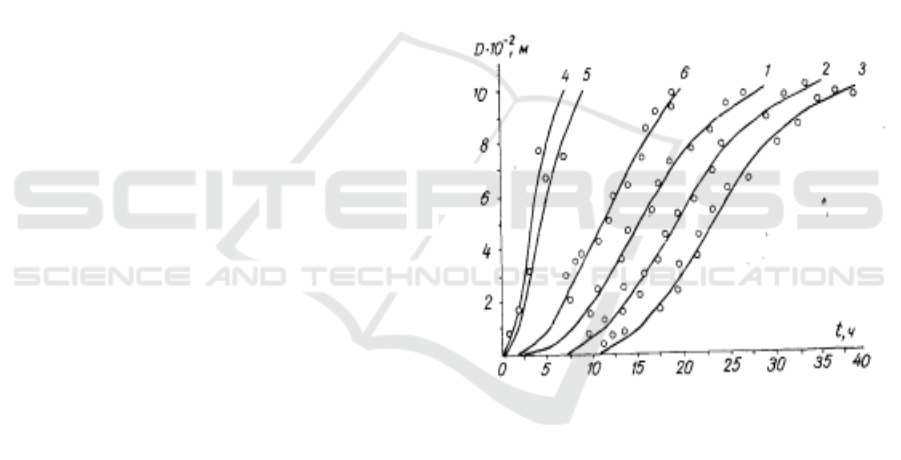
Figure 1: The dependence of the growth rate of the fungus
Fusarium solani on the duration of ozonation.
Figure 1 shows the dependence of the growth rate
of the fungus Fusarium solani on the duration of
ozonation. Therefore, the correctly selected
ozonation regime is important.
Since the object of the study was late-ripening
grape varieties: Nimrang, Taifi pink, Oktyabrsky,
Muscat Uzbekistan, Taifi white. For long-term
storage, grapes are treated with sulfur dioxide or
potassium metabilsulfite. But treatment with
chemicals can have a negative effect on the
consumer’s body. Ozone, in its properties of
destroying bacteria and viruses, is 2.5-6 times more
effective than ultraviolet rays and 300-6000 times
more effective than chlorine. Moreover, unlike
chlorine, ozone even destroys worm cysts. Suggested
ozone treatment regimes are presented in Table 1.
I-CRAFT 2024 - 4th International Conference on Research of Agricultural and Food Technologies
170

Table 1: Suggested ozone treatment regimes.
Grape
variety
Ozone
concent
ration
mg/m3
Ozonation
duration
time
N
umber of
treatments
per week.
N
imrang
3-4 3 3
Octobe
r
3-6 3 4
Taifi
pink
3-6 3 4
Uzbek
Muscat
3-8 4 4
Tayfi
white
3-8 3 3
Husaini
5 3 2
The Table 1 presents the data obtained during
ozone treatment of products stored for long-term
storage in the refrigerator.
It should be noted that there is information in
the literature that the use of ozone in combination
with other technologies such as irradiation with
ultraviolet rays (UV) stimulates an increase in the
amount of antioxidants. Ozone fumigation and M.
albus biofumigation reduced gray mold incidence to
9.7 and 4.4%, respectively.
Ozone is a fairly strong oxidizing agent; its
oxidation potential is approximately 20% higher than
that of chlorine. Ozone effectively destroys aromatic
hydrocarbons in the air of vegetable stores and
refrigerators. Thus, the use of ozone provides an
additional effect of room deodorization. Ozone by its
nature is an unstable form of oxygen. O3 gas
disintegrates quite quickly and turns into safe oxygen.
In this way, ozone compares favorably with
traditionally used toxic substances used for
processing fruits and vegetables and vegetable stores.
4 CONCLUSIONS
To summarize, we can draw the following
conclusions about the feasibility of using ozone for
processing fruits and vegetables. Ozone has a strong
disinfectant effect. Ozone effectively decomposes
toxins formed on the surface of fruits and vegetables.
Ozone effectively destroys unpleasant specific odors
of rot. After treating stored fruits and vegetables with
ozone, no deterioration in their quality and consumer
properties was detected.
Periodic treatment of vegetable stores with small
doses of ozone repels various rodents and affects
insects. The technology of using ozone for processing
fruits and vegetables, refrigerators and vegetable
stores is quite simple but effective. And it should be
noted that the cost of processing fruit and vegetable
products using ozone is lower than the use of
chemical disinfectants, and the cost of electricity for
processing fruit and vegetable products stored in a
refrigeration chamber with a volume of 1000 m3 is 3
- 7 kWh per week.
REFERENCES
Gabler, F.M., Mercier, J., Jiménez, J.I., 2010. Smilanick,
J.L. Integration of continuous biofumigation with
Muscodor albus with pre-cooling fumigation with
ozone or sulfur dioxide to control postharvest gray
mold of table grapes. Postharvest Biology and
Technology, 55, pp. 78-84.
Servili, A., Feliziani, E., Romanazzi, G., 2017. Exposure to
volatiles of essential oils alone or under hypobaric
treatment to control postharvest gray mold of table
grapes. Postharvest Biology and Technology, 133, pp.
36-40
Kangliang Sheng, Huanhuan Zheng, ShanShan Shui,
LingYan, Changhong Liu, Lei Zheng., 2018.
Comparison of postharvest UV-B and UV-C treatments
on table grape: Changes in phenolic compounds and
their transcription of biosynthetic genes during storage.
Рostharvest Biology and Technology, 138, pp. 74-81
Khaliknazarov, U., Ibrokhimov, U. 2024, BIO Web of
Conferences, 85, 01004
https://doi.org/10.1051/bioconf/20248501004
Crupi, P., Pichierri, A., Basile, T., Antonacci, D., 2013.
Postharvest stilbenes and flavonoids enrichment of
table grape cv Redglobe (Vitis vinifera L.) as affected
by interactive UV-C exposure and storage conditions.
Food Chemistry, 141, pp. 802-808
Turdiboyev, A., Khaliknazarov, U., Akbarov, D.,
...Abdullaeva, S., Butaev, T. 2022, AIP Conference
Proceedings, 2686, 020019
Djiyanov, M., Xalilov, R., Isakova, F. 2024, BIO Web of
Conferences, 85, 01034
https://doi.org/10.1051/bioconf/20248501034
Djiyanov, M., Tadjibekova, I., Temirkulova, N.,
Kholmuradov, O. 2024, Lecture Notes in Networks and
Systems, 733, 565–571
Djiyanov, M., Tadjibekova, I., Temirkulova, N. 2022, IOP
Conference Series: Earth and Environmental Science,
1068(1), 012004 doi:10.1088/1755-
1315/1068/1/012004
Isakova, F., Tadjibekova, I., Kurbonov, F. 2024, BIO Web
of Conferences, 85, 01037
https://doi.org/10.1051/bioconf/20248501037
Features of the Use of Ozone for Long-Term Storage of Agricultural Products
171
