
Designing of the Cavities Device Circuit for Installation in Canal of
Fan Sprayer
Khusniddin Irisov
1a
, Ma'oruf Djiyanov
1b
, I Bekmurodov
2c
and Navruz Abdiyev
1d
1
Tashkent State Agrarian University, 100140, University Str. 2, Tashkent, Uzbekistan
2
University of Public Safety, Tashkent Region, 100109, Uzbekistan
Keywords: Cavitation Device, Spray Optimization, Droplet Dispersion.
Abstract: In article is described the structure, operation and advantages of the spreader (caviator) used in the fight
against pests and diseases in agricultural crops, viticulture and horticulture, as well as its advantages over
other spreaders. Also, installing the caviator device on the nozzle of fan sprayers (passing the symmetry of
the axis equal to "k-k" passing through the center of the spray nozzle and selecting point "a" from it, passing
horizontal lines from point "a" to create points " c " and " b ", A scheme was designed to find the point d that
defines the triple part of the conical expander by passing a line 45
0
below the point " b ", and to determine the
point "e" where the axis symmetry of the capillary channel passed at a distance of l
0
from the point "d". The
optimal design parameters of the caviator (diameter of the base of the conical expander that expands the liquid
droplet flow, internal diameter of the injection chamber) are defined in the article. In order to deliver liquid
droplets to a long distance, the method of installing the cavity nozzle at an optimal distance from the fan
nozzle, the distribution of the free air flow from the spray fan in the atmospheric environment and the methods
of selecting the operating modes of the spraying process (the speed of the air flow containing liquid droplets),
the performance of the fan sprayer were determined.
1 INTRODUCTION
The yield and weight of the product in agricultural
crops depend on the type of seed planted, the strength
of the land, the period of planting and vegetation, as
well as the contamination of the fields with disease-
spreading microorganisms, the extent of
contamination with diseased plant residues, the types
and levels of disease spreaders and pathogens.
Disease infections and disease-spreading pests in
most cases can multiply in the roots of weeds in the
initial phase of development and then spread to
cultivated plants (Matchanov, 2016; Akhmetov &
Mirzaev, 2018; Farmonov, 2020; Matmurodov, 2020;
Eshpulatov et al., 2021; Matchanov et al., 2021;
Djiyanov, 2022; Djiyanov et al., 2024).
To fulfill these tasks, it is important for farms
today to increase productivity using intensive
a
https://orcid.org/0000-0001-9555-8813
b
https://orcid.org/0000-0002-7346-539X
c
https://orcid.org/0000-0001-9555-8813
d
https://orcid.org/0009-0002-4089-9201
technologies in the field of agriculture, to protect the
crop from pests, diseases and weeds.
Increasing their volume and quality due to the
reduction of losses caused by most pests, diseases and
weeds to agricultural products, reducing the negative
impact of existing spraying technologies on the
environment and people, solving the problems of its
prevention is reflected in the integrated protection of
plants.
The size of the spray droplets determines the
effective effect of the chemical or biopreparation and
the economic efficiency of the treatment. As the
droplet size decreases, i.e. as the level of spray quality
increases, the working fluid consumption decreases.
According to experts, the technical efficiency of
using boom sprayers for pre-harvest defoliation or
desiccation of cotton in the small-volume spraying
method is high because the spraying process is carried
out close to the cotton stalks. In this case, the
148
Irisov, K., Djiyanov, M., Bekmurodov, I. and Abdiyev, N.
Designing of the Cavities Device Circuit for Installation in Canal of Fan Sprayer.
DOI: 10.5220/0014224000004738
Paper published under CC license (CC BY-NC-ND 4.0)
In Proceedings of the 4th International Conference on Research of Agricultural and Food Technologies (I-CRAFT 2024), pages 148-152
ISBN: 978-989-758-773-3; ISSN: 3051-7710
Proceedings Copyright © 2025 by SCITEPRESS – Science and Technology Publications, Lda.
preparation is carried out due to the kinetic energy of
the treated liquid under the influence of gravitational
force and partial air flow (Derksen, 1994; Podgornyj,
2021; Usenov, 2021; Khaliknazarov et al., 2021;
Khaliknazarov & Ibrokhimov, 2024).
Many authors have proven in their studies that the
use of fan sprayers in a small amount mode is
effective in the treatment of cotton fibers (Jobnson &
Swetnam, 2000).
Different types of sprinklers are being produced
in the world (Sudit, 1973) and complex scientific and
practical research works are being conducted to create
their new projects(Sudit, 1973; Jobnson & Swetnam,
2000; Alimova et al., 2022; Irisov & Bekmurodov,
2023; Khudayorov et al., 2023a; Khudayorov et al.,
2023b; Irisov & Khamidov, 2023).
It is possible to chemically treat the underside of
the plant leaves with the help of the air stream created
on the side of the spray fan. The advantages of
oscillating fan sprayers in the horizontal plane are the
ability to quickly maneuver on turning lanes, the large
coverage width, the ability to process plants from
both sides along with their entire height.
Based on the results of the analysis, a working
hypothesis was adopted that the formation of highly
dispersed droplets can be achieved by the influence
of the kinetic energy of the local and main air currents
generated by the spray fan on the thin liquid film that
is ejected from the nozzle slit (Irisov & Bekmurodov,
2023; Irisov & Khamidov, 2023).
2 MATERIALS AND METHODS
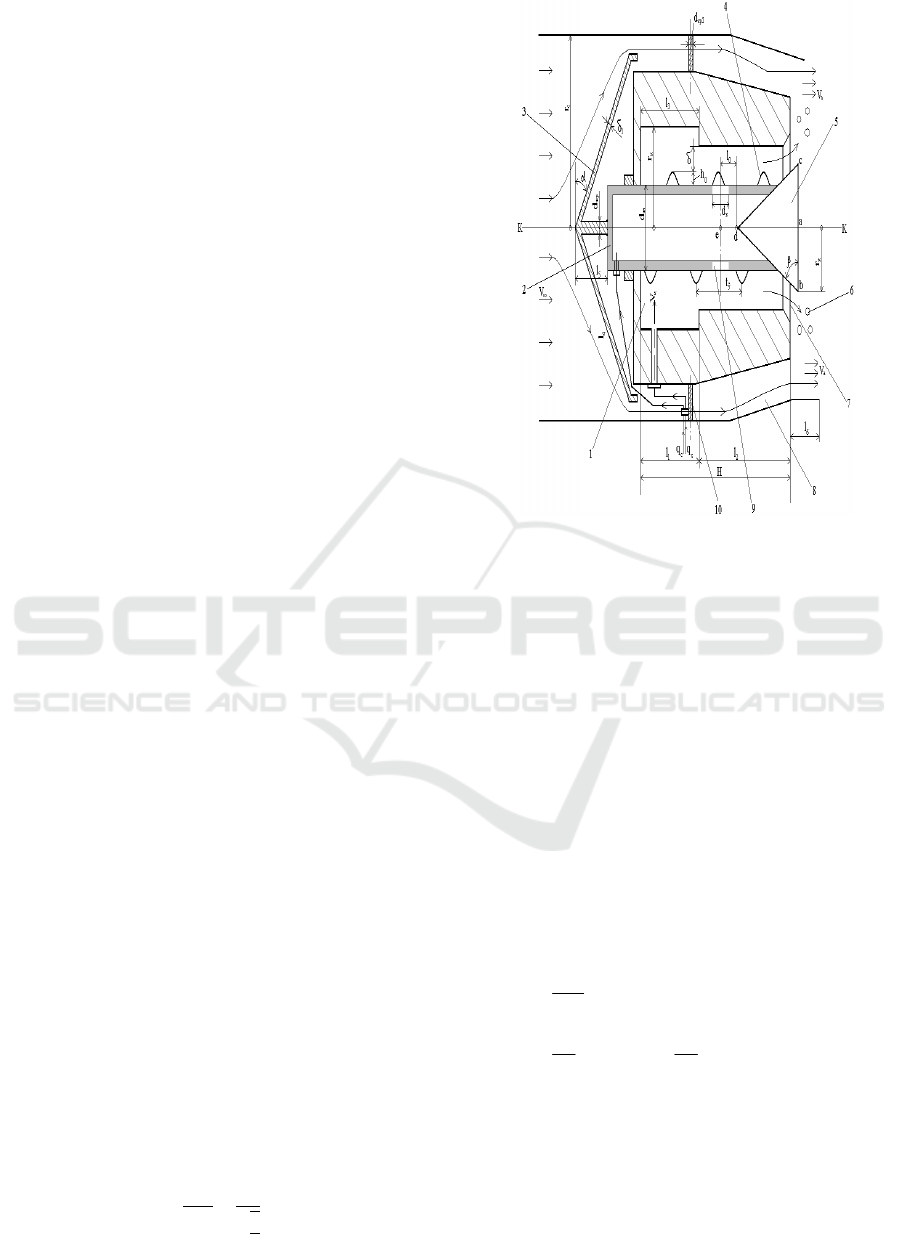
We use the M2:1 scale to design a schematic for
installing a cavitation device (Irisov & Bekmurodov,
2023; Irisov and Khamidov, 2023; Saidova et al.,
2024) on a fan spray nozzle, which creates a thin film
of liquid that is ejected from the nozzle's annular slit
to produce highly dispersed droplets (Figure 1).
The design stage consists of:
We transfer the symmetry of the axis equal to "k-
k" passing through the center of the spray nozzle and
select the point "a" from it.
We create points "c" and "b" by passing horizontal
lines from point "a". Let's define the distance between
these points. From the constructive side, "ac" and
"ab" are equal to rk. Therefore, we can find the
diameter of the base of the conical expander that
expands the liquid droplet flow from the following
expression (𝑎 =10 𝑚𝑚;𝛽 = 45
):
𝑑
=2𝑟
=2
𝑎
𝑡𝑔𝛼
=
10
2
2
= 15 𝑚𝑚
Figure 1: Designing the scheme of placement of the
Caviator device on the fan spray nozzle: 1 – feeding
chamber; 2 – central tube; 3.5 – current expanders; 4 –
spiral deflector-turbulizer; 6 – small drops; 7.8 – nozzle; 9
– capillary channel; 10 – bracket.
We pass the beam 45
0
below the point "b" and find
the point d, which defines the third part of the conical
expander.
We determine the point "e", which is 6 mm from
the point "d", where the axial symmetry of the
capillary channel passes, in which from the structural
side
We accept equal to
мммммkpммkмму
ммммoммk
dddt
hd
14;4;40;2...5,1
;0,2...5,1;2;4...3
2
====
===
δ
We determine the inner diameter of the feeding
chamber in the following proportions:
or
.112,104
2
14
)6...3(
2
14
,
2
ммк
м
к
d
d
d
≈=+=+=
Δ+=
As the fluid consumption decreases, it is
recommended to take the value of
Δ as low as
possible. Otherwise, the process of crushing the drops
coming out of the caviar nozzle will be much more
difficult.
Designing of the Cavities Device Circuit for Installation in Canal of Fan Sprayer
149
The number of spiral windings in the deflector-
turbulizer should not be less than 2..3 on the upper
and lower sides of the capillary channel 9. Too few or
too many packages can adversely affect the stability
of the worker being transferred.
A conical flow expander 3 is poured on the
windward side of the cavity. It allows the flow of air
transmitted by the fan to surround the caviar without
great resistance, and the small liquid drops ejected
from the caviar nozzle 7 can mix deeper with the air
flowing around the spray nozzle and deliver them to
a longer distance, thus increasing the technical
efficiency of the working fluid used.
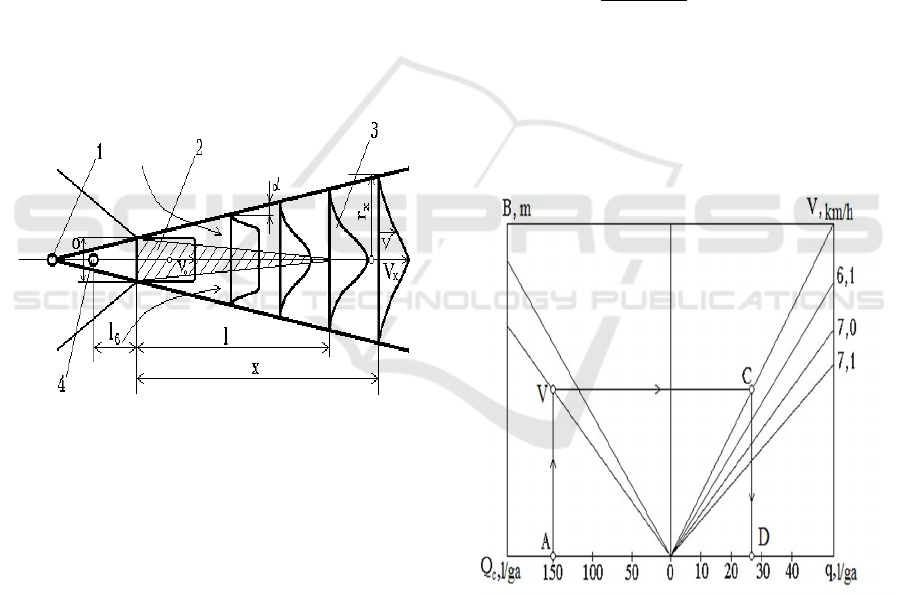
The second way to deliver liquid droplets to a long
distance is to install the cavity nozzle 7 at an optimal
distance of 16 from the fan nozzle 8. Because the
initial velocity vo of the air to the triangular core of
the turbulent air flow from the nozzle 8 (dashed in
Fig. 2) is constant and the length of the distance is
equal to е=0,335d/
η
- (where d is the diameter of the
core of the fan nozzle; d - turbulence coefficient
(fountains for ƞ=0.07...14).
Figure 2: Distribution scheme of the free air flow coming
out of the spray fan in the atmosphere: 1 – flow pole; 2 –
current core; 3 – transition section; 4 – the point where the
caviar nozzle is installed; d - nozzle diameter; v
о
– the initial
speed of the air leaving the nozzle; a – expansion angle; r
х
– the radius of the cross-section of the fountain at the
distance x from the nozzle; ƞ - turbulence coefficient.
3 RESULTS AND DISCUSSION
Velocity of air flow with liquid droplets in the axis of
symmetry of the section at distance "x" from the
nozzle:
),145,0//(48,0 += daxvv
ox
m/s (1)
Fan sprayer performance:
Q=sv
ўр
т
, m
3
/s; (2)
v
ўр
т
= (0,75...1,0) v
о
, m/s, (3)
where, s – is the cross-sectional area of the fan
nozzle, m
2
;
v
aver
– the average speed of the air coming out of
the nozzle, m/s.
Moving away from the axis, the speed v
о
decreases and becomes zero at its extreme point. The
air velocity vx at any cross-section of the main part
located in the core of the flow is zero at the flow limit
(distance R
x
), decreasing as it moves away from the
fan nozzle.
Fluid flow rate that should flow out of the сaviator
device every minute:
600
* nBvQ
q
c
c
=
, l/min
(4)
where В – is the coverage width of the aggregate
during processing, m; v – unit speed, km/h; n – the
number of cavities installed in the nozzle, pcs.
Working fluid consumption qc can also be
determined using a nomogram (Figure 3).
Figure 3: Nomogram for determining the required amount
of working fluid.
For it, the fluid consumption Q
c
given from the
nomogram is selected and the quantity q located on
the abscissa axis along the arrow A→V→S→D is
found. If q<50 l/ha, the eye of the side capillary
channels in the central tube is adjusted closer to the
nozzle 7 and the liquid consumption is reduced, if
q>50 l/ha, on the contrary, the eye of the side
I-CRAFT 2024 - 4th International Conference on Research of Agricultural and Food Technologies
150

capillary channels is pushed into the cavity of the
condensing chamber 1 and the liquid consumption is
increased. It is also possible to use the central tube,
which corresponds to the cavity of the side capillary
channel.
Both high-dispersed and polydispersed drops are
formed from the recommended carrier systems and
have universal properties. And traditional zasitkikh
systems do not have such an opportunity.
At the end of the design, the main contour lines of
the cavity device and the fan nozzle are drawn in dark
color
.
4 CONCLUSIONS
The use of the correction system of Caviator devices
allows obtaining both highly dispersed and
polydispersed droplets in a given spray unit itself.
The treatment system of the Caviator devices can
also be used as boom sprayers.
The above-mentioned expressions and design
allow to choose the most optimal constructions of
caviators, to justify their main parameters and
operating modes
.
REFERENCES
Akhmetov, A.A., Mirzaev, B.S., 2018. Technical means for
chemical plant protection (Tashkent).
Alimova, F.A., Primkulov, B.Sh., Saidova, M.T., &
Boboniyozov, E.A., 2022. Combined aggregate for
strip tillage and simultaneous sowing of re-crops. IOP
Conference Series: Earth and Environmental Science,
1112, 012021. https://doi.org/10.1088/1755-
1315/1112/1/012021
Derksen, R.C., 1994. Hydraulic nozzles for boom sprayers.
NRAES, p. 6.
Djiyanov, M., Tadjibekova, I., Temirkulova, N., 2022.
Development of models for functioning of a universal
service center in agriculture of Uzbekistan. IOP
Conference Series: Earth and Environmental Science,
1068, 012004. DOI: 10.1088/1755-
1315/1068/1/012004.
Djiyanov, M., Xalilov, R., Isakova, F., 2024. Justification
of commercialization of export-oriented harvesting
apparatus for intensive processing of cotton boxes. BIO
Web of Conferences, 85, 01034.
https://doi.org/10.1051/bioconf/20248501034.
Eshpulatov, N., Khalmuradov, T., Khalilov, R., Nurmanov,
S., Omonov, D., 2021. Theoretical substantiation of the
influence of electric pulse processing on the process of
obtaining juice from grapes and fruits. E3S Web of
Conferences, 264, 04086.
https://doi.org/10.1051/e3sconf/202126404086.
Farmonov, E., Lakaev, Sh., Khalilov, R., & Gorlova, I.,
2020. Aeromechanical purification of freshly harvested
seed heaps of desert fodder plants. IOP Conference
Series: Materials Science and Engineering, 883,
012097. DOI: 10.1088/1757-899X/883/1/012097.
Irisov, Kh.D., Bekmurodov, I. R., 2023. Theoretical aspects
of substantiating the parameters of the working body of
an environmentally comfortable spraying unit. IOP
Conference Series: Earth and Environmental Science,
1284, 012041. DOI: 10.1088/1755-
1315/1284/1/012041.
Irisov, Kh., Khamidov, G., 2023. Formation of highly
dispersed droplets with harmless effect on the
environment and the results of their mathematical and
statistical processing. E3S Web of Conferences, 386,
03003. https://doi.org/10.1051/e3sconf/202338603003.
Jobnson, M.P., Swetnam, L.D., 2000. Sprayer nozzles:
selection and calibration. University of Kentucky. – Pat
3. – p. 6.
Khaliknazarov, U., Akbarov, D., Tursunov, A., Gafforov,
S., & Abdunabiev, D., 2021. Existing problems of
drying cocoon and making chrysalis feeble, and their
solutions. IOP Conference Series: Earth and
Environmental Science, 939, 012020. DOI:
10.1088/1755-1315/939/1/012020.
Khaliknazarov, U., Ibrokhimov, U., 2024. Design of a
water pump-solar source system for drinking water
supply. BIO Web of Conferences, 85, 01004.
https://doi.org/10.1051/bioconf/20248501004.
Khudayorov, Z., Khalilov, R., Gorlova, I., Mirzakhodjaev,
S., & Mambetsheripova, A., 2023a. Mathematical
model of water drop trajectory in artificial rainfall. E3S
Web of Conferences, 365, 04011.
https://doi.org/10.1051/e3sconf/202336504011.
Khudayorov, Z., et al., 2023b. Deflector nozzles of rain
irrigation machines. E3S Web of Conferences, 390,
01033. https://doi.org/10.1051/e3sconf/202339001033.
Matchanov, R., Rizayev, A., Astanakulov, K., Tolibaev, A.,
Karimov, N., 2021. Combined cotton picker with
interchangeable devices. IOP Conf. Series: Earth and
Environmental Science IOP Conference Series: Earth
and Environmental Science, 677, 1–6. DOI:
10.1088/1755-1315/677/5/052021.
Matchanov, R.D., 2016. Plant protection in the system
culture-pest-drug-machine (Tashkent)
Matmurodov, F., Dustkulov, A., & Abdiyev, N., 2020.
Mathematical simulation of transfer mechanisms of
crocheting potato harvesting machine. IOP Conference
Series: Materials Science and Engineering, 883,
012176. DOI: 10.1088/1757-899X/883/1/012176.
Podgornyj, Yu.I., Skeeba, V.Yu., Kirillov, A.V.,
Maksimchuk, O.V., Lobanov, D.V., & Martyushev,
N.V., 2021. Algorithm for the cams synthesis for the
slay mechanism drive. Journal of Physics: Conference
Series, 2061, 012039. DOI: 10.1088/1742-
6596/2061/1/012039
Saidova, M., Tursunbaev, S., Boltaeva, M., & Isakulova,
N., 2024. Comparison of pneumatic sowing machines
by the number of seeds in the slots of the discs and the
distance between the slots. BIO Web of Conferences,
Designing of the Cavities Device Circuit for Installation in Canal of Fan Sprayer
151

105, 01004.
https://doi.org/10.1051/bioconf/202410501004.
Sudit, J.M., 1973. Research and development of a
methodology for designing the spraying bodies of field
sprayers. Dissertation (Moscow: Agropromizdat).
Usenov, A.B., et al., 2021. Study of cellulose extraction and
cavitation from plant raw materials. IOP Conference
Series: Earth and Environmental Science, 868, 012047.
DOI: 10.1088/1755-1315/1112/1/012148.
I-CRAFT 2024 - 4th International Conference on Research of Agricultural and Food Technologies
152
