
Assessment of the Degree of Activity of Abrasive Particules in the of
Machine Components Involved in the Wear Process
Khikmat Ishmuratov
1a
, Madrakhim Allanazarov
2b
and Tolib Khalmuradov
2c
1
Tashkent State Technical University named after Islam Karimov, Tashkent, Uzbekistan
2
Tashkent State Agrarian University, Tashkent, 100140, Uzbekistan
Keywords: Abrasive Particles, Wear Process, Oil Replacement.
Abstract: This article considers the regularities of abrasive particles activity changing in the oil of machine units, which
take part in the process of gear-wheel wear at constant and increasing concentration varying with the number
of loading cycles of gear teeth, considering the share of crushed abrasive particles in one loading cycle of the
gearing which is used to determine the oil replacement time in the machine unit.
1 INTRODUCTION
One of the factors that most significantly affect the
results of calculation and experimental determination
of the wear resistance of gear materials is the degree
of activity of abrasive particles in the oil of machinery
transmission units.
In the process of friction for each cycle of loading
of gear teeth, the concentration of active abrasive
particles in the oil of the machine constantly changes.
It occurs because of crushing of abrasive particles,
being in oil of the aggregate and entering of a fresh
portion from environment (Ishmuratov, 2019;
Mirzaev et al., 2019; Mamatov et al., 2021;
Mirzakhodjaev et al., 2021; Khudayorov et al., 2023;
Khudayorov, et al., 2023; Khudayorov,et al., 2023;
Mirzakhodjaev et al., 2024; Mirzakhodjaev et al.,
2024). Therefore, when assessing the wear resistance
of gear teeth and the oil change period in the units it
is necessary to consider the regularities of abrasive
particles activity change in the process of oil
circulation. Analysis of the state of the matter in
question showed that in the literature this issue is not
sufficiently covered, mainly limited to the study of
the process of crushing abrasive particles located in
the contact zone of gear teeth (Ishmuratov et al.,
2020; Djiyanov et al., 2022; Astanakulov et al., 2023;
a
https://orcid.org/0009-0008-2266-0372
b
https://orcid.org/0009-0009-3602-4841
c
https://orcid.org/0000-0002-3704-8361
Djiyanov et al., 2024; Djiyanov et al., 2024; Isakova
et al., 2024; Irisov et al., 2024).
The purpose of this work is to obtain
computational dependences for estimating the
activity of abrasive particles, at their constant and
increasing concentrations.
2 MATERIALS AND METHODS
In heavily loaded gears, the load falling on the
abrasive particles in the wedge-shaped gap of gear
teeth, in most cases exceeds their compressive
strength, as a result of which these particles are
subjected to crushing (Zhigaev, 1971; Melnikov,
1999). Because according to (Mirzakhodjaev et al.,
2024) the coefficient of re-crushing of abrasive
particles equal to 7, after crushing process, the size of
crushed abrasive particles should not exceed:
da<Rz+h
0
, m, (1)
where R
z
is the roughness height of the friction
surfaces of the gear teeth, m; h0 is the thickness of the
oil film between the friction surfaces of the gear teeth,
m.
In the process of gear teeth wear, abrasive
particles of the size corresponding to expression (1)
128
Ishmuratov, K., Allanazarov, M. and Khalmuradov, T.
Assessment of the Degree of Activity of Abrasive Particules in the of Machine Components Involved in the Wear Process.
DOI: 10.5220/0014223100004738
Paper published under CC license (CC BY-NC-ND 4.0)
In Proceedings of the 4th International Conference on Research of Agricultural and Food Technologies (I-CRAFT 2024), pages 128-131
ISBN: 978-989-758-773-3; ISSN: 3051-7710
Proceedings Copyright © 2025 by SCITEPRESS – Science and Technology Publications, Lda.

do not come into force interaction with friction
surfaces, and wear from their influence does not
occur.
The total concentration of abrasive particles in the
oil of the unit can be constant and increasing in time,
because of their penetration from the environment.
Let us see how the abrasive particles activity changes
for these cases.
3 RESULTS AND DISCUSSION
The total concentration of abrasive particles in the oil
is constant, its value in time remains constant, i.e., no
new portions of abrasive particles enter the oil from
the outside. This variant is characteristic for testing of
roller samples of cogwheels for wear resistance on the
friction machine MI-1M. The size of abrasive
particles used for wear testing should be greater than
the sum of the roughness height and oil film thickness
(exceeding 4 microns). In this case, the initial
concentration of abrasive particles in the unit oil was
taken equal to their total concentration (ε
max
).
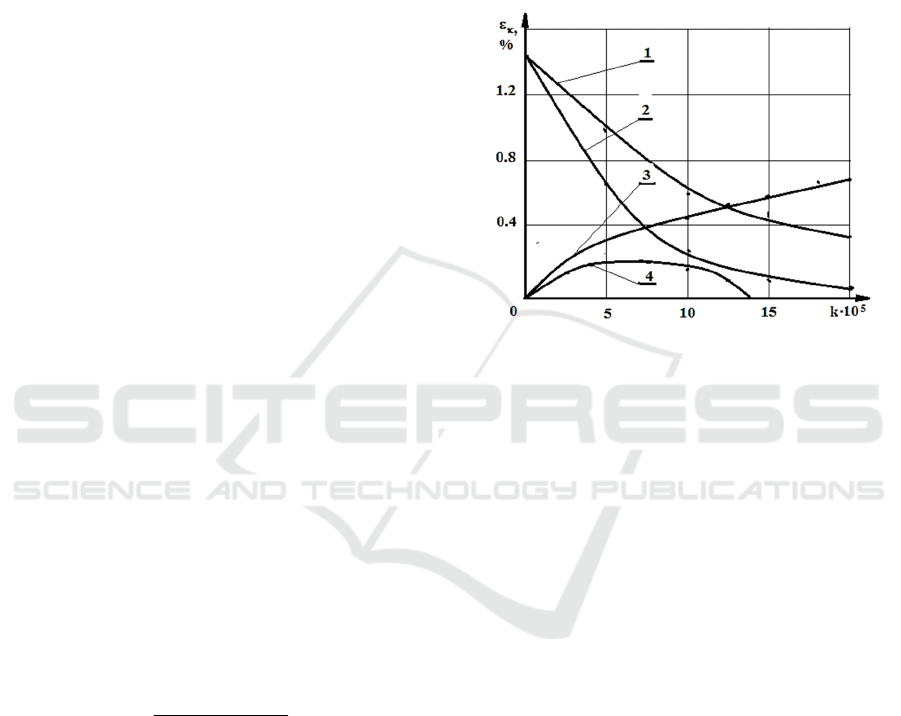
At crushing of active abrasive particles,
depending on number of loading cycles, their
concentration decreases (fig.1, graphs 1, 2). Let us
consider changes of abrasive particles activity in the
process of wear resistance test, after each loading
cycle. Loading cycle is one complete revolution of a
spherical toothed wheel specimen, which is dipped
into oil containing abrasive particles of spherical
shape (Irgashev et al., 2021; Ishmuratov et al., 2023).
After the first load cycle:
The concentration of crushed abrasive particles,
1max1d
A
εε
=
, (2)
where A
1
is a coefficient taking into account the
share of crushed abrasive particles for one cycle of
loading, at constant total concentration of abrasive
particles in oil. For calculation of A1 value the
dependence is offered (Djiyanov et al., 2024b),
1
.
2
cp m
mt
Rld
A
G
π
γ
=
, (3)
here R - radius of curvature of sample,
surrounding in oil, m; dcp - average size of abrasive
particles, participating in wear process, m; 1 - contact
length of samples, m; γ
m
- oil density, kg/m
3
; Gm.t -
amount of oil, poured into friction machine tank at
test on wear resistance of samples, made of cogwheel
material, kg,
concentration of active abrasive particles in the
friction machine oil after the first loading cycle,
1max 1
(1 )
A
εε
=−
.
After the second loading cycle:
The concentration of crushed abrasive particles,
211max 1
(1 )
d
A
A
εε ε
== −
;
concentration of active abrasive particles,
2
212 max1 1 max 1
(1 ) (1 )
d
A
AA
εεε ε ε
=− = − = −
Similarly, after k loading cycles:
The concentration of crushed abrasive particles,
1
11 max 1 1
(1 )
k
kd k
AAA
εε ε
−
−
== −
, (4)
concentration of active abrasive particles,
max 1
(1 ) .
k
k
A
εε
=−
(5)
The obtained analytical dependencies show that at
constant total concentration of abrasive particles,
which are in oil, increase of abrasive particles size,
radius of curvature and width of contact of samples,
made of toothed wheels material, dipped in oils in the
friction machine tub, leads to growth of their crushing
intensity. This is explained by the fact that increasing
the radius of curvature leads to a narrowing of the
wedge-shaped gap between the samples of the friction
process, leading to an increase in the contact area
between the surfaces of samples and abrasive
particles, due to which, increases the number of
adhered and crushed abrasive particles on the contact
surfaces of friction (Akhmetov et al., 2021;
Zhanikulov et al., 2022; Akhmetov et al., 2023).
The received analytical dependences show that at
constant total concentration of the abrasive particles
being in oil, the increase in size of abrasive particles,
radius of curvature and width of contact of the
samples made of gear wheel material dipped in oils in
the bath of friction machine leads to increase in
intensity of their crushing. This is explained by the
fact that increasing the radius of curvature leads to a
narrowing of the wedge-shaped gap between the
samples occurring in the friction process, leading to
an increase in the contact area between the surfaces
Assessment of the Degree of Activity of Abrasive Particules in the of Machine Components Involved in the Wear Process
129
of samples and abrasive particles, thereby increasing
the number of adhered and crushed abrasive particles
on the contact surfaces of friction.
2. The initial concentration of abrasive particles in
the oil of the unit is zero; it increases with increasing
number of loading cycles of the driven gear (fig. 1,
graphs 3, 4). This case corresponds to the real
operating conditions of the gear transmission in the
unit.
Let us assume that tightness of crankcase and
dustiness of environment during exploitation of
machines remain constant. As a result, penetrated
abrasive particles from the environment are subjected
to crushing and the concentration of active abrasive
particles in the machine oil changes constantly during
each load cycle (Akhmetov et al., 2023).
After the first loading cycle of the gear wheel:
concentration of crushed abrasive particles,
1
0
d
ε
=
,
concentration of active abrasive particles,
1 z
εδ
=
,
where is the number of active abrasive particles
entering the unit oil during one cycle of the driven
gear loading, % rev.
After the second cycle of gear wheel loading:
concentration of crushed abrasive particles is,
2dz
B
εδ
=
where B - the coefficient taking into account the
share of crushed abrasive particles at their arrival
from the environment, corresponding to the operating
conditions of machine units,
1
2
cp m p
m
nmd L k
B
G
γ
=
(6)
here n
1
- the number of gear pairs in the unit,
dipping in oil; m - meshing module, m; L - gear tooth
length, m; G
m
- quantity of oil in the unit, kg; k
p
-
coefficient taking into account the heterogeneity of
abrasive particles size that penetrate into the unit,
depending on the dusty environment and abrasive
particle size value in the oil k
p
= 0,40 - 0,65,
2
2(2)
zz z
BB
εδδδ
=−= −
Similarly, after k1 cycles of gear wheel loading:
concentration of crushed abrasive particles,
1
1
(1)
kd z
Bk
εδ
=−
(7)
concentration of active abrasive particles
1
111
((1))
kzkdz
kkBk
εδεδ
=−= − −
(8)
Figure 1: Change of concentration of active abrasive
particles in aggregate oil from the meshing module and
number of cycles of loading: 1, 2 - total concentration of
abrasive particles in oil is constant; 3, 4 - the initial
concentration of abrasive particles in aggregate oil is equal
to zero and changing for each cycle of loading, 1, 3 – m =
0,010 m; 2, 4 – m = 0,015 m
Graphical dependencies presented in Fig. 1,
obtained from expression (6 and 8) graphs 3, 4,
constructed at: n
1
=2; d
cp
=0,000012 m; L=0,058 m; γ
m
= 910 kg/m
3
; k
p
=0,5; G
m
=20 kg; δ
z
=0,65 10
-6
%/rev
show, that if initial concentration of abrasive particles
in oil is zero, with increase of loading cycles
concentration of crushed abrasive particles gradually
increases, after its value reaches some critical value,
it slightly decreases. This can be explained by the
excessive amount of crushed abrasive particles in the
oil of the unit compared to the abrasive particles
coming into the unit from the environment.
4 CONCLUSIONS
Thus, the obtained expressions for determining the
activity of abrasive particles (9) make it possible to
calculate:
1. durations of wear testing of gear wheel material
on samples at a constant total concentration of
abrasive particles in the oil;
I-CRAFT 2024 - 4th International Conference on Research of Agricultural and Food Technologies
130

2. the period of oil replacement of units of
machines with toothed gears, working in the presence
of abrasive particles in the working environment
REFERENCES
Akhmetov, A.A., Akhmedov, Sh.А., Allanazarov, M.A.,
Asamov, R.H. 2023, IOP Conference Series: Earth and
Environmental Science, 1138(1), 012047
doi:10.1088/1755-1315/1138/1/012047
Akhmetov, A.A., Allanazarov, M.A., Muratov, L.B.,
Kambarova, D.U. 2021, IOP Conference Series: Earth
and Environmental Science, 868(1), 012075.
Astanakulov, K., Kurbonov, F., Isakova, F. 2023, E3S Web
of Conferences, 381, 01001
https://doi.org/10.1051/e3sconf/202338101001
Djiyanov, M., Tadjibekova, I., Temirkulova, N. 2022, IOP
Conference Series: Earth and Environmental Science,
1068(1), 012004 doi:10.1088/1755-
1315/1068/1/012004
Djiyanov, M., Tadjibekova, I., Temirkulova, N.,
Kholmuradov, O. 2024, Lecture Notes in Networks and
Systems, 733, 565–571
Djiyanov, M., Xalilov, R., Isakova, F. 2024, BIO Web of
Conferences, 85, 01034
https://doi.org/10.1051/bioconf/20248501034
Irgashev, Kh K Ishmuratov, M A Allanazarov, K Kh
Ishmuratova. Assessment of ambient dust limit of open
gear of cotton harvester. IOP Conf. Series: Earth and
Environmental Science 868 (2021) 012068 рр.1-12.
doi:10.1088/1755-1315/868/1/0120686.
Irisov, K., Gorlova, I., Khudaev, I. 2024, BIO Web of
Conferences, 105, 01016
https://doi.org/10.1051/bioconf/202410501016
Isakova, F., Tadjibekova, I., Kurbonov, F. 2024, BIO Web
of Conferences, 85, 01037
https://doi.org/10.1051/bioconf/20248501037
Ishmuratov H K, Irgashev B A. Assessment of the Wear
Resistance for Gearwheel Teeth in an Open Toothed
Gear under the Conditions of a High Level of Dust.
Journal of Friction and Wear. Volume 41, Issue 1,
January 1, 2020, Pages 85-90.
Ishmuratov Kh K 2019 Dissertation of the degree of Doctor
of Philosophy in Technical Sciences (PhD) 156.
Kh. K. Ishmuratov, Mirzaev N.N., Abdullaeva B.,
Mamasalieva M.I. Energy analysis of wear sliding
friction units. E3S Web of Conferences 383, 04019
(2023)
https://doi.org/10.1051/e3sconf/202338304019.
Khudayorov, Z., Khalilov, R., Gorlova, I., Mirzakhodjaev,
S., Mambetsheripova, A. 2023, E3S Web of
Conferences, 365, 04011
https://doi.org/10.1051/e3sconf/202336504011
Khudayorov, Z., Khalilov, R., Mirzakhodjaev, S.,
Nurmikhamedov, B., Mamasov, S. 2023, E3S Web of
Conferences, 376, 02013
https://doi.org/10.1051/e3sconf/202337602013
Khudayorov, Z., Mirzakhodjaev, S., Khalilov, R.,
Nurmikhamedov, B., Mamasov, S. 2023, E3S Web of
Conferences., 390, 01033
https://doi.org/10.1051/e3sconf/202339001033
Mamatov, F., Mirzaev, B., Mirzahodzhaev, S., Uzakov, Z.,
Choriyeva, D. 2021, IOP Conference Series: Materials
Science and Engineering, 1030(1), 012164 DOI:
10.1088/1757-899x/1030/1/012164
Melnikov V Z. Increased bearing capacity and wear
resistance of gears. Tractors and agricultural machines.
1999. №2
Mirzaev, B., Mamatov, F., Ergashev, I., Kodirov, U.,
Ergashev, G. 2019, E3S Web of Conferences, 135,
01065 https://doi.org/10.1051/e3sconf/201913501065
Mirzakhodjaev, S., Djiyanov, M., Nurmikhamedov, B.,
Mamasov, S. 2024, BIO Web of Conferences, 85,
01035 https://doi.org/10.1051/bioconf/20248501035
Mirzakhodjaev, S., Shodiev, K., Uralov, G., Badalov, S.,
Choriyeva, D. 2021, E3S Web of Conferences, 264,
04047 https://doi.org/10.1051/e3sconf/202126404047
Mirzakhodjaev, S., Utaganov, K., Musurmonov, A. 2024,
BIO Web of Conferences, 85, 01036
https://doi.org/10.1051/bioconf/20248501036
Zhanikulov, S., Khalmuradov, T., Allanazarov, M. 2022,
IOP Conference Series: Earth and Environmental
Science, 1112(1), 012015 DOI 10.1088/1755-
1315/1112/1/012015
Zhigaev V D. Durability of quartz sand grains. 1971. №1.
С. 101-105.
Assessment of the Degree of Activity of Abrasive Particules in the of Machine Components Involved in the Wear Process
131
