
The Influence of Suspension Plough Support Wheel Diameter and
Width on Its Performance Indicators
Abdusalim Tukhtakuziev
1a
, Abdurakhmon Rasuljonov
1b
, Sherzod Barlibaev
2c
,
Dilfuza Karimova
3d
and Madina Turdiyeva
3e
1
Scientific-Research Institute of Agricultural Mechanization, Samarkand str. 41, Yangiyul dis., Tashkent reg., Uzbekistan
2
Tashkent Institute of Irrigation and Agricultural Mechanization Engineers, National Research University,
K. Niyazi str. 39, Tashkent, Uzbekistan
3
Andijan Institute of Agriculture and Agrotechnology Oliygoh str. 1, Kuyganyor, Andijan, Uzbekistan
Keywords: Support Wheel, Plough Performance, Depth Stability.
Abstract: The article presents the results of theoretical and experimental studies conducted on the study of the influence
of the diameter and width of the support wheel of the suspension plough on the driving depth and its stability,
and on the basis of this, to determine their optimal values. In theoretical studies, it was noted that the stability
of the driving depth at the level of requirements is mainly ensured by the correct choice of the diameter of the
plough support wheel and the width of it, and for a three-body suspension plug, their value is not less than 35
and 16 cm, respectively. In order to verify these obtained results, we prepared a three-body suspension plough
and conducted experimental studies using it. For conducting experimental studies, the base wheels with the
diameter and the width of the beam at 5 cm intervals from 30 cm to 50 cm and from 10 cm to 30 cm,
respectively, were prepared. In experimental studies, the influence of the diameter of the plough support wheel
and the width of its furrow, the driving depth, its mean square deviation, the vertical pressure force exerted
by the support wheel on the soil, and the plow's traction resistance were studied. In order to reduce the
influence of various variable factors on the obtained results, the experiments were carried out on specially
prepared agro-funds, that is, they were first plowed, then leveled and fully irrigated. Based on the results of
experimental studies, the following can be noted: in order for the plough to work stably at the specified depth,
the diameter of the support wheel should be at least 40 cm, and the width of the rim should be at least 20 cm.
These results fully correspond to the results of theoretical studies.
1 INTRODUCTION
It is known that the depth of cultivation and its
stability are the main performance indicators of all
soil tillage machines. If the tillage depth is at the
required level and its stability is ensured, i.e. it is
uniform development and ripening of crops and a
high yield will be achieved, otherwise, crops will
develop and ripen unevenly, productivity will
decrease. This situation has been proven in many
studies conducted in Uzbekistan and foreign
countries. For this reason, there are strict
a
https://orcid.org/0009-0003-4950-4840
b
https://orcid.org/0000-0003-4669-9526
c
https://orcid.org/0009-0004-5991-7425
d
https://orcid.org/0009-0007-5214-000X
e
https://orcid.org/0000-0008-1033-1247
requirements and restrictions on the depth of
cultivation and its deviation from the specified for
each tillage machine (Tukhtakuziev & Rasuljonov,
2020a; Tukhtakuziev & Rasuljonov, 2020b;
Turdaliev et al., 2022; Djurayev et al., 2022).
The depth of tillage and its stability and impact on
the development and productivity of cotton and grain
crops have been studied. It was noted by them that the
change of the tillage depth from the set acceptable
value to one side or the other will lead to a 12-15
percent decrease in crop yield (Norchayev et al.,
116
Tukhtakuziev, A., Rasuljonov, A., Barlibaev, S., Karimova, D. and Turdiyeva, M.
The Influence of Suspension Plough Support Wheel Diameter and Width on Its Performance Indicators.
DOI: 10.5220/0014072700004738
Paper published under CC license (CC BY-NC-ND 4.0)
In Proceedings of the 4th International Conference on Research of Agricultural and Food Technologies (I-CRAFT 2024), pages 116-122
ISBN: 978-989-758-773-3; ISSN: 3051-7710
Proceedings Copyright © 2025 by SCITEPRESS – Science and Technology Publications, Lda.
2021; Mukhamedov et al., 2020; Umurzakov et al.,
2022; Tukhtakuziev et al., 2023).
The above indicates that it is an important issue to
ensure that the tillage depth of soil tillage machines is
uniform at the required level.
This article presents the results of theoretical and
experimental studies on the influence of the diameter
and width of the suspension plough support wheel on
the stability of the plowing depth, and based on this,
their optimal values that ensure the evenness of the
plowing depth are at the required level.
2 MATERIALS AND METHODS
It is known from the literature (Sineokov & Panov,
1977; Mamatov, 2007; Norchayev et al., 2021;
Norchayev et al., 2022; Saidova et al., 2024) that the
following condition must be met for the suspension
plough to sink to a specified depth and to run stably
(uniformly) at this depth:
Q
Z
=Q
M
(1)
Where Q
Z
- vertical pressure force applied to the
soil by the support wheel of the plough, kN;
Q
M
- the optimal value of the vertical pressure
force applied to the soil by the support wheel of the
plough, which ensures the stability of the working
(plowing) depth, kN.
when the condition (1) Q
Z
<Q
M
is met, the base
wheel of the plough is constantly pressed against the
field surface, as a result, the plough sinks to the
specified depth and works without changing the
plowing depth.
Q
Z
>Q
M
otherwise, the support wheel
of the plough cannot adequately adjust to the
unevenness of the field surface, and too much energy
is spent pulling the plough
When the condition (1) is fulfilled, the change of
plough plowing depth during the working process is
mainly due to the change of the depth of immersion
of the support wheel into the soil. Based on this, we
will study the depth of immersion of the plough
support wheel into the soil during the work process.
In this case, we consider that the supporting wheel of
the plough is rigidly knotted, that is, it does not
deform.
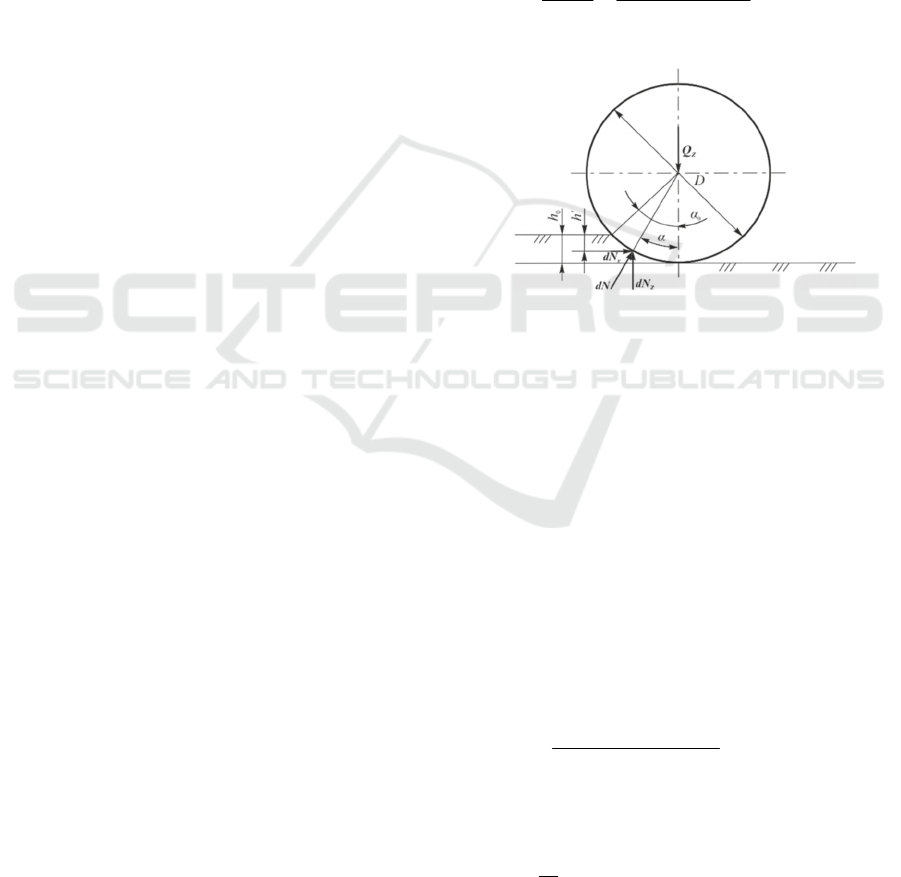
Let the support wheel of the plough move along
the field and create a track at the depth h0 (Fig. 1).
We separate the elementary surface dS=Bтdl (where
Вт is the width of the plough base wheel, m; dl - the
elemental cross-section separated from the plough
base wheel, m) from the part of the base wheel axle
in interaction with the soil. The elementary reaction
force of the soil acting on this surface is equal to:
m
dN pB dl=
, (2)
where p - relative pressure of the soil on the axis
of the plough support wheel, Pa;
As is known from the literature (Sharov, 1964;
Sablikov, 1968; Klenin & Sakun, 1994), the relative
pressure of the soil on the base wheel width, taking
into account the speed of the unit:
()
2
0
1
cos cos
п
m
qh kV
p
p
αα
′
+
==
(3)
Figure 1: The scheme for determining the depth of
immersion of the plough support wheel into the soil.
where p
m
- relative resistance of the soil to vertical
crushing, Pa;
q
0
- static volume compression coefficient of the
soil, N/m
3
;
h ‘- vertical deformation of the soil at the
considered point, m;
k
n
- proportionality coefficient, s
2
/m
2
;
α- the central angle determining the location of the
elemental surface separated from the part of the base
wheel bearing in contact with the ground relative to
the vertical diameter of the base wheel.
Taking into account expression (3), expression (2)
is written as follows:
()
2
0
1
cos
m п
qhB kV dl
dN
α
′
+
=
(4)
Based on the scheme in figure 1:
(5)
()
0
cos cos
2
D
h
αα
′
=−
The Influence of Suspension Plough Support Wheel Diameter and Width on Its Performance Indicators
117
(6)
where α
0
- the angle of the base wheel sinking
into the ground, °;
dα - elementary angle, °.
Taking expressions (5) and (6) into account,
expression (4) becomes:
()
()
22
00
1coscos
4cos
m п
qBD kV
dN d
αα
α
α
+−
=
(7)
divide into vertical and horizontal
components. The sum of the vertical
components is equal to the vertical
compressive force exerted by the supporting
wheel on the soil, i.e.:
()
()
0
22
00
0
1coscos
cos
4
m п
Z
qBD kV
QdN d
α
αα
α
α
+−
==
(8)
Integrating the right side of the expression (8),
we get the following result
()
()
22
0000
1sincos
4
m п
Z
qBD kV
Q
αα α
+−
=
(9)
From the schematic in Fig.1
(10)
(11)
(12)
Taking these expressions into account, expression
(9) becomes:
()
()
2
2
0
00
2
00 0
1
2
2 2 arcsin .
4
m п
Z
qB D kV
D
hh
QDhhDh
D
+
−
=−−−
(13)
Q
Z
=Q
M
= 3,5 kN (for a three-mouldboard
suspension plough) (Klenin & Sakun, 1994), q
0
=
1.75·107 N/m
3
(Mamatov, 2007), k
n
= 0.08 (Shiryaev,
1988) assuming V= for speeds of 6 and 9 km/h using
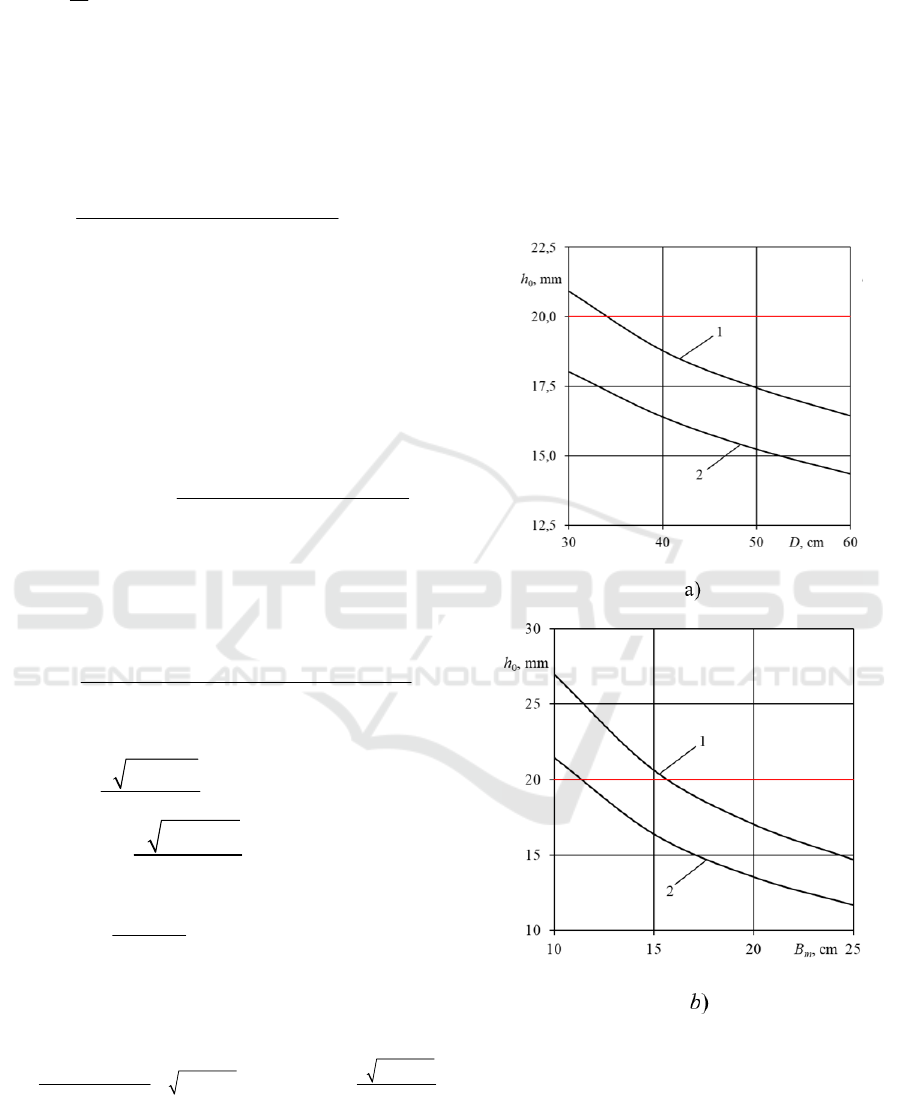
the numerical solution method according to the
expression (13), graphs of the change in the depth of
the plough support wheel into the soil h
0
were
constructed depending on D and B
m
(Fig. 2). It can be
seen from the obtained data that as the width and
diameter of the wheel width increased, the depth of
its immersion in the soil decreased, and therefore, the
actual working depth was closer to the specified
working depth.
Figure 2: 1, 2 - the speed of movement is 6 and 9 km/h,
respectively Graphs of the change of the depth of the plough
support wheel into the soil depending on its diameter (a)
and the width of the bridge (b).
2
D
dl d
α
=
dN
Z
dN
X
dN
Z
dN
Z
Q
2
00
0
2
sin
D
hh
D
α
−
=
2
00
0
2
arcsin
Dh h
D
α
−
=
0
0
2
cos
D
h
D
α
−
=
I-CRAFT 2024 - 4th International Conference on Research of Agricultural and Food Technologies
118
3 RESULTS AND DISCUSSION
The increase in speed from 6 km/h to 9 km/h also
reduced the ground contact depth of the main wheel.
According to existing agrotechnical requirements, the
deviation of plowing depth from the specified should
not exceed 2 cm. For this, the graphs presented in Fig.
2 show that the diameter of the plough support wheel
should not be less than 35 cm and the width of its
width should not be less than 16 cm.
Experimental studies were conducted in order to
verify the results obtained in the conducted
theoretical studies and to determine the influence of
the width and diameter of the plough support wheel
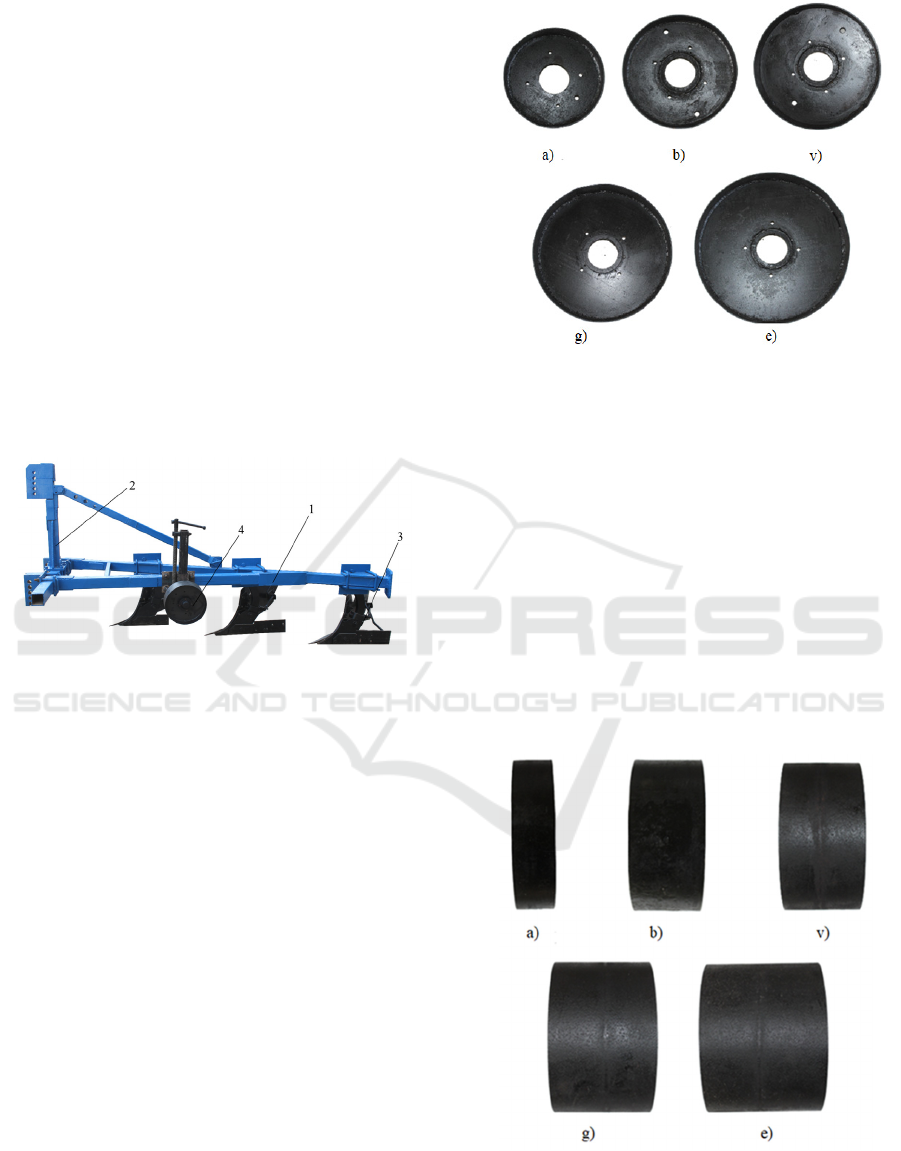
on its performance. In order to conduct experimental
studies, a three- mouldboard suspension plough was
developed in the "Soil Cultivation Machines"
laboratory of SRIAM to be aggregated with wheeled
tractors of class 3-4 (Fig. 3).
Figure 3: Overview of suspension plug. Frame 1; 2
nd
suspension device; 3
rd
corps; 4
th
base wheel
Experimental studies were carried out in agro
fund specially prepared to create the same working
conditions throughout the field, i.e. first plowed, then
leveled and thoroughly irrigated. The soil of the field
where the experiments were conducted is gray soil of
medium-heavy, slightly mechanical composition, and
underground water is located at a depth of 10-12 m.
Before conducting the experiments, the moisture,
density and hardness of the soil in layers of 0-10, 10-
20, 20-30 and 30-40 cm was defined according to
GOST 20915-11 “Testing of agricultural machinery.
Methods for determining test conditions” (GOST
20915-11, 2013). According to the obtained results,
in the 0-10-20, 20-30 and 30-40 cm layers, they are
15.7, 17.3, 18.1 and 18.9 percent, respectively, and
their hardness is 1.57, 3.19, 3.45 and 4.21 MPa and
the density was 1.33, 1.42, 1.57 and 1.61 g/cm
3
.
For conducting experimental studies, base wheels
with a diameter and a width of 5 cm at an interval of
30 cm to 50 cm and 10 cm to 30 cm were prepared
(Figures 4 and 5).
Figure 4: Support wheels with a diameter of 30 (a), 35 (b),
40 (v), 45 (g) and 50 (e) cm.
In the experiments, the plowing depth is 35 cm,
the vertical distance from the base plane of the
suspension plough to the lower suspension points and
the vertical distance between its upper and lower
suspension points are 80 cm and 90 cm, respectively,
the longitudinal distance from the edge of its first
mouldboard share to the axis of the supporting wheel
is 80 cm, and the aggregate speed of movement was
set at 6 and 9 km/h. The driving depth and its mean
square deviation, as well as the traction resistance of
the suspension plough and the vertical pressure force
exerted by the support wheel on the soil were taken
as the main indicators.
Figure 5: Support wheels with a diameter of 10 (a), 15 (b),
20 (v), 25 (g) and 30 (e) cm.
The Influence of Suspension Plough Support Wheel Diameter and Width on Its Performance Indicators
119
Plowing depth UzDSt 3355:2018 "Testing of
agricultural machinery. Machines and weapons for
deep tillage. Test program and methods" (GOST
20915-11, 2013). In this case, the plowing depth was
determined after each pass of the plough along the
edge formed by the final casing using an edge gauge.
For each option, 50 measurements were made in four
repetitions (twice in this direction, twice in this
direction). The measurement error was 0.5 cm.
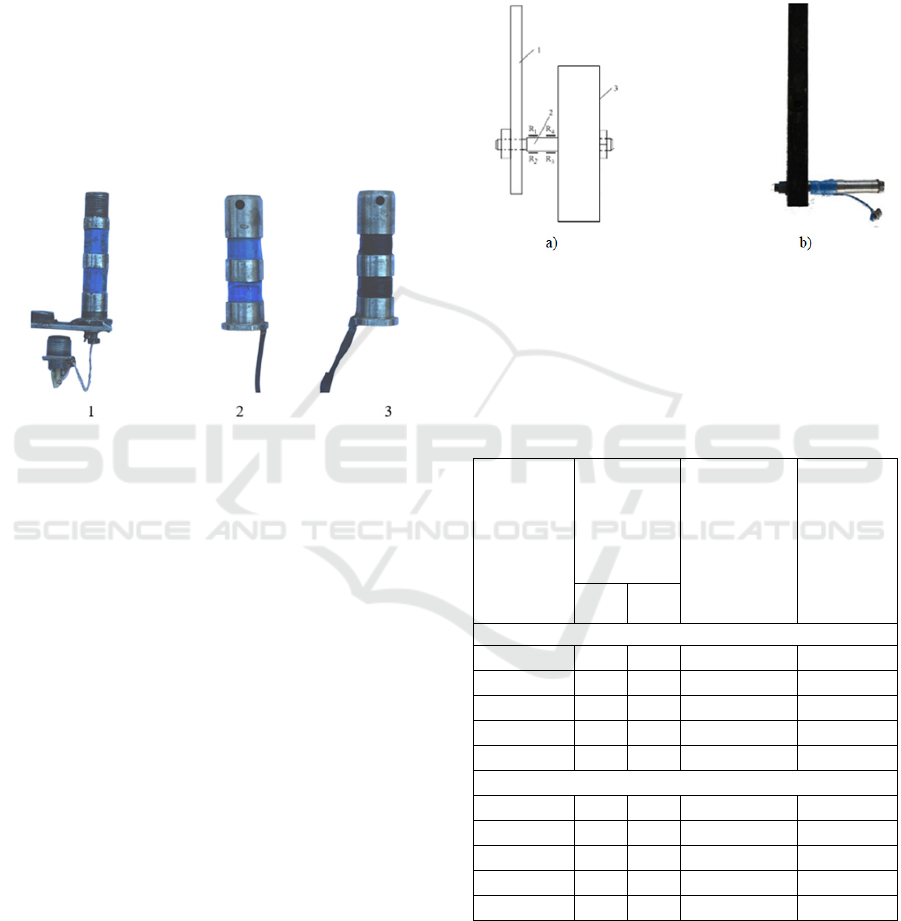
Plough tensile strength UzDSt 3193:2017
"Testing of agricultural machinery. It was determined
using tensometric fingers (Fig. 6) according to the
method of energy assessment of machines"
(Dospekhov, 1979; O‘zDSt 3193, 2017; O‘zDSt
3355, 2018; Alimova et al., 2023).
Figure 6: General view of the fingers.1
st
upper index finger;
2, 3 lower right and left tensofingers.
The vertical compressive force applied to the soil
by the support wheel was also determined using the
tensometry method. In this case, the axle with the
strain gauges glued was used (Fig. 7). During
tensometry, IP-238M measuring equipment was used
to record signals from strain gauges. Before and after
the experiments, the tension fingers and the bullet to
which the strain gauges were glued were calibrated.
The data obtained in the experimental studies were
processed by the methods of mathematical statistics
(O‘zDSt 3193, 2017) and the arithmetic mean values
and mean square deviations of the indicators were
determined. In experimental studies, the plough was
aggregated with a New Holland T 7060 tractor. The
results obtained in experimental studies are presented
in Tables 1 and 2.
From the results presented in Table 1, it can be
seen that the plowing depth and its mean square
deviation decreased with the increase in the diameter
of the plough support wheel. When the diameter of
the base wheel increased from 30 cm to 50 cm, the
plowing depth decreased from 35.8 cm to 35.1 cm and
from 35.7 cm to 34.9 cm at speeds of 6 and 8 km/h,
respectively, its root mean square deviation ±
Decreased from 1.24 cm to ± 1.06 cm and from ± 1.29
cm to ± 1.07 cm. The reason for this is that an increase
in the diameter of the support wheel leads to an
increase in the surface of its interaction with the soil,
and as a result, the depth of immersion of the support
wheel into the soil decreases. This causes the plowing
depth and its root mean square deviation to decrease
and match the target.
Figure 7: Tensometric axis installation scheme (a) and
general view (b) 1st column; 2
nd
strain gauge glued axis; 3
rd
base wheel.
Table 1: The plowing depth of the diameter of the
suspension plough support wheel and its root mean square
deviation, the vertical pressure force exerted by the support
wheel on the soil and its traction effect on resistance.
Diameter
of
suspension
plough
support
wheel, cm
Powing
depth and
its mean
square
deviation,
cm
Vertical
compressive
force exerted
by the
support
wheel on the
soil, kN
Pulling
resistance
of
suspension
plough,
kN
М
ўр
±σ
V=6km/h
30 35,8 1,24
3,73
28,7
35 35,5 1,13
3,62
28,1
40 35,3 1,10
3,54
27,7
45 35,2 1,07
3,49
27,2
50 35,1 1,06
3,41
26,9
V=8 km/h
30 35,7 1,29
3,67
29,4
35 35,4 1,21
3,54
28,7
40 35,2 1,14
3,48
28,1
45 35,1 1,09
3,39
27,8
50 34,9 1,07
3,31
27,5
According to the results of the experimental
research, it should be noted that when the diameter of
the base wheel increased from 30 cm to 40 cm, the
mean square deviation of the plowing depth at both
speeds decreased rapidly, and when it increased from
40 cm to 50 cm, its rate of decrease decreased.
I-CRAFT 2024 - 4th International Conference on Research of Agricultural and Food Technologies
120
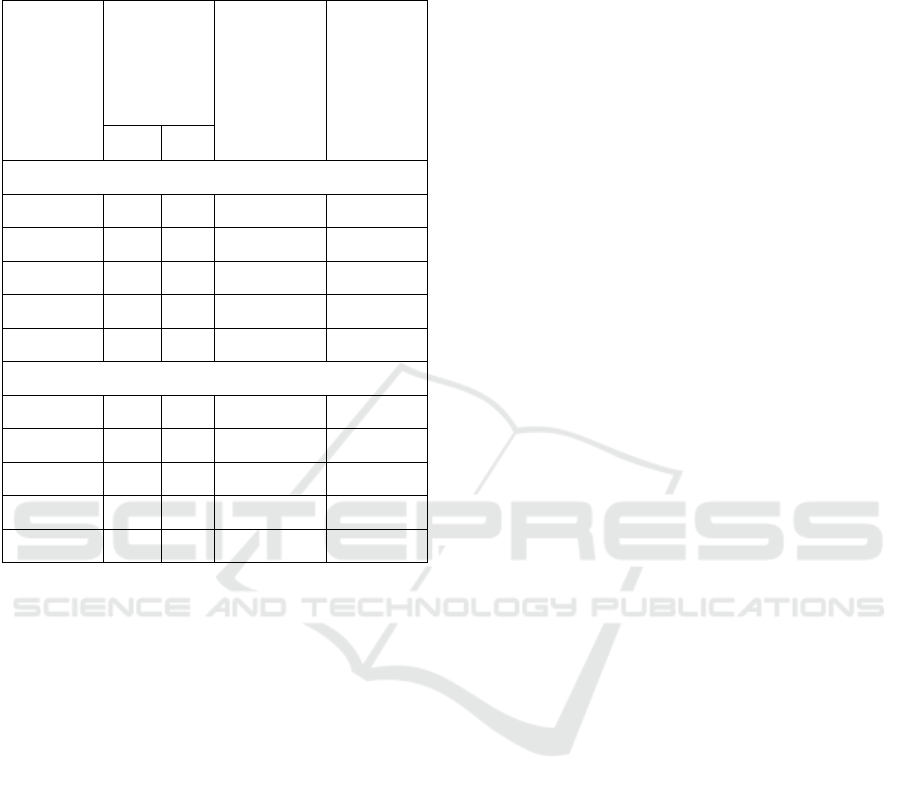
Table 2: The plowing depth and root mean square deviation
of the width of the suspension plough support wheel, the
vertical compressive force exerted by the support wheel on
the soil and its effect on traction resistance.
The width
of the axle
of the
suspension
plough
support
wheel, cm
Plowing
depth and
its mean
square
deviation,
cm
The vertical
compressive
force of the
support
wheel is
applied to
the soil, kN
Pulling
resistance
of
suspension
plough,
kN
М
ўр
±σ
V=6 km/h
10 37,1 1,51 3,85 31,1
15 35,9 1,33 3,69 28,9
20 35,4 1,15 3,52 27,9
25 34,9 1,05 3,42 27,1
30 34,5 1,02 3,29 26,5
V=9 km/h
10 36,8 1,58 3,73 31,9
15 35,9 1,39 3,59 29,5
20 35,1 1,17 3,43 28,7
25 34,7 1,10 3,32 28,3
30 34,3 1,06 3,18 27,8
For example, when the diameter of the base wheel
increased from 30 cm to 40 cm, the mean square
deviation of the plowing depth decreased by ± 0.11-
0.17 cm, and when it increased from 40 cm to 50 cm,
it decreased by ± 0.03-0.05 cm. This indicates that the
diameter of the support wheel should be at least 40
cm in order for the plough to work stably at the
specified depth.
An increase in the diameter of the suspension
plough support wheel from 30 cm to 50 cm reduces
its traction resistance from 28.7 kN to 26.9 kN at a
speed of 6 km/h and from 29.4 kN to 27.5 kN at a
speed of 8 km/h came This is due to the fact that the
plowing depth decreases with the increase in
diameter.
An increase in the diameter of the suspension
plough support wheel from 30 cm to 50 cm led to a
decrease in the vertical pressure force exerted by it on
the soil, that is, this force decreased from 3.73 kN at
a speed of 6 km/h to 3.41 kN at a speed of 8 km/h.
Reduced from 3.67 kN to 3.31 kN. This is due to the
reduction of the vertical distance between the base
wheel axis and the instantaneous center of rotation of
the plough.
At the diameter values of 35-45 cm, the pressure
force applied to the soil by the support wheel was at
the required level (3.5 kN).
From the results presented in Table 2, it can be
seen that the plough depth and its mean square
deviation decreased with the increase in the width of
the support wheel hub. When the wheelbase width
increased from 10 cm to 30 cm, the plowing depth
decreased from 37.1 cm to 34.5 cm and from 36.8 cm
to 34.3 cm at speeds of 6 and 9 km/h, respectively.
Decreased from ± 1.51 cm to ± 1.02 cm and from ±
1.58 cm to ± 1.06 cm. However, the rates of reduction
of plowing depth and root mean square deviation
decreased with increasing wheelbase width. For
example, at a speed of 6 km/h, when the width of the
support wheel hub increases from 10 cm to 20 cm, the
plowing depth decreases by 1.7 cm and its root mean
square deviation decreases by ± 0.36 cm, when it
increases from 20 cm to 30 cm, these indicators are
suitable were 0.9 cm and ± 0.13 cm, respectively. At
a speed of 9 km/h, these changes were 1.7 cm and ±
0.41 cm and 0.8 cm and ± 0.11 cm, respectively.
When the width of the wheel hub is less than 15
cm, the suspension plough is sunk deeper than
specified, that is, the plowing depth is greater than the
specified 35 cm, and when it is greater than 20 cm,
the plug is sunk to the specified depth.
An increase in the width of the wheelbase from 10
cm to 30 cm led to a decrease in the traction resistance
of the suspension plough, that is, the traction
resistance of the plough decreased from 31.1 kN to
26.5 kN at a speed of 6 km/h, to 31.9 at a speed of 9
km/h. reduced from kN to 27.8 kN. This is explained
by the fact that an increase in the width of the wheel
hub causes a decrease in the depth of its immersion in
the ground.
An increase in the width of the suspension plough
support wheel from 10 cm to 30 cm has led to a
decrease in the vertical pressure force exerted by it on
the soil, that is, this force is from 3.85 kN at a speed
of 6 km/h to 3.29 kN at a speed of 9 km/h and
decreased from 3.73 kN to 3.18 kN. This can be
explained by the fact that an increase in the width of
the support wheelbase has led to a decrease in the
plowing depth. In the range of 15-25 cm values
of the base wheel axle, the pressure force exerted by
it on the soil was at the required level (3.5 kN).
Therefore, in order for the suspension plough to
work stably at the specified depth and for the vertical
pressure force applied to the soil by the support wheel
to be at the required level, its width should be at least
20 cm. The results obtained in experimental studies
showed that the results obtained in theoretical studies
are correct.
The Influence of Suspension Plough Support Wheel Diameter and Width on Its Performance Indicators
121

4 CONCLUSIONS
On the basis of the above, it is possible to draw the
following conclusion: in order for the suspension
plow to work stably at the specified depth, the
diameter of the supporting wheel and the width of the
beam should be at least 40 cm and 20 cm,
respectively.
REFERENCES
Alimova, F.A., Saidova, M.T., & Primkulov, B.Sh., 2023.
Pneumatic feed mechanism for accurate sowing of bare
cotton seeds. IOP Conference Series: Earth and
Environmental Science, 1231(1), 012012.
https://doi.org/10.1088/1755-1315/1231/1/012012.
Djurayev, A.D., Alimukhamedov, Sh.P., Turdaliev, V.M.,
Sheraliev, I.I., & Sherboev, M., 2022. Vibrational
motion of soil-compaction tools in agriculture. Russian
Engineering Research, 42, 969–971.
https://doi.org/10.3103/S1068798X22100094.
Dospekhov, B.A., 1979. Methodology of field experience.
Moscow: Kolos, p. 416.
GOST 20915-11, 2013. Testing of agricultural machinery.
Methods for determining test conditions. Moscow:
Standartinform, p. 23.
Klenin, N.I. & Sakun, V.A., 1994. Agricultural and
reclamation machines. Moscow: Kolos, p. 751.
Mamatov, F.M. 2007. Wood roasting machine. Tashkent:
Fan, p. 338.
Mukhamedov, Z., Turdaliev, V.M. & Kosimov, A.A., 2020.
Kinematic nonuniformity of the rotation of a toothed
belt transmission with a composite pulley. Russian
Engineering Research, 40, 705–709.
https://doi.org/10.3103/S1068798X20090130.
Norchayev, D.R., Xaliqulov, M.A., Shermuxamedov, X.P.,
& Ibragimova, G.N., 2021. Test results of the new Root
Crop Harvester. IOP Conference Series: Earth and
Environmental Science, 868(1), 012059.
https://doi.org/10.1088/1755-1315/868/1/012059.
Norchayev, D.R., Xaliqulov, M.A., Turkmenov, X.I.,
Shermuxamedov, X.P., & Ibragimova, G.N., 2022.
Acceptable solutions for harvesting root crops in the
soil climate of the Republic of Uzbekistan. IOP
Conference Series: Earth and Environmental Science,
1076(1), 012029. https://doi.org/10.1088/1755-
1315/1076/1/012029 .
O‘zDSt 3193: 2017. The countryside is covered with
machinery. He is a source of energy.” Tashkent, p. 21.
O‘zDSt 3355: 2018. The countryside is covered with
machinery. A machine for deep drawing of pipes and
pipelines. Synovlarning guidelines and methodology.
Tashkent, p. 70.
Sablikov, M.V., 1968. Agricultural machines. Part 2.
Fundamentals of theory and technological calculation.
Moscow: Kolos, p. 296.
Saidova, M., Tursunbaev, S., Boltaeva, M., & Isakulova, N.,
2024. Comparison of pneumatic sowing machines by
the number of seeds in the slots of the discs and the
distance between the slots. BIO Web of Conferences,
105, 01004.
https://doi.org/10.1051/bioconf/202410501004.
Sharov, N.M., 1964. On the uniformity of the stroke depth
of a mounted plow with an increase in the speed of
movement of the unit. Proceedings of the MIISP, 25-
37.
Shiryaev, A.M., 1988. Near-sowing soil compaction.
Mechanization of agriculture. Moscow, 3, p. 33-35.
Sineokov, G.N. & Panov, I.M., 1977. Theory and
calculation of tillage machines. Moscow:
Mashinostroenie, p. 328.
Tukhtakuziev, A., & Rasuljonov, A.R., 2020a. Ensuring the
stability of the processing depth of suspended soil
mounted machines. IOP Conference Series: Earth and
Environmental Science, 614(1), 012156.
https://doi.org/10.1088/1755-1315/614/1/012156 .
Tukhtakuziev, A., & Rasuljonov, A., 2020b. Results of
laboratory and field experiments on an experimental
mounted chisel cultivator. Effectiveness of Innovative
Technological and Technical and Social and Water
Management, 112-115.
Tukhtakuziev, A., Rasuljonov, A.R., Turkmenov, H.I.,
Irgashev, A.A., & Barlibaev, S., 2023. Ensuring the
stability of the suspended chisel-cultivator processing
depth. E3S Web of Conferences, 390, 01038.
https://doi.org/10.1051/e3sconf/202339001038.
Turdaliev, V.M., Alimukhamedov, S.P., Mukhamedov, Z.,
Komilov, S.R., 2022. Measuring the variable center
distance in a chain transmission. Russian Engineering
Research, 42 (Suppl 1), 57–59.
https://doi.org/10.3103/S1068798X23020259.
Umurzakov, A.K., Turdaliev, V.M. & Khakimov, U.A.,
2022. Low-power hydraulic motor for mobile
micropower stations and pumps. Russian Engineering
Research, 42(8), 791–793.
I-CRAFT 2024 - 4th International Conference on Research of Agricultural and Food Technologies
122
