
Possibilities and Prospects of Implementing Dual Education in the
System of Higher Education in Sustainable Economic Development
Muhammad Ali Saidov
a
, Dildora Saidova
b
and Filyura Khudayberdiyeva
c
Tashkent State Agrarian University, 100140, University str. 2, Tashkent, Uzbekistan
Keywords: Dual Education, Higher Education, Sustainable Economy.
Abstract: The reforms of higher education in Uzbekistan radically changed not only the content of the system, but also
its structure. Along with this, the opportunities available today in the higher education system do not always
meet the needs of graduates and the labor market. The content of dual higher education is studied, the
possibilities of implementation and potential risks that prevent its successful implementation in the republic
are considered.
1 INTRODUCTION
The decisive factors for the sustainable development
of the economy of Uzbekistan in modern conditions
are the innovative component of economic growth,
measures to intensify the process of modernization
and the introduction of modern technologies. To
achieve this, the republic has a strong innovation
base, a number of scientific and specialized institutes
operate, there is scientific and personnel potential,
and the level of education of the population is quite
high. The most important direction in the
development of innovation activity is strengthening
human potential.
The acceleration of innovation processes
occurring in society, globalization and digitalization
requires fundamental adjustment changes in all
spheres of human activity, including education. To
this end, it is necessary to ensure the development of a
holistic system of lifelong education that meets the
requirements of an innovative economy. Because
education is a contribution to the future, which, first
of all, benefits society itself. It comes first, necessary
to work successfully, create social wealth,
competitive products and have a worthy place in
society. Education is a necessary factor in raising a
harmoniously developed generation, the most
important engine of the innovation process, the basis
a
https://orcid.org/0009-0005-9955-1132
b
https://orcid.org/0009-0005-9955-5544
c
https://orcid.org/0000-0003-0285-8601
for the socio-economic development of the country,
its intellectual and spiritual potential. The education of
society is an integral part of national wealth and the
innovation process. Society needs, first of all,
modernly educated, moral, initiative people who can
independently make responsible decisions in a
situation of choice, predicting their possible
consequences, who are capable of cooperation, and
who have a developed sense of responsibility for their
country.
2 MATERIALS AND METHODS
In the process of research, theoretical methods of
induction, deduction, generalization and
comparison were used. The necessary materials are
investigated on the basis of the methods of
typological analysis, the synthesis of statistical data.
3 RESULTS AND DISCUSSION
Higher education institutions play an important role
in the creation, dissemination, transfer of knowledge
and penetration of knowledge into manufacturing
sectors. To enhance such penetration,
dual/cooperative higher education will become an
106
Saidov, M. A., Saidova, D. and Khudayberdiyeva, F.
Possibilities and Prospects of Implementing Dual Education in the System of Higher Education in Sustainable Economic Development.
DOI: 10.5220/0014071300004738
Paper published under CC license (CC BY-NC-ND 4.0)
In Proceedings of the 4th International Conference on Research of Agricultural and Food Technologies (I-CRAFT 2024), pages 106-111
ISBN: 978-989-758-773-3; ISSN: 3051-7710
Proceedings Copyright © 2025 by SCITEPRESS – Science and Technology Publications, Lda.

additional conceptual solution for the higher
education system in the task of providing the labor
market with highly qualified personnel capable of
effectively and responsibly performing their
functions and adapting to changing economic
conditions. In Germany and other European
countries, a cooperative training program is directly
to other professions and sectors of the economy
(Heinze, 2019). In the 20th century, the compulsory
school accompanying apprenticeship was dominated
by the training school, which was divided by
profession and, from 1920, called a vocational school.
Compulsory initiated by the employer. The student
receives theoretical knowledge at the university and
practical experience in the company. In Europe, this
system has shown positive results for a hundred years.
Beginning in the 12th century, professional
organizations already regulated the training
(apprenticeship) of their descendants.
By the 19th century, this form of training had
spread vocational school was introduced in Germany
in 1938.
In world practice, three main models of partnership in
the field of higher education can be distinguished
(Heinze, 2019). The first model is that the state plays
a minor role (Great Britain, USA). This model of
interaction between the educational community and
business reflects trends in the decentralization of
public administration. The state does not formally
regulate vocational education; most decisions are
made at the local level with broad participation of
employers. The second model is that the state plans,
implements and manages vocational education
(France, Sweden). This model of interaction between
the system of educational services and the labor
market is characterized, first of all, by a high level of
state regulation of the sphere of higher education. The
third model - the state determines the general
framework for the activities of private companies and
organizations for the implementation of vocational
education (Germany, the Netherlands, Denmark,
Scotland). In particular, the German vocational
education system is characterized by the
concentration and integration of educational
resources. Cooperation between employers and
educational institutions plays a huge role in the
development of a young specialist.
In France, the dual education system opens the
way for students to all professional certificates
registered in the national catalog of qualifications.
In Germany, both public and private universities
offer dual education, and their number is increasing
every year. This system offers more than a thousand
programs. Companies that have invested financial
and time resources in training dual students are
interested in their further employment after
completion of their studies.
On an international scale, German industrial
enterprises work most actively on innovative projects
together with the country's universities. Thus, the
share of companies collaborating with universities in
Germany is more than 50%, in the UK - 30%, in
France- only 25%.
According to the research project Mannheimer
Innovationspanel, in 2007 there were more than
40,000 companies in Germany with scientific
contacts with universities. And this figure is
constantly growing. German companies and corporate
foundations are investing more than 1.7 billion euros
in research at universities. Almost half of the financial
resources are spent on scientific research under
contracts, more than 50% are spent on joint research
projects.
IBA is Germany's largest state-recognized
university for cooperative education and is part of the
F+U group, which has been involved in higher
education for more than 40 years (Gnezdova et al.,
2021). The university was founded in 2006 and offers
bachelor's programs on a dual training scheme (work
+ study) in twelve study centers throughout Germany.
Today, over 3,500 students study at the university.
Dual programs are becoming increasingly popular
in Germany among both students and employers.
Students work in a company while studying for a
bachelor's degree. This means that they gain valuable
work experience during their studies and thus have
excellent job opportunities in the competitive German
job market.
IBA training programs are delivered in partnership
with approved organizations, which employ students
as trainees for the duration of their studies. IBA
practices a "split week" training model based on a 40-
hour work week: students spend approximately 20
hours studying per week and 16-20 hours on-the-job
training at a partner company. By the time they
graduate, IBA students have an ideal combination of
academic and practical competence. IBA offers over
30 undergraduate programs to choose from;
Opportunity to study at one of 12 training centers
located in major cities in Germany;
IBA has over 2,000 partner organizations where
students can find employment.
In the Decree of the President of the Republic of
Uzbekistan dated October 8, 2019 PP-5847 “On
approval of the Concept for the development of the
higher education system of the Republic of
Uzbekistan until 2030,” important tasks in the
direction of systemic reform of higher education in
Possibilities and Prospects of Implementing Dual Education in the System of Higher Education in Sustainable Economic Development
107
the Republic of Uzbekistan are defined:
“implementation of advanced standards of higher
education, in particular phased transition from
education, whose curricula are aimed at obtaining
theoretical knowledge, to an education system aimed
at developing practical skills based on international
experience, raising the content of higher education to
a qualitatively new level, establishing a system for
training highly qualified personnel capable of finding
their place in the labor market , make a worthy
contribution to the stable development of the social
sphere and sectors of the economy" (Bosch, 2018).
Tashkent State Agrarian University participates in
the implementation of the international project
“Vocational education in Central Asia - Promoting
systemic approaches in the food production sector” in
cooperation with the Agency for International
Development Cooperation and international
educational work of Germany (Gesellschaft für
internationale Zusammenarbeit - GlZ). This project
provides support to partner countries (Republic of
Uzbekistan, Republic of Kazakhstan, Kyrgyz
Republic, Republic of Tajikistan) in reforming
vocational education using the example of the food
production sector. Main goal of the project -
improving the regulatory and institutional foundations
of dual/cooperative vocational higher education in
Central Asia in the field of food production. Particular
attention is paid to orientation towards employment
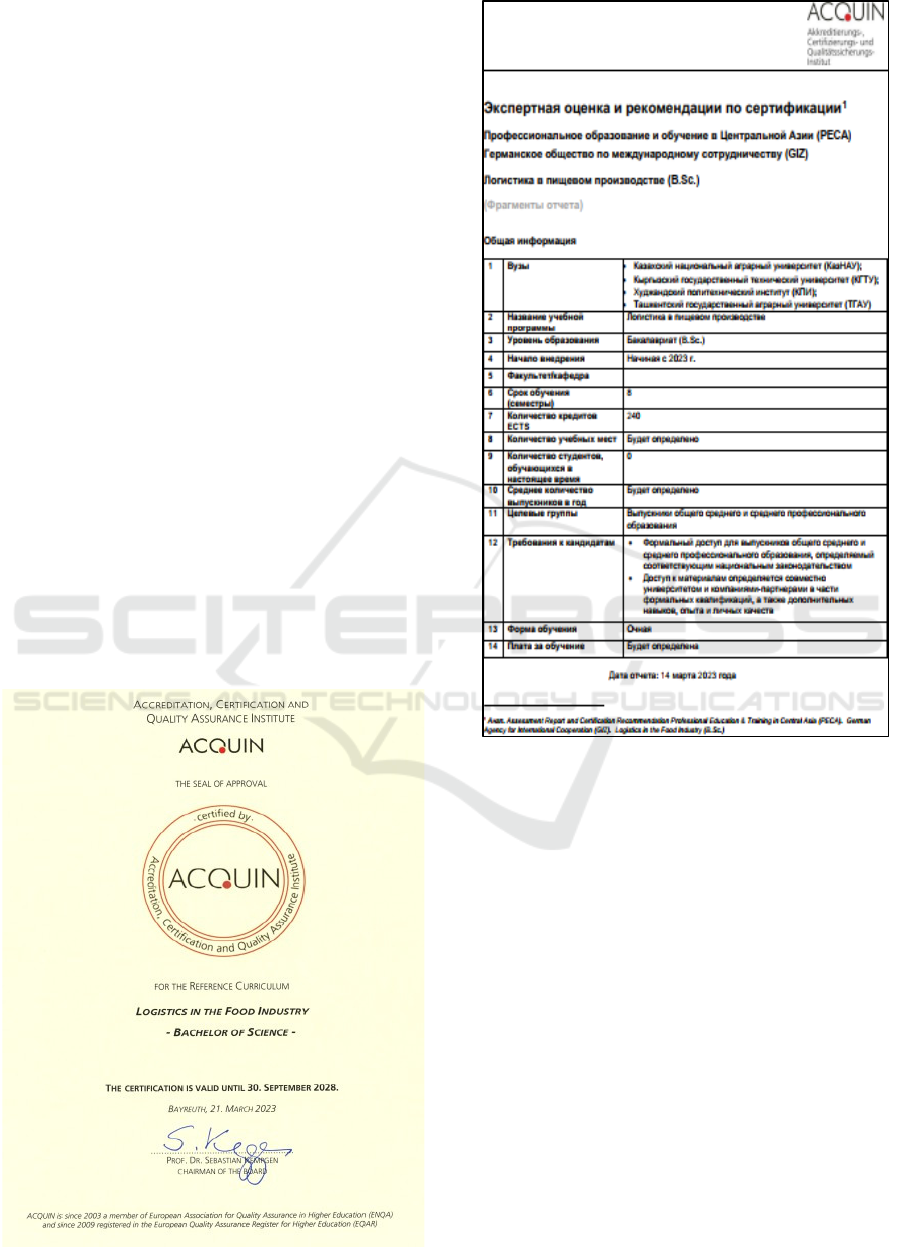
Figure 1: This training program is certified by the Institute
for Accreditation, Certification and Quality Assurance
(ACQUIN).
and the introduction of international quality standards
at the level of higher professional education. The
development of dual/cooperative training, that is, the
combination of training in a real working environment
with training at a university, is at the core of the
activities of this project.
In addition, the project actively strives for regional
harmonization and compatibility of national
vocational education systems. The project is aimed at
its subsequent implementation at the university on the
basis of the department of “Agricultural Economics”
of the cooperative undergraduate program “Logistics
(for food production)”. This is a 4-year (8 semesters)
program with a total credit volume of 240 ECTS,
characterized by a constant alternation of theoretical
study phases at the university and practical phases in
the company and modern, practice-oriented teaching.
I-CRAFT 2024 - 4th International Conference on Research of Agricultural and Food Technologies
108

Dual/cooperative higher education is a training
format that combines training at a higher educational
institution with experience gained during internship
in companies and organizations, that is, the theoretical
part of education is carried out on the basis of an
educational organization, the practical part is carried
out at the student’s workplace. The combination of
higher education and work-based learning aims to
provide both academic skills and professional
knowledge. In this regard, academic theoretical
knowledge acquired in the classroom is
complemented by on-the-job experience. Thus, the
effectiveness of the theory is tested in real life
situations and vice versa. It is based on a structured
partnership between a higher education institution
and employers (commercial or non-profit
organizations, enterprises or public and private
services).
The procedure for organizing dual education is
determined by the Cabinet of Ministers of the
Republic of Uzbekistan (Articles 15 and 17 of the
Law of the Republic of Uzbekistan “On Education”
No. ZRU-637 dated September 23, 2020) (Saidov,
2002). It should be noted that in Uzbekistan, a
Resolution of the Cabinet of Ministers of the Republic
on dual vocational education was adopted (“On
measures to organize dual education in the vocational
education system” Resolution of the Cabinet of
Ministers of the Republic of Uzbekistan No. 163
dated March 29, 2021) (Peregudov and Saidov,
2001).
In dual/cooperative higher education, internship
experience is an integral component of the academic
program, curriculum and plan. The stages of training
at a university and at the workplace are related in time
and content. Students receive academic credits for
practice, as well as support from the university at all
stages of their studies, including during practice. The
basic principle of dual/cooperative higher education
is a continuous cycle between obtaining theoretical
knowledge at a university and applying this
knowledge in practice, in the workplace. This cycle
allows for the creation of synergy between theory and
practice.
Thus, dual/cooperative higher education provides
academic qualifications at undergraduate level, while
enabling students to gain extensive practical
experience. This allows students to take on
challenging tasks early in their professional
development and helps them build a successful career.
It does not replace existing academic programs in
educational institutions, but is a complementary and
necessary learning format for improving the higher
education offering at the institutional, national and
international levels. If necessary, they can also be
offered as part of master's and doctoral programs,
under joint partnership and contractual conditions.
Dual cooperative higher education programs
provide integrated training (by days, weeks, months)
for students within the walls of a higher educational
institution and on the basis of an
enterprise/organization, in compliance with the
requirements of educational standards of
dual/cooperative higher education and professional
standards. These programs are developed on the basis
of systematic/regular coordination of training,
organizational and contractual conditions of
stakeholders, with a clear distribution of
enterprise/organizational functions within the
training program, including placement of students in
workplaces during internships.
In organizational and legal terms, dual/cooperative
higher education is a symbiosis of two independent
(legal) units of the socio-economic system: an
educational institution and an
enterprise/organization. Such integration is a
necessary component of personnel training in the
context of globalization and digitalization of the
economy (in accordance with the provisions of the
strategy “Digital Uzbekistan - 2030”, No. UP-6079
dated October 5, 2020) (Saidov and Saidova, 2020)
and an important contribution to ensuring the
professional competence of the workforce.
Availability of qualifications in accordance with the
requirements of the labor market and international
standards, a guaranteed level of providing graduates
with jobs are important factors in employment and
reducing unemployment in the country, and the
involvement of more qualified personnel in
production activities improves the economic
performance of the enterprise/organization.
The gradual introduction of dual/cooperative
higher education in Uzbekistan, on the one hand, will
help raise to a qualitatively new level the process of
training independently thinking highly qualified
personnel with modern knowledge and high personal
qualities, the modernization of higher education, the
development of the social sphere and economic
sectors, and on the other hand - strengthen the role
and participation of enterprises and organizations in
the educational process and improve the professional
and communication skills of graduates (Table 1, 2, 3,
4).
Possibilities and Prospects of Implementing Dual Education in the System of Higher Education in Sustainable Economic Development
109

Table 1: SWOT analysis of dual/cooperative higher
education in Uzbekistan- Strengths.
Strengths
• Provides academic qualifications at the
undergraduate level, enables students to gain
extensive practical experience and apply scientific
knowledge in practice;
• A high level of academic and administrative support;
• Pedagogical and methodological support for
students at the stages of study at a higher educational
institution and in the workplace
• Professionally oriented training, combining
classroom study and on- the-job practice;
• Tuition fees are usually paid by the partner company;
• Flexible response of the curriculum and academic
qualifications to the needs of the labor market for
highly qualified specialists with appropriate
professional skills and abilities;
• Strengthening the educational infrastructure of the
university of dual/cooperative higher education
through the use of the infrastructure of a partner
enterprise;
• Close connection of the educational process at the
university with practice at enterprises/organizations;
• Faculty development through exposure to new
trends, technologies and developments, as well as
potential collaboration in training and research;
• Emergence of new models of financing.
Table 2: SWOT analysis of dual/cooperative higher
education in Uzbekistan- Threats.
Threats
• Cooperative (joint) training of 1 or 2 specialists with
higher education, once every 3 or 5 years;
• For some enterprises/organizations, long-term
investment of financial resources is impractical due
to a possible oversaturation of specialists in a certain
profile/specialty or potential workplace in the
enterprise, the possibility of obtaining a ready-made
workforce of specialists from outside (i.e., there is
an excess of specialists with higher education in the
labor market, who are looking for a suitable and
well-paid job in their specialty);
• For an enterprise/organization, the financial costs
that will be spent on training (payment for tuition at
a higher educational institution) of a future specialist
employee may seem unjustified;
• There is a possibility that enterprises will refuse to
cooperate in dual/cooperative higher education and
long-term investment;
• It will be a challenge to attract a sufficient number
of enterprises willing and able to invest in dual/co-
operative higher education and the individual
student in terms of financial support, provision of
human resources (mentoring) and related jobs during
co-operative education.
Table 3: SWOT analysis of dual/cooperative higher
education in Uzbekistan- Weaknesses.
Weaknesses
• Insecure employment of graduates;
• Uncoordinated policies of enterprises/organizations
and higher education institutions;
• Structural changes in a higher educational institution
(organization of a department of dual/cooperative
higher education, appointment of responsible
coordinators/mentors, etc.);
• Organization of the educational process and
redistribution of the teaching load;
• The complex profile of partner companies in
dual/cooperative higher education cannot always be
clearly reflected in the curriculum of
dual/cooperative higher education, which can cause
difficulties in formulating goals and obtaining
expected learning outcomes at a higher educational
institution;
• Creating overly specialized programs to meet
specific employer requirements;
• Developing educational programs that are too
general for the needs involved;
• Requires a relatively high academic load on the part
of the student to study and master the academic load
and for practice in enterprises and/or other
organizations;
• Curricula are too dense;
• Organizing payment (partial or full) of contracts and
scholarships by interested parties for students
studying in dual/cooperative higher education
p
rograms.
Table 4: SWOT analysis of dual/cooperative higher
education. in Uzbekistan- Opportunities.
Opportunities
• Promotes the modernization of higher education;
• The process of training independently thinking,
highly qualified personnel with modern knowledge
and high personal qualities will rise to a qualitatively
new level;
• Expands the prospects and scope of employment
opportunities for graduates;
• Allows higher educational institutions to increase
their competitiveness and attractiveness in the
educational services market;
• Provides universities with the opportunity to
enhance the practical relevance of the higher
education they offer;
• Provides the labor market with qualified personnel
of the required/required qualifications;
• Reduces unemployment in the country;
• Improves the economic performance of an enterprise
or organization;
• Promotes strengthening connections in the
“knowledge triangle” - an integrated approach to
p
olic
y
in the field of science, education and
I-CRAFT 2024 - 4th International Conference on Research of Agricultural and Food Technologies
110

innovation, with an emphasis on the role of
universities as a subject of knowledge production;
• Expands opportunities for applied research and
technology transfer between universities and
industry, thereby promoting innovation in the
economy and in the academic environment;
• Promotes the development of the social sphere and
economic sectors;
• Training competitive specialists in their field with
communicative and professional competencies that
meet the needs of society and the national economy
of Uzbekistan
4 CONCLUSIONS
Implementation dual/cooperative higher education
requires a thorough assessment from the perspective
of all parties interested in dual/cooperative higher
education and their minimization to ensure a viable
approach, including when developing the provisions
of the legislative framework, strategic and
management issues of dual/cooperative higher
education within the framework of this concept and
formulating further actions for its sustainable
implementation (pilot project, road map,
recommendations).
The objectives of the organization of
dual/cooperative higher education are:
Development of socio-economic mechanisms for
supporting dual/cooperative higher education and
models of cooperation between
enterprises/organizations and higher educational
institutions;
Ensuring the relationship between educational
processes of higher educational institutions and
production conditions at the enterprise/organization;
Organization of the practical part of training at
enterprises/organizations and the theoretical part in a
higher educational institution, with the involvement
of students in work activities;
Formation of competencies through the
implementation of educational programs in
combination with work activity;
Systematic improvement of educational programs
taking into account the requirements of employers
and their technological innovations;
Further expansion of the participation of
enterprises/organizations in the certification of
graduates
.
REFERENCES
“On measures to organize dual education in the vocational
education system” Resolution of the Cabinet of
Ministers of the Republic of Uzbekistan No. 163 dated
March 29, 2021. https://lex.uz
Decree of the President of the Republic of Uzbekistan dated
October 8, 2019 PP-5847 “On approval of the Concept
for the development of the higher education system of
the Republic of Uzbekistan until 2030.” https://lex.uz
Decree of the President of the Republic of Uzbekistan dated
October 5, 2020 “Digital Uzbekistan - 2030”, No. UP-
6079. https://lex.uz Source: developed by the authors
Gerhard Bosch, “Das duale System der Berufsausbildung in
Deutschland”, 2018. https://www.ifri.org/sites/default/
files/atoms/files/ndc_143_g._bosch_duales_system
_143_g._bosch_duales_system_berufsausbildung_juli_
2018.pdf New horizons for cooperation between Russia
and Uzbekistan based on the implementation of national
projects and national programs.
https://edu-abroad.su/stati/vysshee-obrazovanie-v-germanii/
dualnoe-obrazovanie/
Klaus-Dieter Heinze. German experience of scientific
cooperation between industrial enterprises and higher
education institutions. Journal VSU Bulletin. 2019 No.
3. http :// www.vestnik.vsu.ru/pdf/educ /2019/03/2019-
03-18.pdf.p.80-84.
L.V.Peregudov, M.H.Saidov Management and economics
of higher education..T .: Moliya, 2001.
Law of the Republic of Uzbekistan “On Education” No.
ZRU-637 dated September 23, 2020. https :// lex.uz
Programming the Demographic Dividend: from Theory
to Experience https://wcaro.unfpa.org/en/publications/
programming-demographic-dividend- theory-experience
Report of the scientific work carried out in 2021
https://www.delst.de/de/lexikon/duales-system-der-
berufsausbildung.
Saidov M. Kh., Saidova D.N. The development of higher
educational institutions is a guarantee of the progress of
society and increasing the competitiveness of the
national economy . Journal Bulletin of Science and
Education, 2020, No. 3 (81).
Saidov M. X. Economics, investments and marketing of
higher education T.: Moliya, 2002.
The-Knowledge-Triangle-Re-Inventing-the- Future.
(2013). Editors Pia Lappalainen, Aalto University
Markku Markkula, Aalto University
https://digitaldublin.files.wordpress.com/2013/05/
markku-markkula-parallel-1-the-knowledge- triangle-re-
inventing-the-future.pdf
Yu.V.Gnezdova, Yu.A.Romanova, M.X.Saidov and others.
Monograph. M.: OOO Publishing and Trade
Corporation Dashkov and K., 2021
Possibilities and Prospects of Implementing Dual Education in the System of Higher Education in Sustainable Economic Development
111
