
Optimization of Bush-Guiding Efficiency in Vertical-Spindle Cotton
Pickers Through Elliptical Drum Design: A Simulation-Based Study
Shavkat Ravutov
1a
, Khushnud Yakubov
2b
, Umidjon Rajapbaev
1,3 c
and Shahzod Komilov
1d
1
Tashkent State Technical University, 100095, Tashkent, Uzbekistan
2
Urgench State University, Kh. Alimdjan Street, Urgench, 220100, Uzbekistan
3
Tashkent Institute of Irrigation and Agriculture Mechanization Engineers', National Research University,
Tashkent, Uzbekistan
Keywords: Elliptical Drum, Cotton Harvester, Spindle Efficiency.
Abstract. This work is dedicated to studying the influence of the design features of the elliptical drum of a vertical-
spindle cotton picker machine on the efficiency of the spindles. The interaction of individual pressing sectors
of the new drum with cotton bushes in the working gap of the cotton picker is investigated. The "GeoGebra"
dynamic mathematics software, which is open-source, was used to simulate the movement of the spindles and
the pressing sectors of the elliptical drum. The software allows virtual manipulation of the geometric
dimensions of the drum's structural elements. By simulating the movement of the spindles and the pressing
sectors of the elliptical drum, a comparison was made of the impact characteristics on the cotton bushes by
the spindles and the pressing sectors of both the elliptical and standard drums. A computer graphical method
was developed to assess the effectiveness of the pressing sector's impact on the cotton bushes as they are
introduced into the working chamber. It was found that by controlling the geometric parameters of the pressing
sector and other dimensions of the elliptical drum, the bush-guiding capability of the vertical-spindle cotton
picker machine can be significantly improved.
1 INTRODUCTION
In Central Asia, the cotton harvesting period is
extended by at least 15-20 days, making the
organization of a one-time harvest of this valuable
raw material more challenging. This extended period
complicates the effective use of high-performance
horizontal-spindle cotton harvesting machines (HS
CHM), which, due to the high activity of their
working parts, collect cotton from both mature and
immature bolls, thereby reducing the quality of the
harvested raw material (Yakubov et al., 2024a).
Conversely, vertical-spindle cotton harvesting
machines (VS CHM) selectively collect cotton only
from mature bolls, providing an advantage in terms of
quality. However, the VS CHM, which are currently
produced in small batches in the Republic of
Uzbekistan, struggle to compete with HS CHM in
a
https://orcd.org/0009-0006-3486-1548
b
https://orcd.org/0009-0009-8171-9917
c
https://orcd.org/0009-0002-4088-1562
d
https://orcd.org/0009-0009-7854-9216
terms of collection completeness and productivity,
particularly in high-yield scenarios (more than 35-45
centners per hectare) (Yakubov et al., 2024b).
Extensive theoretical and experimental studies have
identified that the primary reason for the low
collection completeness of VS CHM is the limited
contact area of the spindles with the cotton plants and
the insufficient number of spindles simultaneously
engaging with the cotton bolls during harvesting
(Rzaev, 2017; Ravutov, 2019).
Another issue affecting the efficiency of VS CHM
is the steep angle at which cotton plants enter the
working chamber, which causes an accumulation of
plant mass in front of the working slot. This
accumulation complicates the even distribution and
proper orientation of the cotton bolls on the spindles
within the impact zone (Ravutov, 2019; Turanov et
al., 2021a). According to the current technological
94
Ravutov, S., Yakubov, K., Rajapbaev, U. and Komilov, S.
Optimization of Bush-Guiding Efficiency in Vertical-Spindle Cotton Pickers Through Elliptical Drum Design: A Simulation-Based Study.
DOI: 10.5220/0014067600004738
Paper published under CC license (CC BY-NC-ND 4.0)
In Proceedings of the 4th International Conference on Research of Agricultural and Food Technologies (I-CRAFT 2024), pages 94-98
ISBN: 978-989-758-773-3; ISSN: 3051-7710
Proceedings Copyright © 2025 by SCITEPRESS – Science and Technology Publications, Lda.

scheme of the VS CHM, as the machine moves along
the cotton rows, the spindle drums—installed in pairs
on the machine—are supposed to pull the plants into
the working slot in a vertical position. However, this
does not occur as expected because the spindles in the
working zone rotate in the opposite direction relative
to the drum, preventing the plants from entering the
working chamber vertically. Consequently, the plants
are forcibly introduced into the working chamber,
leading to crop losses and damage to the plant
elements before they fully enter the chamber. Many
studies focusing on the interaction between the
spindles and the cotton plants at the entry point into
the working chamber, as well as the issue of plant
mass accumulation in front of the machine's working
chamber, have attributed these problems to the design
features of VS CHM (Abdazimov et al., 2011;
Shoumarova et al., 2022; Shoumarova et al., 2023).
These studies suggest that addressing these issues
within the current serial designs of VS CHM is
challenging. To facilitate the entry of plants into the
working chamber in a vertical position, previous
research recommended altering the direction of
spindle rotation around their axes in this zone.
Specifically, friction drives of the spindles were
modified: a reverse rotation block replaced the direct
rotation belt in the collection zone, and a direct
rotation belt was installed in another section. Field
tests of this modified spindle drive yielded positive
results regarding plant entry into the working
chamber. However, due to a decrease in the angular
speed of the spindles by approximately 20% and
reduced spindle activity in this zone, no significant
improvement in collection completeness was
observed (Rzaev, 2017; Rizaev, 2022).
Further studies (Turanov et al., 2021b) proposed
incorporating a special plant guiding mechanism into
the drum design. This mechanism not only prevents
the plants from tilting forward during harvesting but
also ensures proper orientation of the cotton bolls on
the spindles in the working zone. While the modified
machine with the plant guiding mechanism showed
some improvement in agronomic performance, field
tests revealed frequent breakdowns of the
mechanism's elements.The aforementioned studies
indicate that the drawbacks of VS CHM can be
mitigated by using elliptical drums. Our previous
theoretical research on the kinematics and dynamics
of the elliptical drum has shown that employing
elliptical drums significantly enhances the machine's
agronomic performance and spindle efficiency, while
retaining all the benefits of the vertical-spindle cotton
harvesting principle (Ravutov et al., 2023a). Prior
research in this area primarily focused on the
structure and kinematics of the elliptical drum
mechanism, with some attention given to its
dynamics (Ravutov et al., 2023b; Bahadirov et al.,
2021). A comparative analysis of spindle activity
between the serial drum and the elliptical drum
revealed significant advantages in favor of the
elliptical drum (Ravutov et al., 2022; Ravutov et al.,
2023b).
2 MATERIALS AND METHODS
On the elliptical drum, each spindle is mounted on a
separate cassette and has a separate pressing sector,
which are also very important structural elements of
the drum. By changing the geometric parameters of
the links of the elliptical drum mechanism, the
kinematic mode of the spindle and the pressing sector
can be controlled (Bahadirov et al., 2021).
Another distinctive feature of the elliptical drum
is the variability of the spindle speed modes in the
working zones. Thus, when the spindle enters the
collection zone, it has one speed, and when it exits the
zone, it has another. Moreover, unlike the serial drum,
the relative speed of the spindle has an increasing
characteristic (Bahadirov et al., 2021). These and
other kinematic and structural features of the elliptical
drum complicate the analysis of the impact pattern of
the working parts on the cotton plants to some extent,
and it is convenient to obtain initial information
through direct observation of the working parts'
movements (Bahadirov et al., 2021; Ravutov et al.,
2023b). Traditionally, such observations were
conducted using high-speed filming of the process
(Sablikov, 1985). This method provides a real picture
of observations; however, it requires careful
preparation of experimental resources and significant
time and labor for processing the obtained results.
This study is dedicated to examining and
comparatively analyzing the interaction features of
the spindles and pressing sector of elliptical and serial
drums with elements of the cotton plant.
Recently, simulating the movement of mechanical
system parts using various computer programs has
become popular among designers of new machines.
The use of simulation programs often eliminates the
need for labor-intensive and costly experimental
studies (Amanov et al., 2019).
In the existing technology, the elements of cotton
plants first encounter the spindles and pressing
sectors of the drum, and they begin to interact. The
efficiency of the cotton harvesting apparatus largely
depends on the rationality of this interaction.
Optimization of Bush-Guiding Efficiency in Vertical-Spindle Cotton Pickers Through Elliptical Drum Design: A Simulation-Based Study
95
To simulate the movement of the spindles and the
pressing sector, we used the open-source dynamic
mathematics software "GeoGebra." This software
allows simulating the movement of the spindle and
the drum's pressing sector by adjusting the
dimensions of the ellipse's major and minor axes and
other structural elements. By changing the
dimensions of the axes, it is possible to achieve the
trajectory of the spindles along the circumference (the
circumference being a special case of the ellipse).
For convenience in comparing the movement
characteristics of the spindles and pressing sectors of
the serial and elliptical drums, as well as for reasons
of unifying the dimensions and construction of the
serial apparatus, the main dimensions of the elliptical
drum are identical to those of the serial drum: the
number of spindles for both drums is the same—
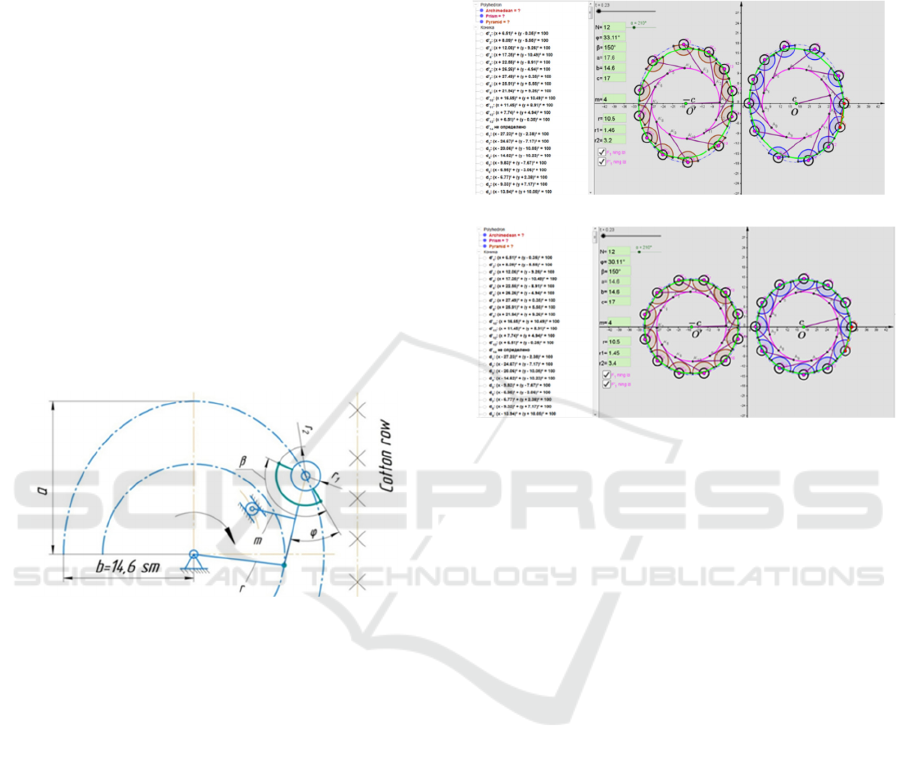
N=12 units; the minor axis of the ellipse b=14.6 cm,
equal to the radius of the serial drum (Rb=14,6 cm);
the radius of the spindle r1=1,45 cm; the radius of the
pressing sector r2=3,2 cm; the coverage angle of the
pressing sector β=1500 (Figure 1).
Figure 1: Parameters of the elliptical drum.
The GeoGebra program allows for varying the
dimensions of any link in the elliptical drum
mechanism and conducting visual observations of
changes in technologically important output
parameters. In our simulation experiment, only the
angle φ, determining the position of the pressing
sector, and the major axis a of the elliptical drum were
varied. By decreasing the size of a, a circle with a
radius equal to the radius of the serial drum can be
obtained, аmin=b=Rb=14,6 cm. To simulate the
orientation of the bolls to the working parts during the
process of introducing cotton plants into the working
chamber, primary attention was paid to observing the
movement characteristics of the spindle and the front
edge of the pressing sector (Figure 2).
As a result of the simulation, it can be noted that
when the spindle center moves along the ellipse, the
front edge of the pressing sector moves along a line
different from the ellipse (quasi-ellipse - shown in
Figure 2, green line). The size and shape of this line
depend on the angle φ and the major axis a. The
GeoGebra program allows simulating the effects of
the spindles and the pressing sector on the plants for
any possible values of these factors.
a)
b)
Figure 2: Simulation fragments of spindle and pressing
sector movement using GeoGebra dynamic mathematics
software; a - elliptical drum; b - drum view at
аmin=b=Rb=14,6 cm (serial drum); dashed line – trajectory
of spindle center movement; green line – trajectory of the
front edge of the pressing sector movement; numbers on the
left green background – controlled geometric parameters of
the mechanism.
From Figure 2a, it can be observed that with the
elliptical trajectory of the spindle in the entry part of
the working chamber, the front edges of the pressing
sectors form projections. After the central part of the
working chamber is passed, these projections move
away from the cotton row into the internal contour of
the drum. As the angle φ and the major axis a
increase, the size of the projection and the intensity of
its impact on the plant elements also increase. With a
rational choice of parameters φ and a, such activity of
the pressing sector can facilitate the pulling of cotton
plant elements during machine operation.
In contrast, on the serial drum, the trajectory of the
pressing sector edge forms a circle concentric with
the spindle center trajectory, meaning that the edges
of the pressing sector remain passive relative to the
cotton row. In this case, the shape and size of the
trajectory of the pressing sector edge depend only on
the angle φ (Figure 3b).
I-CRAFT 2024 - 4th International Conference on Research of Agricultural and Food Technologies
96
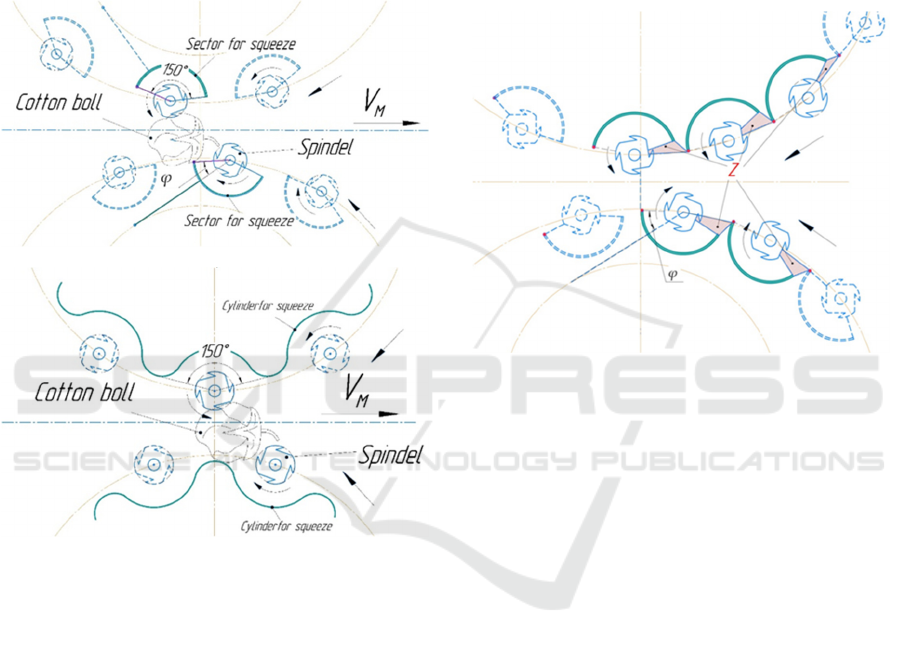
Figure 3 shows a schematic of the interaction
between the pressing sector of the elliptical drum and
a cotton boll. It is easy to see from the diagram that
the edge of the pressing sector of the right drum, with
its complex movement, tends to compress the boll
towards the spindle of the left drum, creating an
additional condition for the reliable penetration of the
spindle tooth into the cotton segment. The simulation
using GeoGebra clearly demonstrates this process.
a)
b)
Figure 3: Diagram of the impact of the pressing sector of
elliptical and serial drums on a cotton boll: a - Apparatus
with elliptical drums; b - Apparatus with serial drums.
3 RESULTS AND DISCUSSION
Based on the visual observation of the spindle and
pressing sector movement characteristics, it was
determined that the approach or departure of the
sector edge from the central line of the working slot
in the transverse direction is related to changes in the
angle φ and the major axis of the ellipse a.
Specifically, increasing the angle φ can increase the
extent of the projection of the front edges of the
pressing sector towards the working slot. In this case,
adjacent spindles and the front edge of the pressing
sector of opposite drums create a zigzag space (zones
Z) in the entry part of the working chamber, which
positively affects the process of introducing the
cotton plants into the working zone (Figure 4). A
similar effect can be achieved by increasing the major
axis a of the ellipse; however, unlike the parameter φ,
changing this parameter significantly impacts the
spindle speed modes, especially in transitional zones
(Yakubov et al., 2024). It should be noted that in the
serial apparatus, the effect of forming zones Z, which
would facilitate the introduction of plants into the
working chamber in a vertical position, is absent.
Figure 4: Formation of the zigzag space Z in the working
slot of the apparatus with elliptical drums.
4 CONCLUSIONS
1. Ensuring the introduction of cotton plants into
the working chamber in a vertical position within
the design of a serial vertical-spindle apparatus is
challenging. Introducing additional devices or
other structural changes into the drum design
may complicate the drum structure or reduce the
machine's performance.
2. The movement characteristics of the pressing
sectors of the elliptical drum, in terms of
interaction with cotton plants in the working
zone, are significantly advantageous compared to
the serial drum. The front edges of the pressing
sectors of the elliptical drum are more active in
the working chamber, and this phenomenon can
be utilized to facilitate the introduction of plants
into the working chamber in a vertical position.
3. The degree of activity of the pressing sector of
the elliptical drum depends on the size of the
major axis of the ellipse 𝑎 and the angle of the
pressing sector's position φ.
Optimization of Bush-Guiding Efficiency in Vertical-Spindle Cotton Pickers Through Elliptical Drum Design: A Simulation-Based Study
97

REFERENCES
Abdazimov, A.D., Sadriddinov, A.S., & Tulaev, A.R.,
2011. Phase discrete modeling of harvesting apparatus
processes during controlled movement of cotton bolls.
Tashkent: Izdat. Nas. Library of Uzbekistan named
after A. Navoi.
Amanov, A., Sembiring, J.P.B.A., & Amanov, T., 2019.
Experimental investigation on friction and wear
behavior of the vertical spindle and v-belt of a cotton
picker. Materials, 12(5), 773.
https://doi.org/10.3390/ma12050773.
Bahadirov, G., Ravutov, S., Abdukarimov, A., &
Toshmatov, E., 2021. Development of the methods of
kinematic analysis of elliptic drum of vertical-spindle
cotton harvester. IOP Conference Series: Materials
Science and Engineering, 1030(1), 012160.
https://doi.org/10.1088/1757-899X/1030/1/012160.
Ravutov, S.T., 2019. Problems of increasing the efficiency
of the vertical spindle cotton picker. Problems of
Mechanics, Tashkent, 4, 51-55.
Ravutov, Sh.T., Rizayev, A.A., & Rajapbaev, U.A., 2023a.
Enhancing cotton harvesting efficiency through
elliptical drum design: A comparative analysis of
spindle performance in the working area. IOP
Conference Series: Earth and Environmental Science,
1231, 012005. https://doi.org/10.1088/1755-
1315/1231/1/012005.
Ravutov, Sh.T., Ibragimov, G.I., Shokirov, S.Sh., &
Komilov, Sh.J., 2023b. Synthesis of the contour and
dimensions of the guiding channel of an elliptical drum
according to the operation conditions and kinematic
regimes. IOP Conference Series: Earth and
Environmental Science, 1284, 012015.
https://doi.org/10.1088/1755-1315/1284/1/012015.
Ravutov, Sh.T., Rizayev, A.A., & Rajapbaev, U.A., 2022.
On the issue of increasing the efficiency of the spindles
of a vertical-spindle cotton picker. IOP Conference
Series: Earth and Environmental Science, 1112,
012043. https://doi.org/10.1088/1755-
1315/1112/1/012043.
Rizaev, A.A., 2017. Research and creation of worker
organs of a cotton cleaner with high efficiency.
Tashkent: FAN.
Rizayev, A., Alimova, D., & Alimov, B., 2022. Modeling
spindle drive device of the cotton harvester. IOP
Conference Series: Earth and Environmental Science,
1112, 012042. https://doi.org/10.1088/1755-
1315/1112/1/012042.
Sablikov, V.M., 1985. Cotton pickers. Moscow:
Agropromizdat.
Shoumarova, M., Abdillayev, T., & Yusupov, S. A., 2022.
Parameters of the stabilizer of the poly-V belts of the
drive of vertical spindles for stable cotton harvesting
performance. IOP Conference Series: Earth and
Environmental Science, 1076(1), 012020. DOI:
10.1088/1755-1315/1076/1/012020.
Shoumarova, M., Abdillayev, T., Duskulov, A.A., &
Yusupov, Sh.A., 2023. The need for instrumental
measurement of the traction force of the friction drive
of the vertical spindles of the cotton harvesting
machine. E3S Web of Conferences, 443, 04014. DOI:
10.1051/e3sconf/202344304014.
Turanov, K., Abdazimov, A., Shaumarova, M., & Siddikov,
S., 2021a. Type analysis of a multiloop coulisse
mechanism of a cotton harvester. Advances in
Intelligent Systems and Computing, 1258, 290–305.
https://doi.org/10.1007/978-3-030-57450-5_27.
Turanov, K., Abdazimov, A., Shaumarova, M., & Siddikov,
S., 2021b. Mathematical modeling of a multiloop
coulisse mechanism of a vertical spindle cotton
harvester. Advances in Intelligent Systems and
Computing, 1258, 306–321.
https://doi.org/10.1007/978-3-030-57450-5_28.
Yakubov, K., Ravutov, S., Masharibov, A., Kadirov, İ.,
2024a. Theoretical substantiation of the parameters of
the Debris removal device of the cotton picker
apparatus. BIO Web of Conferences, 116, 01017.
https://doi.org/10.1051/bioconf/202411601017.
Yakubov, K., Ravutov, S., Atakhanov, İ., Radjabov, R.,
2024b. Theoretical justification of the parameters of the
improved transport corridor of the cotton harvester
apparatus. BIO Web of Conferences, 116, 01013.
https://doi.org/10.1051/bioconf/202411601013.
I-CRAFT 2024 - 4th International Conference on Research of Agricultural and Food Technologies
98
