
Granulometric Composition and Dimensional and Mass Parameters
of Granular Feed Distributed to Fish
Komil Astanakulov
1
, Fazliddin Kurbanov
2
and Farida Isakova
2
1
National Research University “Tashkent Institute of Irrigation and Agricultural Mechanization Engineers”,
Tashkent, 100000, Uzbekistan
2
Tashkent State Agrarian University, Tashkent, 100140, Uzbekistan
Keywords: Granules, Granulometry, Fish Feed.
Abstract: When developing a fish feed distribution device and justifying the parameters of the working parts of the feed
distributor, including the centrifugal feed distribution disc, with uniform distribution of granular feed within
the established requirements for fish ponds, it is important to know the granulometric composition and
dimensional and mass parameters of granular feed. Granular feeds contain a relatively large number of
fractions larger than 15 mm. The number of these fractions averages 21.0%, their mean square deviation is
3.54%, and the coefficient of variation is 16.86%. In granular feeds, the smallest amount was fractions within
5-10 mm in length, and their number averaged 10.2% of the total amount of feed. The average square deviation
of the amount of feed of this size was 1.92%, and the coefficient of variation was 18.82%. This condition
means that granules of 5 to 10 mm in size will have similar dimensions, while granules of 10 to 15 mm in size
and fractions of more than 15 mm in size will have relatively large size differences from each other.
1 INTRODUCTION
The design features of the device when developing a
device for spreading granular feed into fish ponds are
that in order to study the technological process of the
device and substantiate the parameters of the feed
spreader, it is necessary to study some physical and
mechanical properties of granular feed as a handout.
A number of researchers such as V. A.
Murovanny, M. A. Zaitseva, V. V. Lavrovsky, V. F.
Nekrasivich, A. N. Chipinova, B. T. Sariev, A. T.
Lebedev, T. Condo, K. Mizuno, T. Kato, M.
Mohsenin, D. M. McRandal, P. B. McNulty, V. M.
Sonde, P. N. Belkhode, C. N. Sakhole, A. M. Shal, Z.
Ghorbani, Y. Jekendra, A. Kumar conducted
scientific research in the field of studying the
physico-mechanical properties of granular feeds
(Sattarov et al., 2020; Djiyanov et al., 2024).
In Uzbekistan, a number of researchers have also
been engaged in determining the physical and
mechanical properties of feed. Including I. I.
Khalilov, B. G. Kamilov, D. Niyazov, G. M.
Saifullaev, H. Gafforov, D. S. Gusenov, K. D.
Astanakulov, F. U. Karshiev, B. A. Khotamov, A. N.
Barotov, Sh. H. Gapparov, etc. scientific research was
conducted to study the physico-mechanical and
morphological properties of fish feeds, in the form of
granules and green mass (Isakova et al., 2024;
Astanakulov et al., 2023).
In scientific studies conducted by the above-
mentioned scientists, the physico-mechanical
properties of granular feed were studied, in which the
physico-mechanical properties of granular feed in
terms of dispersion and volatility were not studied
comprehensively enough. In our republic, when
feeding fish, along with the green mass, they are also
fed with granular feed.
On fish farms, when spreading granular feed into
a fish pond, they must scatter granular feed of a
certain size and in the same quantities, taking into
account the specifics of the design of the new device
that does this, as well as the fact that the device must
distribute them all with the same quality, despite the
fact that different granular feeds are distributed in the
dispenser. It will study the physical and mechanical
properties of feed.
It is also important to know the granulometric
composition and dimensional and mass parameters of
granular feed when developing a fish feed distribution
device and justifying the parameters of the working
parts of the feed distributor, including the centrifugal
feed distribution disk, with uniform distribution of
Astanakulov, K., Kurbanov, F. and Isakova, F.
Granulometric Composition and Dimensional and Mass Parameters of Granular Feed Distributed to Fish.
DOI: 10.5220/0014045300004738
Paper published under CC license (CC BY-NC-ND 4.0)
In Proceedings of the 4th International Conference on Research of Agricultural and Food Technologies (I-CRAFT 2024), pages 79-82
ISBN: 978-989-758-773-3; ISSN: 3051-7710
Proceedings Copyright © 2025 by SCITEPRESS – Science and Technology Publications, Lda.
79
granular feed within the established requirements for
fish ponds.
2 MATERIALS AND METHODS
Experiments to determine the physical and
mechanical properties of granular feed were carried
out on the basis of the methods set out in the
normative documents GOST 20915-2011
“Agricultural machinery. Methods for determining
test conditions” and "physical properties of plant and
animal materials" (Аlijanov et al., 2020; Orlov and
Richagov, 1985).
The proposed research program mainly included
the determination of the average length, diameter,
weight and composition of granular feeds, as well as
the ratio of their constituent components, density,
angle and coefficient of friction and crushing
strength.
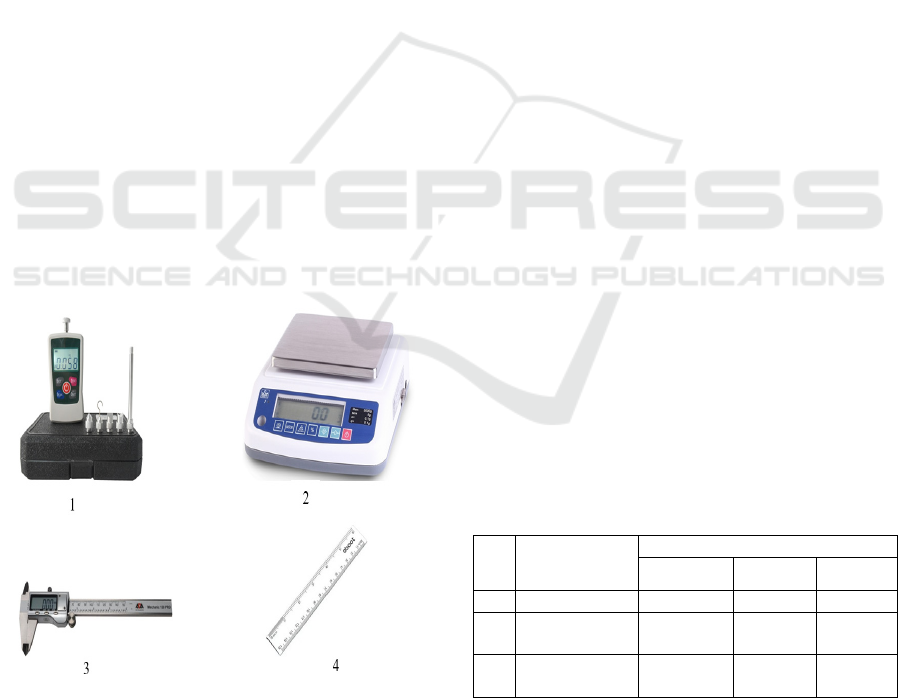
A ruler, a caliper, an electronic scale, an inclined
plane device and an AMF-500 device for determining
the crushing resistance force were used as measuring
instruments for determining the size and mass
parameters of granular feed (Fig.1).
The results obtained in the experiments were
processed by mathematical statistics methods and
their statistical characteristics were determined,
namely: the average value of (M
average)
, the mean
square deviation (σ), the coefficient of variation (V),
etc.
1- AMF-500 device; 2- Electronic Scale; 3- Caliper; 4-
Ruler.
Figure 1: Measuring instruments.
Feeds intended for feeding fish are produced
according to certain established standards GOST
28758-97 – “Granular feed for fish” and interstate
standards GOST 10385-2014 – “Compound feed for
fish” (Orlov and Richagov, 1985; Andrews and Pag,
1975).
The diameter of granular feeds developed for fish
according to these standards should be within 2.0-3.5
mm for small fish and from 2.0 mm to 15 mm for fish
placed for fattening (fish weighing 50 g and above).
It is established that their length should be from 2 to
20 mm, starting with a diameter 2 times larger.
In Uzbekistan, granular feed is mainly used to
feed fish, which are supplied for fattening. For Fish
supplied for fattening, the diameter of pellets
produced in-house and imported from abroad is
mainly in the range of 5-6 mm, and the length is in
the range from 5 mm to 20 mm.
But in order to determine what the fractional
composition of these feeds is, they were divided into
3 groups by length, namely into granular feeds up to
5-10 mm, 10-15 mm and 15-20 mm long.
To improve the accuracy of data on the
morphological composition of granules, experiments
were carried out on samples of granules prepared in
different places by different manufacturers, which
were sequentially distributed among fish for 2-3 years
(Andrews and Page, 1975; Grayton and Beamish,
1977).
3 RESULTS AND DISCUSSION
The experiments were carried out on samples of 1000
g in several revolutions. According to the results of
the experiment, it turned out that on average (M
average
)
68.8% of the composition of granular feeds
developed for fish are feeds in the range of 10-15 mm.
Their mean square deviation (σ) is 3.96%, and the
coefficient of variation (V) is 5.76% (Table 1).
Table 1. Granulometric composition of granular feed
distributed to fish.
№ Fraction size
Number of fractions, %
M
average
σ
±
V, %
1 5-10 m
m
10,2 1,92 18,82
2 Within 10-15
m
m
68,8 3,96 5,76
3 More than 15
m
m
21,0 3,54 16,86
Granular feed contains a relatively large number
of fractions larger than 15 mm. The number of these
fractions averages 21.0%, their mean square
I-CRAFT 2024 - 4th International Conference on Research of Agricultural and Food Technologies
80
deviation is 3.54%, and the coefficient of variation is
16.86%.
In granular feeds, the smallest amount was
fractions within 5-10 mm in length, and their number
averaged 10.2% of the total amount of feed. The
average square deviation of the amount of feed of this
size was 1.92%, and the coefficient of variation was
18.82%.
This condition means that granules of 5 to 10 mm
in size will have similar dimensions, while granules
of 10 to 15 mm in size and fractions of more than 15
mm in size will have relatively large size differences
from each other.
In order to clarify the size and mass parameters of
these fractions, the length, diameter and mass of each
fraction were determined separately. From the
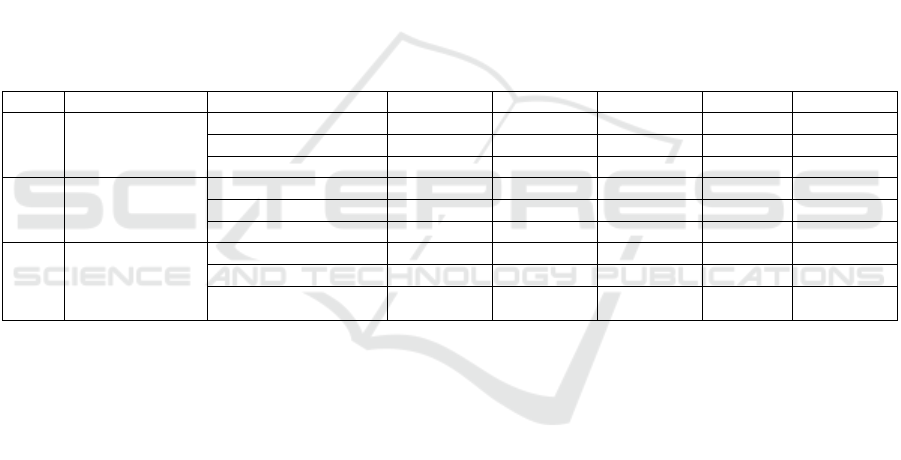
granules of the 5-10 mm fraction, it turned out that
with the length of the largest (x
max
) 9.8 mm, and the
smallest (x
min
) 5.1 mm, their average length is 8.5
mm, the standard deviation is 1.06 mm, and the
coefficient of variation is 12.48% (Table 2).
On the other hand, the diameter of the granules in
the 5-10 mm fraction varied between 5.0-5.2 mm, and
it was found that they averaged 5.09 mm. Their mean
square deviation and coefficient of variation are also
insignificant and amount to 0.05 mm and 0.97%,
respectively.
The length of granules in granular feeds, the size
of which is in the range of 10-15 mm, varies from a
minimum of 10.2 mm to a maximum of 14.9 mm,
with an average of 13.21 mm. Considering that their
mean square deviation is 0.97 mm and the coefficient
of variation is 7.32%, this suggests that they do not
differ much from each other.
The diameter of the granules in this fraction is also
in the range of 5.0-5.2 mm, which averages 5.09 mm,
and their difference is very small, the mean square
deviation is 0.05 mm, and the coefficient of variation
is 0.9 %.
Table 2.:Size and mass indicators of granular fish feed.
№ Granule sizes Indications x
max
x
min
M
average
σ V, %
1 5-10 mm
len
g
th, m
m
9,8 5,1 8,50 1,06 12,48
diameter, m
m
5,2 5,0 5,09 0,05 0,97
weight, g
r
0,271 0,159 0,21 0,03 14,03
2 10-15 mm
length, m
m
14,9 10,2 13,21 0,97 7,32
diameter, m
m
5,2 5,0 5,09 0,05 0,92
wei
g
ht,
gr
0,389 0,265 0,32 0,03 8,81
3 15-20 mm
len
g
th, m
m
20,0 15,2 16,90 1,22 7,25
diameter, m
m
5,2 5,0 5,10 0,06 1,19
weight, gr 0,479 0,365 0,40 0,03 7,77
This circumstance is explained by the use of
matrices of the same diameter in the production of
granular feed. The difference in the diameter of the
granules is explained by the fact that they expand or
contract relatively during the construction process.
The diameter of the granules in the 15-20 mm
fraction also varied between 5.0-5.2 mm, their
average value was 5.1 mm, and was the same as the
diameter of the granules in the 5-10 mm to 10-15 mm
fraction.
Within the limits of a 15-20 mm long fraction, the
maximum length of the granules was 20.0 mm, and
the minimum was 15.2 mm, while their average value
was 16.9 mm. With their mean square deviation of
1.22 mm, the coefficient of variation was 7.25
percent. This circumstance indicates that in fractions
with a length of 15-20 mm, the length of the granules
is mainly in the range of 15.7-18.1 mm, while
granules, larger or smaller in size, make up a very
small amount.
In the experiments, the mass of granules was also
determined by fractions. At the same time, the mass
of granules in a fraction with dimensions within 5-10
mm varies between 0.159 - 0.271 g and averages 0.21
g, the mass of granules in a fraction with dimensions
within 10-15 mm varies between 0.265 - 0.389 g. The
mass of granules in a fraction with dimensions within
15-20 mm varies on average 0.265 g, the mass
granules in the range of 0.479 g, which is an average
of 0.40 g turned out.
4 CONCLUSION
1. As a rule, the mass of granules in a fraction with
a size of 10-15 mm is 1.52 times greater than the
mass of granules in a fraction with a size of 5-10
mm, whereas the mass of granules in a fraction
with a size of 15-20 mm is 1.25 times less.
Granulometric Composition and Dimensional and Mass Parameters of Granular Feed Distributed to Fish
81

2. The maximum value of the mass of granules
(0.271 g) In a fraction in the range of 5-10 mm,
exceeding the minimum value of the mass of
granules in the range of 10-15 mm (0.265 g), this
condition is observed even in fractions in the
range of 10-15 mm and 15-20 mm, which is
explained by the fact that each granule also
partially differs from each other in density.
3. The difference in the mass of granular feed
indicates that they directly affect the uneven
distribution during the distribution process, and
this must be taken into account when justifying
the parameters and operating modes of the feed
distributor disk.
REFERENCES
Andrews J and Page J 1975 Transaction of American
Fisheries Society 104 (2) 317-321
Astanakulov K D, Gapparov Sh, Karshiev F,
Makhsumkhonova A and Khudaynazarov D 2020 IOP
Conf. Series: Earth and Environmental Science 614
012158
Astanakulov, K., Kurbonov, F., Isakova, F. 2023, E3S Web
of Conferences, 381, 01001
https://doi.org/10.1051/e3sconf/202338101001
Bone Q and Bidwell J P 1978 Journal fishers research
board Canadian 35 (7) 1012-1016
Borotov A 2021 IOP Conference Series: Earth and
Environmental Science 868 012035
Borotov A Cutting length the fodders of green stalks by
drum chopper. IOP Conf. Series: Materials Science and
Engineering 883 012160
Djiyanov, M., Xalilov, R., Isakova, F. 2024, BIO Web of
Conferences, 85, 01034
https://doi.org/10.1051/bioconf/20248501034
Edwards D 1976 Fish Farming International 3 (4) 16-20
Gapparov Sh and Karshiev F 2020 IOP Conference Series:
Materials Science and Engineering 883 012158.
Grayton B D and Beamish F W H 1977 Aquaculture 2 159-
172
Isakova, F., Tadjibekova, I., Kurbonov, F. 2024, BIO Web
of Conferences, 85, 01037
https://doi.org/10.1051/bioconf/20248501037
K D Аstanakulov, G G Fozilov, N M Kurbanov, B Sh
Adashev and S A Boyturayev 2020 IOP Conf. Series:
Earth and Environmental Science 614 012129
Khudayorov, Z., Khalilov, R., Gorlova, I., Mirzakhodjaev,
S., Mambetsheripova, A. 2023, E3S Web of
Conferences, 365, 04011
https://doi.org/10.1051/e3sconf/202336504011
Khudayorov, Z., Khalilov, R., Mirzakhodjaev, S.,
Nurmikhamedov, B., Mamasov, S. 2023, E3S Web of
Conferences, 376, 02013
https://doi.org/10.1051/e3sconf/202337602013
Khudayorov, Z., Mirzakhodjaev, S., Khalilov, R.,
Nurmikhamedov, B., Mamasov, S. 2023, E3S Web of
Conferences., 390, 01033
https://doi.org/10.1051/e3sconf/202339001033
Mamatov F, Karshiev F and Gapparov Sh 2021 IOP
Conference Series: Earth and Environmental Science
868 012060
Mamatov, F., Mirzaev, B., Mirzahodzhaev, S., Uzakov, Z.,
Choriyeva, D. 2021, IOP Conference Series: Materials
Science and Engineering, 1030(1), 012164 DOI:
10.1088/1757-899x/1030/1/012164
Mirzakhodjaev, S., Djiyanov, M., Nurmikhamedov, B.,
Mamasov, S. 2024, BIO Web of Conferences, 85,
01035 https://doi.org/10.1051/bioconf/20248501035
Mirzakhodjaev, S., Shodiev, K., Uralov, G., Badalov, S.,
Choriyeva, D. 2021, E3S Web of Conferences, 264,
04047 https://doi.org/10.1051/e3sconf/202126404047
Mirzakhodjaev, S., Utaganov, K., Musurmonov, A. 2024,
BIO Web of Conferences, 85, 01036
https://doi.org/10.1051/bioconf/20248501036
Orlov Yu I and etcl. 1990 Fisheries 3 84
Orlov Yu I and Richagov L N 1985 Fisheries 3 72
Sattarov N E, Borotov A N, Ashurov N A, Sattarov M N,
Yunusov R F and Abduganiev A A 2020 IOP Conf.
Series: Earth and Environmental Science 548 072032
Аlijanov D, Abdurokhmonov Sh, Jumatov Y and
Bozorboev A 2020 IOP Conf. Series: Materials Science
and Engineering 883 012155
I-CRAFT 2024 - 4th International Conference on Research of Agricultural and Food Technologies
82
