
Development of Technology for the Production of a New Lightweight
Composite Using Recycled Aluminum and Mineralized Wood Waste
Simonetta L. Pagliolico
1a
, Shirinkhon Turakhujaeva
2b
, Graziano Ubertalli
1c
,
Abdutolib Parmonov
3d
and Madina Safarova
4e
1
Department of Applied Science and Technology, Politecnico di Torino, Italy
2
Department of Mechanical and Aerospace Engineering, Turin Polytechnic University in Tashkent, Uzbekistan
3
Jizzakh branch of the National University of Uzbekistan, Jizzakh, Uzbekistan
4
Jizzakh State Pedagogical University, Jizzakh, Uzbekistan
Keywords: Composite Materials, Lightweight Structures, Recycled Aluminum.
Abstract: This paper presents the development of an innovative technology for producing a lightweight composite
material utilizing recycled aluminum and mineralized wood waste. The primary objective is to create an
environmentally sustainable material that offers significant weight reduction and enhanced mechanical
properties for various industrial applications. The process involves the amalgamation of aluminum, reclaimed
from post-consumer products, with wood waste that has undergone mineralization to improve its durability
and compatibility with metal matrices. Key aspects of the development include optimizing the mineralization
process, ensuring uniform dispersion of wood particles within the aluminum matrix, and achieving strong
interfacial bonding. Preliminary results demonstrate that the new composite exhibits superior strength-to-
weight ratios and thermal stability compared to traditional materials. This advancement holds potential for
widespread applications in automotive, aerospace, and construction industries, promoting both resource
efficiency and environmental conservation.
1 INTRODUCTION
The management of waste and by-products from
manufacturing and agricultural activities represents a
great challenge for the circular economy and
sustainable development.
The European Commission adopted the new
Circular Economy Action Plan (CEAP) in March
2020 (European Commission, 2020) as part of the
European Green Deal to improve the benefits of the
circular economy on carbon reduction and carbon
removals, also through long term storage in wood
construction and re-use and storage of carbon in
products such as mineralization in building material.
While specific regulations regarding the reuse of
wood waste from agricultural activities are not
explicitly outlined, the European Green Deal
a
https://orcid.org/0000-0003-4390-8345
b
https://orcid.org/0009-0004-2069-9362
c
https://orcid.org/0000-0002-4628-7639
d
https://orcid.org/0000-0002-2423-5299
e
https://orcid.org/0009-0002-7872-8872
emphasizes sustainability, circularity, and resource
efficiency across various sectors, including
agriculture and forestry. Initiatives and policies aim
to reduce waste, enhance resilience, and promote
sustainable practices throughout the entire lifecycle
of products (European Commission, 2020).
The Republic of Uzbekistan is reforming its
legislation to have a sustainable wastes management.
The State Committee on Ecology and Environmental
Protection of the Republic of Uzbekistan organized in
2019 a roundtable discussion on the “Strategy for
solid waste management in the Republic of
Uzbekistan for 2019-2028” (State Committee on
Ecology and Environmental Protection of the
Republic of Uzbekistan, 2019), which promoted,
among other topics, the secondary resource
utilization, encompassing both reusing and recycling
40
Pagliolico, S. L., Turakhujaeva, S., Ubertalli, G., Parmonov, A. and Safarova, M.
Development of Technology for the Production of a New Lightweight Composite Using Recycled Aluminum and Mineralized Wood Waste.
DOI: 10.5220/0014043500004738
Paper published under CC license (CC BY-NC-ND 4.0)
In Proceedings of the 4th International Conference on Research of Agricultural and Food Technologies (I-CRAFT 2024), pages 40-44
ISBN: 978-989-758-773-3; ISSN: 3051-7710
Proceedings Copyright © 2025 by SCITEPRESS – Science and Technology Publications, Lda.

of materials, with the aim of an overall energy savings
and energy reduction to create new items, and
recovery using wastes as alternative energy sources
(State Committee on Ecology and Environmental
Protection of the Republic of Uzbekistan, 2019).
In the hierarchy of sustainable waste
management, waste reduction or minimization comes
first. When we reduce waste, we consume fewer raw
materials, helping to preserve natural resources. In the
central part of the pyramid which represents the
hierarchy of sustainable waste management we find
recycling, i.e. the processing of waste materials to
create new products. This can reduce the energy
needed to create new items and conserve raw
materials, avoiding waste disposal in landfill. Energy
recovery is a step lower and allows to generate energy
and reduce the use of landfills. At the base of the
pyramid we find landfill disposal, which involves a
significant use of land and the risk of methane
emissions and leachate formation. The best approach
involves a combination of these strategies,
prioritizing waste reduction and promoting a circular
economy.
Wood waste is commonly either downcycled for
use as biomass fuel or upcycled into engineered wood
products that exhibit superior properties compared to
solid wood. These products are typically created by
bonding fragmented wood using organic
thermosetting adhesives, including plywood, OSB
(oriented strand board), MDP (medium-density
particleboard), MDF (medium-density fiberboard),
and HDF (high-density fiberboard) (Bianco et al.,
2021).
Mineralized wood (MW) can be derived from
woodworking waste. One of the authors of this study
utilized wood chips, mineralized with spherical,
silicon-rich, aluminosilicate particles, as coarse
aggregate to create an innovative structural
lightweight concrete specifically designed for
insulated lightweight building envelope applications,
as discussed by (Becchio et al., 2009). Several
benefits were achieved, including improved
durability, as silica reinforces cell walls, making them
more resistant to decay, increased fire resistance, as
silica could be a protective layer reducing wood
flammability, enhanced strength, due to the
impregnation process strengthening the wood
structure, and reduced swelling and shrinkage in
damp conditions.
One crucial focus within engineering materials
science involves developing novel, efficient, and
promising alloys for use in foundry production. The
utilization of wood waste from agricultural activities,
sawmills, and processing industries (which produce
panels, building components, and furniture) presents
an innovative opportunity for creating lightweight
aluminum components reinforced with natural wood
fibers. Omoniyi et al. (2022) created aluminum and
wood composites by incorporating wood particles
into the aluminum alloy matrix using the stir casting
technique. These aluminum-based wood composites
offer solutions for structural challenges in large roof
and floor spans. Characterization results indicate that
increasing the wood particle content in the
composition, up to a certain percentage in weight,
leads to reduced composite density while enhancing
impact strength and tensile strength compared to
unreinforced aluminum alloys.
In a prior study (Ubertalli et al., 2023), the authors
of this research started to explore the feasibility of
creating aluminum-mineralized wood (AMW)
composites materials as the core for lightweight
aluminum components by incorporating mineralized
wood chips into an aluminum alloy matrix using a
casting process.
Aluminum alloys are the second most used
metallic alloys in buildings (skirting, roof, cladding,
window and door frame, solar panel, staircase, air
conditioning system, heat exchange system, furniture,
curtain wall) and constructions (consumer electronic,
power line, thermal and electrical engine, spacecraft
component, component of land and sea vehicle)
thanks to their low density, high ductility and specific
strength, higher corrosion resistance than plain
carbon steels in environmental atmospheric
conditions, and could be 100% recycled, thus
reducing the environmental footprint and ecological
impact. Furthermore, aluminum is considered non-
combustible (A1-Euroclass reaction to fire) because
it does not sustain combustion. Some recent research
works proposed the use of aluminum foams to
produce core cavity in stiffer cast products for
automotive and aerospace, with increased stiffness,
damping properties, vibration absorption, and
acoustic and thermal insulation characteristics, even
if the wide pore size distribution and the non-
homogeneous localization of pores in the component
cause anisotropy in material properties (Ubertalli &
Ferraris, 2020; Ubertalli et al., 2020; Ferraris et al.,
2021; Ferraris et al., 2022).
In this research it is crucial to focus on improving
the efficiency of component materials (Turakhujaeva
et al., 2023). Additionally, we investigated the macro
and microstructure of the composite samples.
Aluminum alloy components are manufactured using
sand casting process. Sand casting is one of the oldest
and most popular methods that allowing for the
production of small batches. The process involves
Development of Technology for the Production of a New Lightweight Composite Using Recycled Aluminum and Mineralized Wood Waste
41
pouring liquid aluminum alloy into sand molds that
contain Mineralized Wood (MW) chips inside
cylindrical permeable cages, which serve as the core
volume inside the component. The liquid aluminum
infiltrates the spaces between the wood chips
resulting, after solidification, in a continuous,
interconnected metal structure, connected to the
aluminum skin of the component.
This approach may allow the production of thick-
walled components with superior bending and
torsional properties compared to thin-walled, ribbed
components, while still maintaining a lower overall
density. The characterization of the micro and macro
structure of Aluminum Mineralized Wood (AMW)
composites involved techniques such as optical and
electron scanning microscopy and CT-scan. In an
ongoing works we will explore how the inclusion of
mineralized wood chips impacts the properties of the
samples, including vibration and sound absorption
(Cottone et al., 2023; Tursunbaev et al., 2023;
Tursunbaev et al., 2024).
2 MATERIALS AND METHODS
Four samples have been prepared. Mineralized Wood
(MW) chips were selected based on two different size
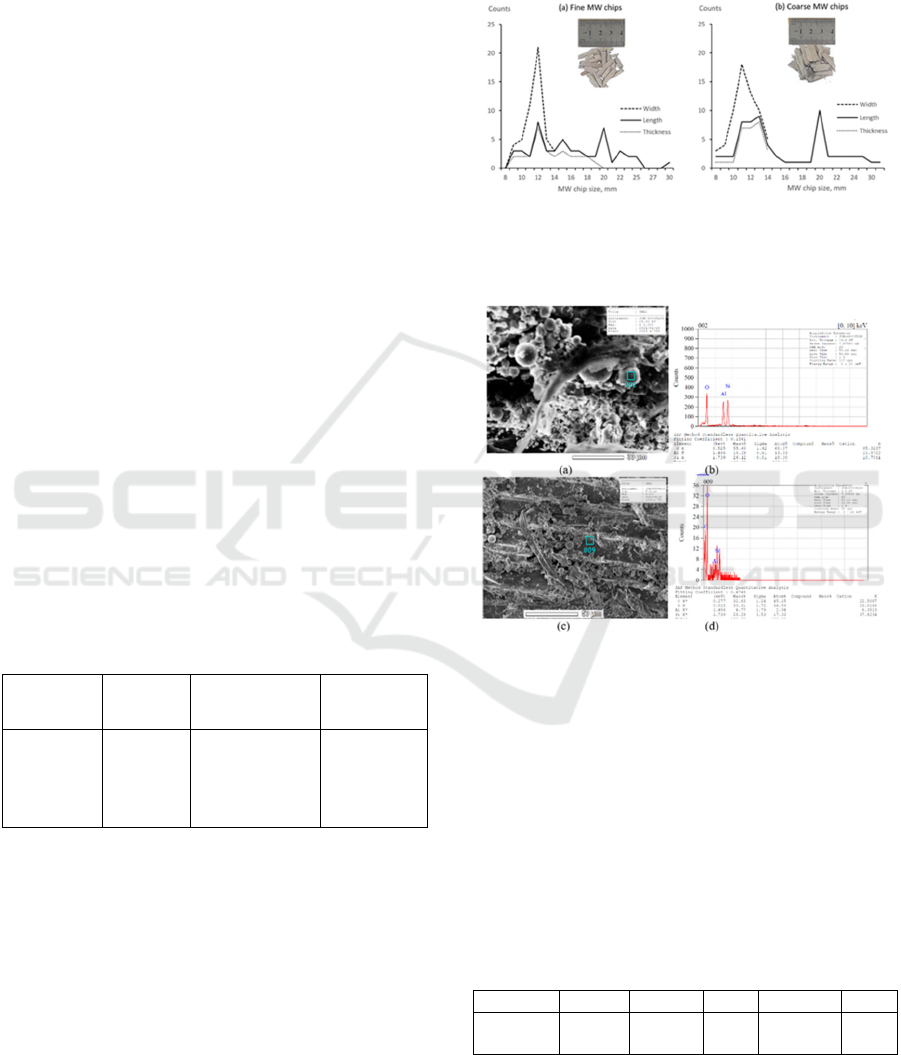
distribution, fine and coarse (Figure 1), oven dried at
103°C until a constant mass was reached, weighed
and proportioned for each sample as reported in the
Table 1.
Table 1: MW weight and weight percent of coarse and fine
chips used in the AMW composite samples (#).
Sample ID MW
wtg
Coarse MW
wt
%
Fine MW
wt
%
1 3.18 79% 21%
2 3.16 62% 38%
3 3.27 55% 45%
4 3.55 40% 60%
In Figure 2 are reported the SEM micrographs of
the spherical, silicon-rich, aluminosilicate particles
formed in mineralization process (a) and the
associated EDS spectra (b). These particles have a
slight variation in Al, Si and O proportions and
significantly differ in size. The morphology and
elemental analysis indicated that the particles were
composed of aluminosilicate spheres and probably
traces of iron.
The micrographs of wood (c) associated with the
EDS spectra (d) highlights the morphology of the
long tubular wood cells and the deposition on wood
cell walls of spherical, silicon-rich, aluminosilicate
particles. EDS analysis on wood walls showed the
presence of carbon and oxygen, which are the main
elements in wood, and, possibly, also the
impregnation of the walls by silicon-rich compounds.
Figure 1: Mineralized wood chips: particle size distribution
(length, width and thickness) of fine (a), and coarse chips
(b).
Figure 2: Micrographs of MW chips: SEM image (x1000)
(a) and EDS elemental spectra of the spherical, silicon rich,
aluminosilicate particles (b); SEM image (x600) (c) and
EDS elemental spectra of wood (d).
The recycled aluminum alloy used for casting is
the AK5M2, according to the GOST designation
(GOST 1583-93, 1993) Tursunbaev et al., 2023;
Ubertalli and Ferraris, 2020; Ubertalli et al., 2023). It
is a foundry alloy of the system Al-Si-Cu used to
manufacture shaped castings by various casting
techniques, including sand casting, and having the
chemical composition reported in table 2.
Table 2: Chemical composition of samples.
Standar
d
Si Cu Fe Ti Al
GOST
1583-93
4-6 1.5-3.5
≤1
0.05-0.2 Rest
Four permeable cylindrical aluminum mesh cages
(Figure 3a) containing the MW chips have been
I-CRAFT 2024 - 4th International Conference on Research of Agricultural and Food Technologies
42
placed inside the molds (Figure 3b). Sand molds are
formed by packing sand around a pattern, which
replicates the external shape of the desired cylindrical
casting. These cages formed the core of AMW
samples (Figure 3c). Molten AK5M2 alloy is heated
up to 750 °C, and it is than poured into the molds
containing mineralized wood chips (Figure 3c).
Figure 3: Permeable cylindrical aluminum mesh cages
containing the MW chips (a); cylindrical aluminum mesh
cages containing the MW chips are placed inside the molds
(b); pouring of aluminum into the mold (c).
3 RESULTS AND DISCUSSION
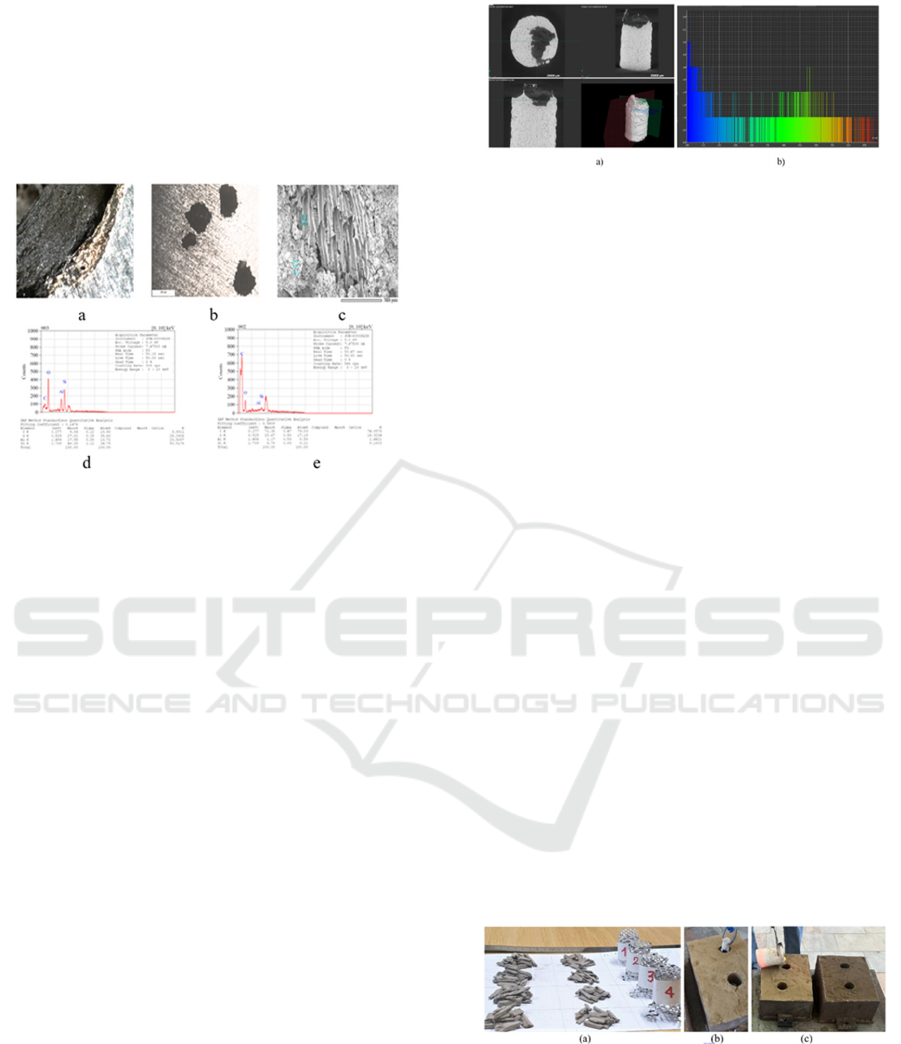
After solidification, the axial section of the samples
showed that the mineralized wood chip had become
black in color (Fig. 4a) undergoing a pyrolysis
process with marked development of fume (observed
during casting) and that the aluminum metal cage had
melted, allowing to charred wood to float on liquid
aluminum. The interface between wood and
aluminum appears to copy the shape of the chips, but
there is an almost continuous gap between the two
materials, also due to the poor wettability of the
wood. In the metallographic image of a cross-section
(Figure 4b) some bubble-like cavities and nodule-like
particles appear. We can assume that they have been
generated by bubble gas developed during casting (cf.
Figure 5a).
The morphology and the elemental composition
of spherical aluminosilicate particles (Figure 4c and
Figure 4d) seems not to be changed after casting. On
the contrary, the composition of wood (Figure 4c and
Figure 4e) varied sensibly (cf. Figure 2d and Figure
4e) because of wood pyrolysis in contact with the
molten alloy at high temperature and burning of wood
in contact with air. The elemental analysis highlights
that the percentage of oxygen is noticeably decreased.
Figure 4: Sample 1 after casting: macro image (a);
metallographic image (b); SEM image of MW surface after
casting (c); EDS analysis of spherical aluminosilicate
particles; EDS analysis of MW after casting (e).
Sample 1 was analyzed by CT-scan showed wood
chips on top of the sample, due to the dissolution of
the aluminum cage containing the MW chips, the
difference of density between metal and wood and the
gases developed from wood during casting which did
not allow the rapid formation of a skin of solid
aluminum on the top of the sample (Figure 5a). It is
also evident the high amount of pores and nodule-like
particles in the aluminum-based matrix (Figure 5b)
due to the delivering of gases before solidification.
Gases are produced during partial combustion but
mainly wood pyrolysis of the chips wood at high
temperature due to hot liquid aluminum.
Figure 5b shows the size distribution of AMW
composite void and/or nodule-like particles
calculated by the add-on Foam/powder analysis
module of CT-scan VGStudio Max 3.5 software
(Volume Graphics, Heidelberg, Germany). The void
(and/or nodule-like particles) equivalent diameter for
any single unit, i.e. the diameter of a sphere that has
the same volume as the single unit cell, has been
calculated. The equivalent diameter distribution
appears bimodal with two mean diameter values,
respectively 110 µm and 475 µm. Majority of voids
(and/or nodule-like particles) of sample 1 shows high
sphericity (φ = 0.80-0.92) and the largest voids show
the lowest sphericity.
Figure 5: Sample 1 after casting: CT-scan images (a); pore
and/or nodule-like particles size distribution (b).
4 CONCLUSIONS
In this initial research, the feasibility of casting
aluminium-mineralized wood composites was
Development of Technology for the Production of a New Lightweight Composite Using Recycled Aluminum and Mineralized Wood Waste
43

evaluated. The wood chip can guarantee the
formation of a light component core, thanks to the
low reactivity of the wood, when pyrolyzed, with
liquid aluminium. The casting process highlighted
some critical issues that can be addressed by
improving the pouring step and optimizing the
architecture of the AMW-based components. Our
future efforts will focus on overcoming these
problems and, also, optimizing materials and
components.
ACKNOWLEDGEMENTS
The authors would like to acknowledge the
Laboratory of Foundry Technologies of Tashkent
State Technical University for aluminum alloy
casting, and Prof. Sara Ferraris of GLANGE
Research Group of the Institute of Materials Physics
and Engineering, Department DISAT of Politecnico
di Torino, for SEM-EDS analysis.
REFERENCES
Becchio, C., Corgnati, S., Kindinis, A., & Pagliolico, S.,
2009. Improving environmental sustainability of
concrete products: Investigation on MWC thermal and
mechanical properties. Energy and Buildings, 41 (11),
1127-1134.
http://dx.doi.org/10.1016/j.enbuild.2009.05.013.
Bianco, I., Thiébat, F., Carbonaro, C., Pagliolico, S.,
Blengini, G.A, Comino, E., 2021. Life cycle assessment
(LCA)-based tools for the eco-design of wooden
furniture. Journal of Cleaner Production, 324, 129249.
https://dx.doi.org/10.1016/j.jclepro.2021.129249.
Cottone, R., Shtrepi, L., Serra, V., Pagliolico, S.L., 2023.
The recycling and reuse of natural materials: sound
absorbing box patterns that use waste from olive tree
pruning. Acoustics, 5(1), 177-192.
https://doi.org/10.3390/acoustics5010011.
European Commission, 2020. A new circular economy
action plan for a cleaner and more competitive Europe.
COM (2020) 98 final. Brussels, 11.3.2020. https://eur-
lex.europa.eu/legal-
content/EN/TXT/?qid=1583933814386&uri=COM:20
20:98:FIN.
Ferraris, S., Santostefano, A., Barbato, A., Molina, R.,
Ubertalli, G., 2021. Al-based foams as permanent cores
in al castings: effect of surface skin thickness and
composition on infiltration and core-shell bonding.
Metals, 11(11), 1715.
https://doi.org/10.3390/met11111715.
Ferraris, S., Santostefano, A., De Marco, F., Campagnoli,
E., Matteis, P., Barbato, A., Molina, R., Ubertalli, G.,
2022. Co-Casting of Al and Al-Foams. Advanced
Enginnering Materials, 24(9), 1-13.
https://doi.org/10.1002/adem.202200116.
GOST Standard 1583-93, 1993. Alloys aluminum casting.
Omoniyi, P., Adekunle, A., Ibitoye, S., Olorunpomi, O.,
Abolusoro, O., 2022. Mechanical and microstructural
evaluation of aluminium matrix composite reinforced
with wood particles. Journal of King Saud University –
Engineering Sciences, 34(6), 445–450.
https://doi.org/10.1016/j.jksues.2021.01.006.
State Committee on Ecology and Environmental Protection
of the Republic of Uzbekistan, 2019. Roundtable
discussion on “solid waste management strategy for the
period 2019-028”. https://uza.uz/posts/145784.
Turakhujaeva, Sh., Karimov, K, Turakhodjaev, N.,
Akhmedov, A., 2023. Mathematical modeling of
quantitative changes in hydrogen and oxide inclusions
in aluminum alloy. E3S Web of Conferences, 365,
05016. https://doi.org/10.1051/e3sconf/202336505016.
Tursunbaev, S., Turakhodjaev, N., Mardonakulov, S., &
Toshmatova, S., 2024. Effect of germanium oxide on
the properties of aluminum casting details in
agricultural machinery. BIO Web of Conferences, 85,
01024. https://doi.org/10.1051/bioconf/20248501024.
Tursunbaev, S., Turakhodjaev, N., Odilov, F.,
Mardanokulov, S., & Zokirov, R., 2023. Change in
wear resistance of alloy when alloying aluminium alloy
with germanium oxide. E3S Web of Conferences, 401,
05001. https://doi.org/10.1051/e3sconf/202340105001.
Ubertalli, G., Ferraris, S., 2020. Al-Based Metal Foams
(AMF) as Permanent Cores in Casting: State-of-the-Art
and Future Perspectives. Metals, 10(12), 1592.
https://doi.org/10.3390/met10121592.
Ubertalli, G., Turakhujaeva, S., Pagliolico, S.L., 2023.
Aluminium-Mineralized Wood Composites: exploring
a new possibility for the lightening of structural
components. International Scientific and Scientific-
Technical Conference on "Resource and Energy-
Saving Innovative Technologies in the Field of
Foundry" (Tashkent, Uzbekistan), pp. 46-49.
I-CRAFT 2024 - 4th International Conference on Research of Agricultural and Food Technologies
44
