
Determination of the Parameters of the Working Bodies of the Drum
of a Horizontal Spindle Cotton Harvesting Apparatus
Nabijon Omonov
a
, Mubarakhan Atadjanova
b
, Odiljon Kholikulov
c
and Sobirjon Sherkobilov
d
Tashkent State Technical University, 100095, University str. 2, Tashkent, Uzbekistan
Keywords: Spindle Drum, Cotton Harvesting Apparatus, Disk Separator.
Abstract: This paper presents the development of an innovative technology for producing a lightweight composite
material utilizing recycled aluminum and mineralized wood waste. The primary objective is to create an
environmentally sustainable material that offers significant weight reduction and enhanced mechanical
properties for various industrial applications. The process involves the amalgamation of aluminum, reclaimed
from post-consumer products, with wood waste that has undergone mineralization to improve its durability
and compatibility with metal matrices. Key aspects of the development include optimizing the mineralization
process, ensuring uniform dispersion of wood particles within the aluminum matrix, and achieving strong
interfacial bonding. Preliminary results demonstrate that the new composite exhibits superior strength-to-
weight ratios and thermal stability compared to traditional materials. This advancement holds potential for
widespread applications in automotive, aerospace, and construction industries, promoting both resource
efficiency and environmental conservation
1 INTRODUCTION
In recent years, in our republic, at the Tashkent
Tractor Plant JSC (Agrotech cluster), the high-
performance company "Djon-Dir" has been
producing cotton picking machines (CPM) with a
horizontal spindle (HS) equipped with picking
devices, and until now, hundreds of machines have
been delivered to clusters and farms. gave It is known
that the HS CHM was produced in the USA and is
mainly adapted to the soil-climate conditions and
agronomy of this country. Currently, more than 30
types of cotton varieties are regionalized in our
country, of which early varieties, mid-ripening and
promising varieties are considered, in addition, it is
recommended to plant new varieties. In our republic,
cotton varieties are now planted at 60, 76 and 90 cm
between rows (Matchanov, 2023).
The analysis of the work efficiency of HS and
vertical spindle (VS) CHM in the conditions of
a
https://orcid.org/0000-0001-8618-5808
b
https://orcid.org/0000-0002-9753-816X
c
https://orcid.org/0009-0001-4446-0645
d
https://orcid.org/0000-0002-6446-562X
Uzbekistan showed that the ATCs of HS machines
are on average 6...9% higher than those of VS, and
the work efficiency is almost twice as large. Based on
the results of experiments, analysis and calculations
of experts, HS CHM yield is higher than 30 t/ha,
especially in fields with high yield (43...51 t/ha) and
the degree of furrow opening is high (90% and
above), reliability indicators are also showed that it
will be high. It was shown that these HS CHMs are
not fully adapted to the conditions of Uzbekistan
(Glushenko et al., 2004; Abdazimov et al., 2014;
Abdazimov et al., 2019).
In order to eliminate the above-mentioned
shortcomings, in-depth study of the technological
process of picking this GS CHM, especially the
research of the process of pulling and wrapping the
cotton in the groin of GSh, and establishing the
dimensions and modes of the cotton picking
apparatus (CHA) suitable for the conditions of our
republic, carrying out constructive and technological
36
Omonov, N., Atadjanova, M., Kholikulov, O. and Sherkobilov, S.
Determination of the Parameters of the Working Bodies of the Drum of a Horizontal Spindle Cotton Harvesting Apparatus.
DOI: 10.5220/0014043300004738
Paper published under CC license (CC BY-NC-ND 4.0)
In Proceedings of the 4th International Conference on Research of Agricultural and Food Technologies (I-CRAFT 2024), pages 36-39
ISBN: 978-989-758-773-3; ISSN: 3051-7710
Proceedings Copyright © 2025 by SCITEPRESS – Science and Technology Publications, Lda.

adaptation works based on the suitability criteria
requires going.
2 MATERIALS AND METHODS
In our ongoing research work, the number of spindles
in the drum, spindle location parameters, spindle
material and tooth sizes were studied based on the
type of regionalized and promising varieties, the size
of cotton branches, structure and bolls, yield, planting
scheme, which are considered the main working
organs of HS CHM (Petre, 2015).
Cotton varieties have their own pattern of
formation depending on the shape and type of bush,
which pattern was determined based on the statistical
processing of the results of experiments on each
zoned cotton variety. Experiments were conducted on
the dynamics of boll opening, arrangement and
elasticity of boll elements (branches, bolls, leaves,
etc.).
Usually, it is noted that the axis of the drum and
separator should be 120-125 mm in the longitudinal
direction and 220 mm in the transverse direction
(Glushenko et al., 2004; Abdazimov et al., 2014). It
is desirable for the disk separator to be located near
the colosnik grid, that is, near the exit of the spindle
from the working chamber, but it is difficult to turn
the cassette with the spindle into the separation zone
at a short distance and in a short time. This is achieved
by choosing the most optimal variant of the guideway
profile, in which it is necessary to take into account
the increase in pressure on the guideway of the roller
when the spindle cassette turns.
It is important that the drum of the cotton picker
with horizontal spindles completely and qualitatively
separates the cotton wrapped around the spindles, that
is, it does not damage the cotton fibers and seeds. If
even a small amount of cotton pieces remain on the
spindle after passing through the disc separator, the
cotton piece of the spindle at 3000-4125 rev/min will
be wrapped in plaster and will be stuck to the cotton
in the groin in the working chamber, and the quality
of wrapping the cotton piece will be negatively
affected. Spindles in each tier should pass under the
separator disks at a distance of 0.1...1.0 mm, if this
gap is larger than this, the cotton will be wrapped
around the spindle (Omonov et al., 2021; Omonov &
Tulaev, 2021).
It is known that the horizontal spindles are
mounted on the curved-shaft cassette, and under the
action of the curved-shaft cassette through the sliding
bearing on the guideway, there are 4 complex
kinematic movements, that is, advancement with the
machine, rotation along with the spindle drum, the
curved-shaft cassette under the influence of the
guideway and the spindle fixed to it according to a
certain law around the axis of the cassette. turns and
the spindle rotates around its axis. In this case, under
the influence of the profile of the guideway, the
spindles must enter and exit the working chamber in
a forward-reciprocating motion perpendicular to the
row of yarn, enter the disk separator sideways, and
exit the separator zone at least 4 times completely,
and the spindle must also complete one full revolution
around its axis in the wetting washer zone. rotation
conditions must be ensured and these conditions are
achieved on the basis of the guideway profile and the
curved cassette. The completeness of separation of
cotton wrapped on the spindle depends on the
structural and technological parameters of the picking
apparatus, as well as on the physical and mechanical
properties of the cotton crop (Abdazimov et al., 2022;
Omonov et al., 2022; Rizaev et al., 2023).
In the study of high-quality and reliable separation
of cotton wrapped from a horizontal spindle, first of
all, development of the optimal design parameters of
the disc separator by taking into account the direction
of movement of the separator in relation to the spindle
and speed indicators, the effect of the separator
wrapped on the spindle on the cotton, as well as the
factors determining the surface of the spindle on the
working part and can be put into production. When
determining the outer diameter of the disk, L0-n+m,
where: L0 is the length of the working part of the
spindle processed by the separator, L0 - n is the length
of the working part of the spindle in the separation
zone, where the axis of the separator shaft intersects
with the axis of the spindle; m is the distance from the
end of the spindle to the separator shaft, mm
(according to the research data of M.V. Sablikov,
m=32...36 mm was considered sufficient) (Glushenko
et al., 2004).
3 RESULTS AND DISCUSSION
Work was carried out to determine the optimal
technological and structural parameters of the
guideway and the disk separator for the HS CHM sine
dialing apparatus. In the picking chamber, the
condition must be met that the spindles do not allow
the yarn to bend in the direction of CHM movement,
and for this it is necessary to achieve that the
component of the speed of the spindle center in the
picking zone in the direction of CHM movement
speed Vm=0 (Fig. 1). When determining the optimal
diameter of the disk separator, first of all, the length
Determination of the Parameters of the Working Bodies of the Drum of a Horizontal Spindle Cotton Harvesting Apparatus
37
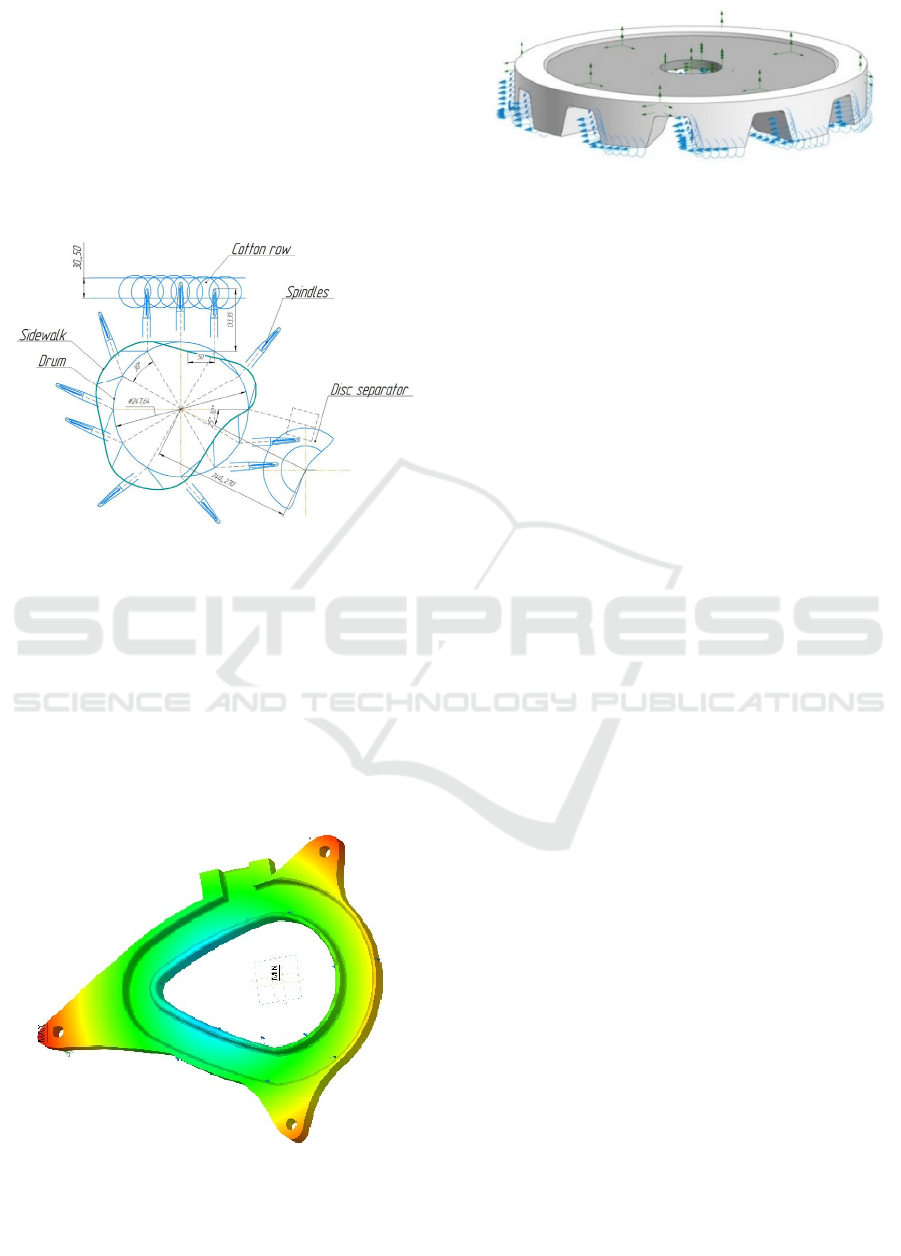
of the spindle working part (50-80 mm, the length of
the working part of the CHM spindle used in our
country is 52 mm) was taken into account, as well as
the spindle and the separator to the mutual kinematic
movement trajectory, which in turn is the spindle
cassette curvature depends on the structural
characteristics of the guideway profile. The
arrangement scheme and dimensions of the guideway
profile and disk separator on the spindle drum of the
HS machine dialing apparatus are given in Fig. 1.
Figure 1: The layout and dimensions of the working bodies
in the dialing apparatus.
A 3D model of the construction of the guideway
of the spindle drum was developed in the Compass
program, in which dynamic forces were applied to the
walls of the guideway along the X, Y, Z coordinates,
and the stability was checked (Fig. 2). In this case, the
known spindle-cassette curve ship is forced to move
along the profile of the guideway with the help of a
sliding bearing, and dynamic forces are applied to the
walls of the guideway.
Figure 2: 3D model of a spindle drum guideway.
Figure 3: 3D model of a disc separator and the forces acting
on it.
A 3D model of the disc separator was also
developed and subjected to dynamic forces and tested
for robustness. For reference, a disc separator consists
mainly of two parts: a metal alloy and a polymer
product (Figure 3).
4 CONCLUSIONS
The guide rail material is Steel 3 according to GOST
R 52246-2016, the total mass is 6.64 kg. The
coefficient of loss of stability of the newly designed
guideway (coefficient zapasa poteri ustoychivosti)
was 0.000305, the stability coefficient was 1.85...10,
the coefficient zapasa po predelu tekuchesti was
1.06...10.
The diameter of the disk separator is D=159 mm,
the total thickness is 24 mm, the diameter of the disk
of the metal part is d=137 mm, the thickness is S=4
mm, the total mass is 525 grams. The composition of
the disc separator metal alloy: Fe 96.87%, Si 1.6%,
Mn 0.96%, Ti 0.35%, Cr 0.04%, V 0.03%, Sb 0.01%,
Pb 0.01%, Sn 0.01%, P 0.01% and Niobium 0.01%.
organizes.
It was found that the structure of guideway and
disc separator in the new structure meets the
requirements of stability and durability.
REFERENCES
Abdazimov, A.D., Omonov, N.N., & Khudayorov, M.T.,
2022. Justification of the parameters of the information
model of the automatic guidance system of the cotton
harvester. IOP Conference Series: Earth and
Environmental Science, 1076, 012002. DOI:
10.1088/1755-1315/1076/1/012002.
Abdazimov, A.D., Radjabov, S.S., & Omonov, N.N., 2019.
Automation of agrotechnical assessment of cotton
harvesting machines. IOP Conference Series: Journal
of Physics: Conference Series, 1260(3), 032001. DOI:
10.1088/1742-6596/1260/3/032001.
Abdazimov, A.D., Uljaev, E., Ubaidullaev, U.M., &
Omonov, N.N., 2014. Fundamentals of automation of
I-CRAFT 2024 - 4th International Conference on Research of Agricultural and Food Technologies
38

control and control of technological parameters of
cotton harvesting machines. TSTU (Technical
University, Tashkent), 11–24.
Glushenko, A.O., Matchanov, R.D., Rizaev, A.A.,
Toshboltaev, M.T., & Khudoykulov, R.R., 2004.
Simulation of dynamic processes in horizontal-spindle
cotton pickers. Science, 7–39.
Matchanov, R.D., 2023. Development of a cotton
harvesting machine for selective cotton harvesting.
Science, Tashkent, 6–34.
Omonov, N.N. & Tulaev, B.R., 2021. Evaluation of the
degree of processing of the stalks on the basis of the
analysis of the trajectory of the spindle of the horizontal
spindle cotton harvesting machin. IOP Conference
Series: Earth and Environmental Science, 868, 012072.
DOI: 10.1088/1755-1315/868/1/012072.
Omonov, N.N., Abdazimov, A.D., Shodiyev, J.G., &
Atadjanova, M.M., 2021. Investigation of spindle
activity of horizontal spindle cotton harvesting
machine. IOP Conference Series: Earth and
Environmental Science, 868, 012073. DOI:
10.1088/1755-1315/868/1/012073
Omonov, N.N., Masharibov, A.R. & Atadjanova, M.M.,
2022. Universal row-crop tractor with a variable base:
calculation of the links of the tractor base change
mechanism. IOP Conference Series: Earth and
Environmental Science, 1076, 012006. DOI:
10.1088/1755-1315/1076/1/012006.
Petre, M., 2015. Combine Harvesters: Theory, Modeling,
and Design (USA), 4-55.
Rizaev, A.A., Alimova, D.B., Omonov, N.N., &
Mamatmurodov, I.A., 2023. About rational number of
spindles on drums of cotton harvester. E3S Web of
Conferences, 401, 04013.
https://doi.org/10.1051/e3sconf/202340104013.
Determination of the Parameters of the Working Bodies of the Drum of a Horizontal Spindle Cotton Harvesting Apparatus
39
