
Analysis of Desert Rangeland Improvement Technologies
Ismoil Ergashev
1a
, Abdulaziz Akramov
1
b
, Allamurod Ismatov
1
c
, Bekzod Tashtemirov
2d
,
Yorqin Islomov
2
e
and Furqat Namazov
2f
1
Samarkand State University Veterinary Medicine, Livestock and Biotechnologies, M. Ulugbek, 77, Samarkand, Uzbekistan
2
Samarkand Agroinnovations and Research University,
Akdarya District, Dahbet Fortress, A. Temur, 7, Samarkand, Uzbekistan
Keywords: Desert Rangelands, Pasture Improvement, Phytomelioration.
Abstract: In the world, areas prone to desertification and potentially dangerous due to desertification occupy an area of
about 52 million square kilometers. Degradation of desert pastures has a negative impact on food security,
agricultural production, and environmental ecology. 21 million hectares of Uzbekistan (47% of the total land
area) are occupied by desert pastures, more than 50% of which have been degraded to varying degrees. The
article analyzes a number of ways to improve these degraded areas, and in addition to this, the technology of
planting with discontinuously strip tillage is proposed. It is theoretically based that when using this technology,
the tillaged area is 1-3%, and the preserved vegetation cover is 97-99%.
1 INTRODUCTION
Globally, desertification-prone and desertification at
risk areas cover approximately 52 million sq km, and
economic losses from desertification alone are
estimated at US$42 billion annually. The
phenomenon of "desertification" occurs mainly as a
result of irrational use of natural resources of the land
(Eduardovich, 2016). According to the latest United
Nations data, more than 20 percent of Central Asia's
total land area is degraded, which is about 80 million
hectares - almost four times the size of Kyrgyzstan.
This situation affects approximately 30% of the
population of the region (Davronov, 2022).
Degradation of desert pastures has a negative
impact on food security, agricultural production, and
environmental ecology. Desert pastures are important
from a socio-economic point of view and serve as one
of the main natural resources for maintaining
ecological balance in the region, ensuring food
security, developing animal husbandry and improving
a
https://orcid.org/0000-0003-2865-3620
b
https://orcid.org/0009-0007-7044-4423
c
https://orcid.org/0009-0001-4111-5803
d
https://orcid.org/0000-0002-7262-4897
e
https://orcid.org0000-0001-5069-1784
f
https://orcid.org/0009-0004-5898-0918
the living standards of the population. For this reason,
it is necessary to improve the natural conditions,
contours, soil, variety and amount of plants and the
level of water supply of pastures.
In particular, 21 million hectares of our Republic
(47% of the total land area) are occupied by desert
pastures, of which more than 50% have been
degraded to varying degrees, 11 million hectares of
pastures have decreased in natural fodder production
potential and have become unusable (Bean et al.,
2004).
In these pastures, due to the insufficient
implementation of the irregular grazing system and
the sharp increase in the number of livestock, the
pastures are under great pressure. There are several
ways to improve pastures and they are listed below:
Improvement by planting (by planting seedlings
of phytomeliorational plants) - this method involves
growing seedlings in separate plots or greenhouses
and then transplanting them as seedlings (indooror
bare roots) to suitable plots. Plants are often grown in
Ergashev, I., Akramov, A., Ismatov, A., Tashtemirov, B., Islomov, Y. and Namazov, F.
Analysis of Desert Rangeland Improvement Technologies.
DOI: 10.5220/0014040800004738
Paper published under CC license (CC BY-NC-ND 4.0)
In Proceedings of the 4th International Conference on Research of Agricultural and Food Technologies (I-CRAFT 2024), pages 5-11
ISBN: 978-989-758-773-3; ISSN: 3051-7710
Proceedings Copyright © 2025 by SCITEPRESS – Science and Technology Publications, Lda.
5

greenhouses for ≥ 1 year to regenerate before planting
(Avdeeva et al., 2022). The use of seedlings with a
closed root system in planting has a number of
important advantages compared to seedlings with an
open root system. In particular, seedlings with a
closed root system take root better even in
unfavorable conditions, are resistant to transportation
over long distances, and significantly extend the
seedling period of the plant. In addition, seedlings
with a closed root system are important because the
roots are protected and the seedlings are not damaged
during planting (Brown et al., 1979).
Improvement by seeding (seeds of
phytomelioration plants) - Usually, sowing of seeds
is carried out by hand, with seeders and with the help
of airplanes, depending on the size of the cultivated
area. Sometimes the seeds are covered with husks or
covered with a protective mulch to conserve moisture
and reduce the risk of being killed by insects and
animals that feed on the seeds (Mwebaze, 2002).
Many scientists have conducted scientific
research on the development of technologies that
improve the condition of pastures by planting
seedlings and seeds abroad; (Mwebaze, 2002;
Serebrova et al., 2011; Thom et al., 2011; Yang et al.,
2012; Rayburn & Laca, 2013; Zhao, 2017; Ivansova
et al., 2019). On the development and improvement
of technologies and technical means of improving the
state of pastures with the help of seeds and seedlings
of phytomeliorative plants even in the conditions of
Usbekistan (Olmosov, 2019), (Gafurova & Nabiyeva,
2019; Ergashev et al., 2020; Farmonov et al., 2020;
Farmonov, 2021; Khudoyberdiyev et al., 2021), other
scientists, researches on planting seedlings of
phytomeliorative plants conducted by (Makhmudov
et al., 2006).
Improvement through water resources - to
improve degraded desert pastures, rainwater
harvesting basins are used to irrigate plants, and water
trucks are used if it is not raining. Practical work on
this method of solving the problem has been started
in many countries of the world with desertification
and degradation problems. As an example, Israel's
anti-desertification program focuses on centralized
water management (Farmanov, 2021). In addition, it
is possible to restore desert pastures through spring
water (Ergashev et al., 2020). Many foreign scientists
have conducted scientific research on the role of
water resources in the improvement of desert pastures
and the development of improvement technologies,
through them (Orlander & Due, 1986; Dehghanisanij
et al., 2006; Cirelli et al., 2009; Cui et al., 2015; Yi &
Zhao, 2016; Marin et al., 2017; Cui et al., 2017; Zhao,
2017; Pfeil, 2018; Orlovsky & Zonn, 2019; Dor-Haim
et al., 2023).
Improvement through fertilization (various soil
enrichment additives) - Improves soil composition
using additives, fertilizers, and other methods to
promote ecosystem-friendly soil properties when
improving degraded desert grasslands. Adding
fertilizers or organic matter (which increases the soil's
water-holding capacity) will improve soil conditions
(Çaçan & Kokten, 2019). Several scientists have
conducted scientific research on the use of fertilizers
and organic matter in enriching the composition of
degraded grassland soils. There are (Kulakov, 2006;
Zotov et al., 2011; Scott & Prater, 2018; Çaçan &
Kokten, 2019; Chen et al., 2022; Namozov et al.,
2022; Qin & Zhao, 2023).
Improvement by exposure to soil -
Rehabilitating degraded soils helps reduce erosion
and stabilize soil, and is used to provide shade
structures that help protect plants, protect seeds, and
more (Bauman, 2020). Scientists who conducted
scientific research in this regard (Yang et al., 2012;
Kimiti et al., 2016; Stephen et al., 2016; Lopez et al.,
2019; Khujanazarov et al., 2021).
Improvement without impacting the soil - it
means protecting pastures whose productivity is
decreasing for a while from livestock and other
influences. In this case, the existing plant cover will
develop, and productivity will increase due to the
reduction of external influence. Many scientific
studies have been carried out by world scientists on
the approaches to solving the problems related to the
degradation of deserts and pastures, and technologies
have been developed by scientists to solve the
problem (James, 2014; Bauman, 2020; Tlili et al.,
2021). Depending on the degree of degradation, the
region where desert pastures are located requires the
use of the above-mentioned improvement
technologies.
2 MATERIALS AND METHODS
One of the effective ways to improve pastures in
drought protection is phytomelioration, that is,
planting seeds of some desert plants from shrubs,
semi-shrubs or quality seedlings. However, when
improving pastures by seeding of phytomeliorative
plants, it takes a long time for the seeds to germinate
and be used as feed. In addition, seeding of some
phytomeliorative plants requires manual
implementation. In this case, improvement of
pastures by planting seedlings is considered to be an
acceptable solution, as well as the loss of the area
I-CRAFT 2024 - 4th International Conference on Research of Agricultural and Food Technologies
6
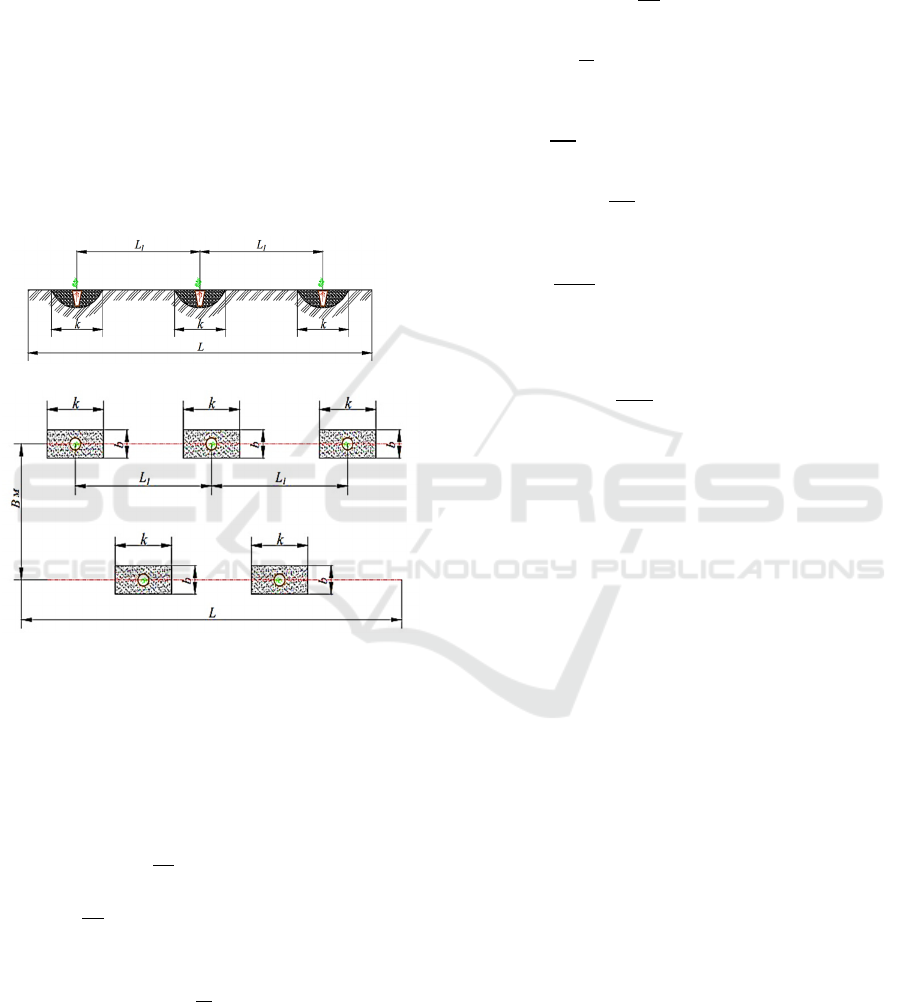
where seedlings are planted and the increase in
volume of dry areas. For planting seedlings of
phytomeliorative plants, the discontinuous strip
planting technology has been developed, by which it
is possible to achieve the preservation of the plant
cover of the intermediate area of the planted seedlings
(Fig. 1). In the proposed technology of discontinuous
strip cultivation (Fig. 1, a and b), an area with width
b and length k (k-constant number) is cultivated in the
pasture and seedlings of phytomeliorative plants are
planted in this area.In this case, the L
1
-k distance
between the tillaged areas is left uncultivated. B
M
between tillaged rows can change depending on the
type of plant to be planted.
a)
b)
a) longitudinal section; b) top view.
Figure 1: A technological scheme for improving pastures
by planting closed-root seedlings.
If we take the length L and width B of the area where
seedlings are planted, then the tillaged area with a
continuously strip (width b) is determined as follows.
𝑭
𝟏
𝒃∙𝑳∙
𝑩
𝑩
𝑴
, (1)
Here
𝑩
𝑩
𝑴
– represents the number of rows to be
worked at B
M
row spacing in a pasture of width B.
When planting seedlings in discontinuously strips in
pastures, we determine
𝑳
𝑳
𝟏
𝒏
𝒑
, since the length of
the uncultivated distance 𝓵 through the distance L
1
between seedlings is equal to 𝓵 𝑳
𝟏
𝒌.
Here k- is a fixed number, equal to k=1
n
p
-Represents the number of seedlings to be
planted in each row.
(1) Using the expression, the surface area of the
same-size (B, L) field when discontinuously tillaged
is determined as follows.
𝑭
𝟐
𝒃∙𝒏
𝒑
∙𝒌∙
𝑩
𝑩
𝑴
. (2)
Since the total area of the pasture is 𝑭
𝒕
𝑩∙𝑳,
we find 𝑩
𝑭
𝒕
𝑳
.
Then for continuously tillage technology
cultivated area equal to
𝑭
𝟏
𝒃∙𝑭
𝒕
𝑩
𝑴
. (3)
And the total uncultivated area surface equal to
𝑭
𝒄𝒐𝒏
𝑭
𝒕
𝒃∙𝑭
𝒕
𝑩
𝑴
. (4)
For discontinuously strip tillage technology,
cultivated area will be equal to
𝑭
𝟐
𝒃∙𝒌 𝑭
𝒕
𝑳
𝟏
∙𝑩
𝑴
. (5)
And the surface area of the total uncultivated area
is found from the following expression.
𝑭
𝒅𝒊𝒔.𝒄
𝑭
𝒕
𝒃∙𝒌𝑭
𝒕
𝑳
𝟏
𝑩
𝑴
. (6)
From the expressions (1) and (2), it is possible to
calculate the cultivated strip width b for 1 ha area
(L=100m, B=100m) and the cultivated area surface
for B
M
between the rows in a discontinuously tillage
and a continuously tillage.
Using expressions (4) and (6), it will be possible
to determine the surface of the field that has not been
cultivated in in a discontinuously tillage and a
continuously tillage for planting seedlings of
phytomeliorations.
3 RESULTS AND DISCUSSION
The area of influence on the soil surface of each
tillage and planting method was analyzed for
discontinuously tillage and continuously was
determined by comparison (Figures 2, 3 and 4). For
both methods, the values of the distance between
rows 𝑩
𝑴
(1) 𝐵
=1,2 m; 2) 𝐵
=2,4 m; 3) 𝐵
=3,6 m)
and the strip width b, were taken as equal (Figures 2,
3). The influence of the distance between rows 𝑩
𝑴
on
the area of the tillaged field 𝑭
𝟏
in continuously strip
planting was studied (Fig. 2).
In Figure 2, it can be seen that the values of the
distance between the rows B
M
and the width of the
strip b, increase in accordance with each other, and
the value of the tillaged area surface F
1
increases. At
B
M
=3,6 m and b=0,15 m the total tillaged area of 1
Analysis of Desert Rangeland Improvement Technologies
7
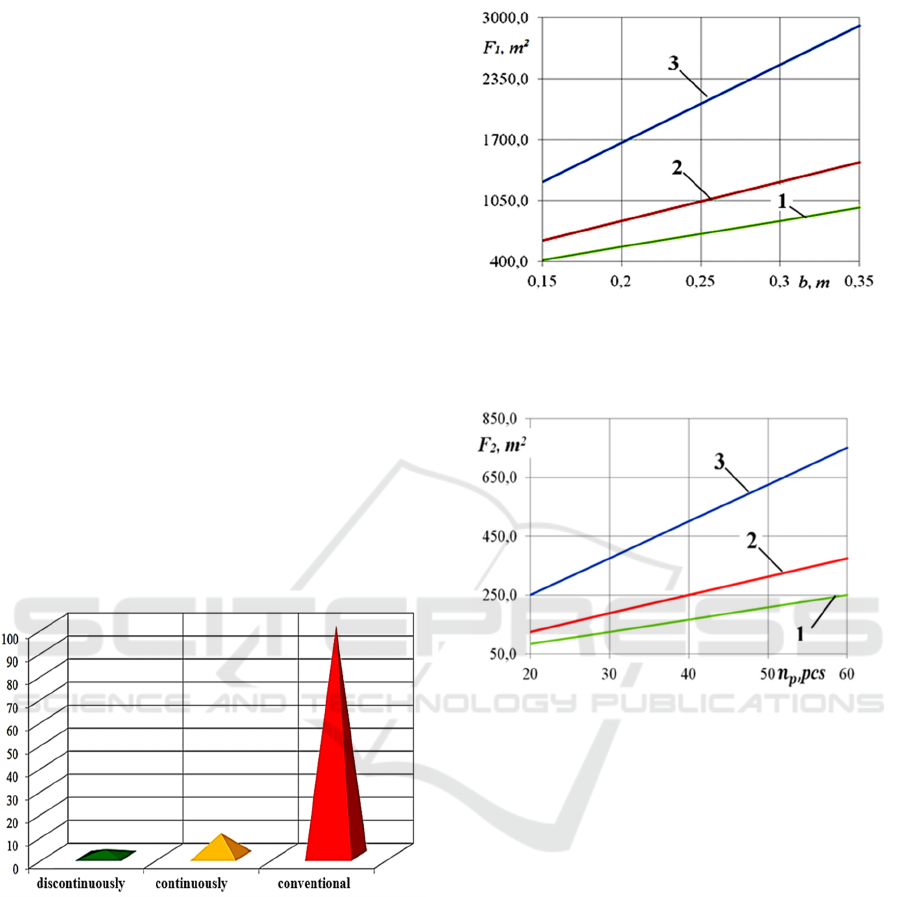
hectare of field is F
1
=361,1 m
2
. At B
M
=1,2 m and
b=0,15 m the total tillaged area of 1 hectare of field is
F
1
=1250 m
2
. The effect of the number of seedlings 𝒏
𝒑
on the surface of the tillaged area F
2
was studied (Fig.
3). It turned out that the value of the distance between
the rows B
M
is directly proportional to the value of
the number of planted seedlings 𝒏
𝒑
. That is, in Figure
3, it became known that as the values of B
M
decrease,
the value of 𝒏
𝒑
also decreases. It was found that the
decrease in the number of planted seedlings 𝒏
𝒑
directly affects the decrease in F
2
of the cultivated
field surface (Fig. 3).
In discontinuously strip planting, between the
rows B
M
=3,6 m and width of tillaged strip b=0,15 m
the cultivated area for 1 hectare will be equal to
F
2
=83,3 m
2
and the number of seedlings to be planted
is 𝒏
𝒑
560 pcs, if between the rows B
M
=3,6 m and
the width of the tillaged strip b=0,15 m the cultivated
area for 1 hectare will be equal to F
2
=250 m
2
and the
number of seedlings to be planted is 𝒏
𝒑
1667 pcs.
Based on the mathematical expressions defined
above, we will be able to compare the technologies of
planting seedlings of phytomeliorative plants using
conventional (overall), continuously strip and
discontinuously strip tillage of the soil (Fig. 4).
Figure 4: The effect of different (discontinuously,
continuously and conventional) technologies on the soil in
relation to the area of the tillage.
As can be seen from the given figure 4, the
technologies of continuously strip, discontinuously
strip and conventional (overall) soil tillage differ from
each other in the fact that the area of the tillaged soil
is different.
1) BM=1,2 m; 2) BM=2,4 m; 3) BM=3,6 m.
Figure 2: Effect of row spacing B
M
on cultivated field
surface F
1
in continuously strip planting.
1) BM=1,2 m; 2) BM=2,4 m; 3) BM=3,6 m.
Figure 3: The effect of the number of seedlings nk on the
surface area of the tillaged area F2 in discontinuously strip
planting.
4 CONCLUSIONS
Currently, there are various ways to prevent
degradation of pastures and to improve them,
conventional, continuously strip and discontinuously
strip tillage of pasture soils, sowing of seeds and
planting of seedlings technologies are used. If we
consider the surface of cultivated areas to be 10,000
m2, the surface area to be cultivated during planting
with conventional tillage will be 100%. Theoretical
calculations showed that in continuous strip tillage,
the soil is tillaged up to 4-12% of the total area, while
in discontinuous strip tillage only 1-3% of the total
area is tillaged. This allows to plant up to 560-1667
seedlings in the tillaged area and ensures that the
natural vegetation cover in the area is preserved to 97-
99%. Thus, when improving pastures by sowing
I-CRAFT 2024 - 4th International Conference on Research of Agricultural and Food Technologies
8

seeds of phytomeliorative plants, continuously strip
tillage is considered promising, and when improving
by planting seedlings, discontinuously strip tillage is
considered most promising.
REFERENCES
Eduardovich, S.T., 2016. Manifestations of desertification
in soils and their diagnostics. Dissertation. Moscow.
Davronov, O.U., 2022. Condition of desert pastures. ISSN:
2776-0979, 3(4).
Bean, T. M., Smith, S. E., Karpiscak, M.M., 2004. Intensive
revegetation in Arizona’s hot desert: The advantages of
container stock. Native Plants Journal 5, 173-180.
Avdeeva, E.V., Rovnykh, N.L., Ivanov, D.V., Sukhenko,
N.V., Kuhar, I.V., Kalinin, M.D., 2022. Russian and
world experience in growing planting material with a
closed root system. Siberian State University of Science
and Technology named after Academician M. F.
Reshetnev Russian Federation, Conifers of the boreal
zone. T. KhL, no. 4. pp. 250–258.
Brown, J.H., Reichman, O.J. & Davidson, D.W., 1979.
Granivory in desert ecosystems. Annual Review of
ecology and Systematics 10, 201-227.
Mwebaze, S., 2002. Pasture improvement technologies.
Working Paper No. 18.
Rayburn A.P. & Laca E.A., 2013. Strip-seeding for
Grassland Restoration: Past Successes and Future
Potential. Ecological Restoration.
Ivansova, E., Fayziev, R., Dordzhiev, O., 2019.
Improvement of Degraded Pastures of Northwestern
Сaspian Areas. Advances in Engineering Research,
volume 191 IV International Scientific and Practical
Conference Anthropogenic Transformation of
Geospace: Nature, Economy, Society.
Serebrova, I.V., Simonov, G.A., Serebrov, D.V., 2011.
Energy-saving technology for improving old-seeded
pastures. Livestock and feed production. Achievements
of science and technology apk, No. 01.
Zhao, Y., 2017. Technological Innovation of Desertification
Control in the Kubuqi Desert / Advances in engineering
Research (AER), volume 153 / 2017 International
Conference Advanced Engineering and Technology
Research.
Thom, E.R., Fraser, T.J., Hume, D.E.., 2011. Conference:
Pasture Persistence. Grassland Research and Practice
Series, 15: 25-30.
Yang, X., Baskin, C.C., Baskin, J.M., Liu, G., Huang, Z.,
2012. Seed Mucilage Improves Seedling Emergence of
a Sand Desert Shrub, PLoS ONE 7(4): e34597.
https://doi.org/10.1371/journal.pone.0034597.
A.N. Sadirov, M.N. Olmosov. Technology and machine for
improving arid pastures (researchgate.net)
E.T. Farmonov, A.I. Korsun, I.G. Gorlova, Patent RUz №
04515, Wide-grip seeder, Byull (2009).
E.T. Farmonov, A.N. Sadirov, F.E. Farmonova, Patent RUz
№ 06604, Combined modular planter for desert fodder
plants, Byull (2021).
Farmonov, E.T., Ismailova, Z., Abdilaev, T., Farmonova, F.,
2020. Mechanized sowing of seeds of desert fodder
plants, IOP Conference Series: Materials Science and
Engineering 883, 012096.
Ortikova L. S., Esankulova D. S., Soliyeva G. D.,
Ibragimov I. E. Diversity of ecological conditions of the
kyzylkum desert with pasture phytomelioration.
European Journal of Research and Reflection in
Educational Sciences Vol. 8 No. 10, 2020.
Gafurova, L.A. & Nabiyeva, G., 2019. Soil protection and
resource-saving technologies in the restoration of
degraded pastures in Uzbekistan. The role of the seed
industry in ensuring food security. …………..?????
Khudoyberdiyev, F.S., Mukhamadov, K.M., Bobojonov,
S.U., 2021. Development of pastures, new pastures and
efficient use of pastures. ResearchJet Journal of
Analysis and Inventions, 2(5).
M.T. Bayirov, A.A. Sadyrov, S.M. Bayirov//Advanced
technologies and machines for improving arid pastures
in Uzbekistan. Journal of VNIIMZH No. 2 (6)-2012.
M.M. Makhmudov, L.S. Ortikova. Selection of promising
phytomeliorants for improving saltwort pastures in the
Kyzylkum desert // Scientific journal Vol. 4. No. 5.
2018.
Makhmudov, M.M., Bekchanov, B., Muqimov, T.K., et al.,
2006. Environmentally differentiated technologies of
cattle breeding pastures and their use. – Samarkand: 36.
Farmanov, E.T., 2021. Scientific and technical solution of
mechanization of planting seeds of Saksovul and
Circassian plants. Dissertation.
Ergashev, F.M., Tashtemirov, B., Pardayev, H., 2020.
Results of experimental research of combined tool for
planting seedlings // “Science and education in the
modern world: challenges of the XXI century”, - Nur-
Sultan: 70-74.
Abella S. R., Restoration of Desert Ecosystems. Nature
Education Knowledge 4(1):7. Nature
Education Citation (2012).
Cirelli, A.F., Arumi, J.L., Rivera, D., Boochs, P.W., 2009.
Environmental effects of irrigation in arid and semi-arid
regions. Chilean Journal of Agricultural Research 69
(Suppl. 1): 27-40.
Yi, Z. & Zhao, C., 2016. Desert “Soilization”: An Eco-
Mechanical Solution to Desertification. 2095-8099.
Elsevier LTD: Chinese Academy of Engineering and
Higher Education Press Limited Company.
Orlovsky, N.S., Zonn, I.S., 2019. The role of technology in
preventing desertification processes in Israel. Series 1.
Economics and management. No. 3 (30).
Dehghanisanij, H., Oweis, T., Qureshi, A.S., 2006.
Agricultural Water Use and Management in Arid and
Semiarid areas: Current Situation and Measures for
Improvement.https://www.researchga te.net/2006.
Dor-Haim, S., Brand, D., Moshe, I., Shachak, M., 2023.
Functional Restoration of Desertified, Water-Limited
Ecosystems: The Israel Desert Experience. Land 2023,
12(3): 643; https://doi.org/10.3390/land12030643
Pfeil, F., 2018. Water Harvesting in Drylands. Verlag
München.
Analysis of Desert Rangeland Improvement Technologies
9

Marin, P., Tal, S., Yeres, J., & Ringskog, K., 2017. Water
Management in Israel. International Bank for
Reconstruction and Development / The World Bank
1818 H Street NW, Washington, DC 20433.
Orlander, G. & Due, K., 1986. Water relations of seedlings
of Scots pine grown in peat as a function of soil water
potential and soil temperature. Studia Forestalia
Suecica No: 175.
Bowker M. A., Biological soil crust rehabilitation in theory
and practice: An underexploited
opportunity. Restoration Ecology 15, 13-23 (2007).
Cui, Y.Q., Ma, J.Y., Feng, Q., 2017. Water sources and
water-use efficiency of desert plants in different
habitats in Dunhuang, NW China. 10.1007/s11284-
017-1433-8.
Çaçan, E. & Kokten, K., 2019. Determining the appropriate
improvement methods for the pastures of eastern
Anatolia region of Turkey. Range Mgmt. &
Agroforestry 40 (1): 26-32.
Cui, Y.Q., Ma, J. & Sun, W., 2015. A preliminary study of
water use strategy of desert plants in Dunhuang, China.
10.1007/s40333-014-0037-1
Kulakov, V.A., 2006. Efficiency of organic fertilizers on
pastures. Achievements of science and technology
APKB No. 9.
Zotov, A.A., Shamsutdinov, Z.S., Kosolapov, V.M.,
Savchenko, I.V. & Kutuzova, A.A., 2011. Resource-
saving methods for improving and using hayfields and
pastures in the Volga region. Management. Moscow.
Chen, X., Jiao, T., Nie, Z., Zhang, D., Wang, J. & Qi, J.,
2022. Effects of different fertilizers on nutrient quality
and mineral elements in different economic forage
groups in Qilian Mountain alpine meadows. PeerJ, DOI
10.7717/peerj.14223.
Qin, W. & Zhao, X., 2023. Impact of fertilization and
grazing on soil N and enzyme activities in a karst
pasture ecosystem. Geoderma.Volume 437, 116578.
Scott, D., & Prater, N., 2018. Nutrient Cycling in Pastures.
NCAT Agricultural Specialists ©NCAT IP136.
Namozov, N., Teshaboev, B., Saidova, M., Kodirova, D.,
Usmanova, M. & Tursinbaev, M., 2022. Effectiveness
of application of mineral fertilizers in growing food
plants in desert pasture conditions of Uzbekistan.
Sustainable Management of Earth Resources and
Biodiversity IOP Conf. Series: Earth and
Environmental Science 1068. 012033.
Kimiti, D.W., Riginos, C., Belnap, J., 2016. Low-cost grass
restoration using erosion barriers in a degraded African
rangeland.
Alimova, F., Saidova, M., Boboniyozov, E., & Mirzayev, B.
(2024). Analysis of the state of mechanized sowing of
rice in seedlings. BIO Web of Conferences, 85.
https://doi.org/10.1051/bioconf /20248501032
Alimova, F., Saidova, M., Primqulov, B., & Erdem, T.
(2024). Optimization of the parameters of the
pneumatic feed mechanism for precise clustered
sowing. BIO Web of Conferences, 85.
https://doi.org/10.1051/bioconf/20248501026
Lopez, V.S., Cardoso, I.M., Fernandes, O.R., Bragança, R.,
Fernandes, A., 2019. Terraced Pasture Changes the Soil
Moisture Dynamics.
Stephen, E.F., Decker, C., Michael, C., 2016. Duniway,
Mark E. Miller. Small-scale barriers mitigate
desertification processes and enhance plant recruitment
in a degraded semiarid grassland. 7(6): e01354.
Khujanazarov, T., Khasankhanova, G., Toderich, K., 2021.
Innovative techniques for Improving salt-and drought
affected rangelands in arid zone of Uzbekistan. (PDF)
Innovative techniques for Improving salt-and drought
affected rangelands in arid zone of Uzbekistan
(researchgate.net). 2021.
Tlili, A., Fetoui, M., Ben Salem, F., Louhaichi, M., Neffati,
M., Tarhouni, M., 2021. Enhancing Sustainability and
Fodder Production of Lowland Pastures Through
Fencing and Conservation Agriculture in Arid Agro-
Pastoral Ecosystems. Applied Ecology and
Environmental Research, 19(6):4357-4371.
Bauman, P., 2020. Pasture Fences: Innovations. South
Dakota Board of Regents.
James, EG., 2014. Field Clearing: Stone Removal and
Disposal Practices in Agriculture & Farming. ASC
Bulletin 76.
Akramov A.A., Tashtemirov B.R. Constructive analysis of
planting machines. Scientific research is the basis of a
modern innovation system. isbn 978-5-907808-09-6
part 1. International Research Agency. https://ami.im.
2023.
Pashchenko, V. F., & Syromyatnikov, Y. U. N. (2019). The
transporting ability of the rotor of the soil-cultivating
loosening and separating vehicle. Tractors and
Agricultural Machinery, 86(2), 67-74.
https://doi.org/10.31992/0321-4443-2019-2-67-74.
Syromyatnikov, Y. N., Orekhovskaya, A. A., Dzjasheev, A.
M., Tikhonov, E. A., Kalimullin, M. N., Ivanov, A. A.,
& Sokolova, V. A. (2021). Improving stability of
movement of machine section for soil preparation and
seeding. In Journal of Physics: Conference Series (pp.
42027-42027). https://doi.org/10.1088/1742-
6596/2094/4/042027.
I.T. Ergashev, B.R. Tashtemirov, Y. I. Islomov, F.A.
Namazov, and A. Akramov. Combined tool for
improving arid pastures. E3S Web of Conferences 462,
01017 (2023) AFE-2023.
I. T. Ergashev, B. R. Tashtemirov, F. A. Namazov, A.
Kuvondikov. Justification of the parameters of the
coulter of the combined implement. Volume 3 | SB
TSAU Conference | 2022 Tashkent State Agrarian
University Theoretical and Practical Principles of
Innovative Google Scholar indexed Development of the
Agricultural Sector in Uzbekistan.
Ergashev, I. T., Islomov, Y. I., Tashtemirov, B. R., Pardaev,
K. K., & Namazov, F. A. (2023). Combined tool for
improving arid pastures. In E3S Web of Conferences
(Vol. 390). EDP Sciences.
Islomov, Y., Tashtemirov, B., Akramova, A., & Islomov, N.
(2024). Results of grapes storage studies. In E3S Web
of Conferences (Vol. 486, p. 02023). EDP Sciences.
I-CRAFT 2024 - 4th International Conference on Research of Agricultural and Food Technologies
10

H.; Lee, B.K. Cranking capability estimation algorithm
based on modeling and online update of model
parameters for Li-ion SLI Batteries. Energies 2019, 12,
3365.
Somakettarin, N.; Pichetjamroen, A. Characterization of a
practical-based Ohmic series resistance model under
life-cycle changes for a lithium-ion battery. Energies
2019, 12, 3888.
Burzy´nski, D.; Pietracho, R.; Kasprzyk, L.; Tomczewski,
A. Analysis and modeling of the wear-out process of a
lithium-nickel manganese-cobalt cell during cycling
operation under constant load conditions. Energies
2019, 12, 3899.
Venugopal, P.; Vigneswaran, T. State-of-health estimation
of Li-ion batteries in electric vehicle using INDRNN
under variable load condition. Energies 2019, 12, 4338.
Worwood, D.; Algoo, R.; McGlen, R.J.; Marco, J.;
Greenwood, D. A study into different cell-level cooling
strategies for cylindrical lithium-ion cells in automotive
applications. Int. J. Powertrains 2018, 7, 199.
Fan, J.; Zou, Y.; Zhang, X.; Guo, H. A novel state of health
estimation method for lithium-ion battery in electric
vehicles. J. Phys. Conf. Ser. 2019, 1187, 022014.
Han, X.; Feng, X.; Ouyang, M.; Lu, L.; Li, J.; Zheng, Y.;
Li, Z. A comparative study of charging voltage curve
analysis and state of health estimation of lithium-ion
batteries in Electric Vehicle. Automot. Innov. 2019, 2,
263–275.
Harting, N.; Wolff, N.; Röder, F.; Krewer, U. State-of-
health diagnosis of lithium-ion batteries using nonlinear
frequency response analysis. J. Electrochem. Soc. 2019,
166, A277.
Hildebrand, S.; Rheinfeld, A.; Friesen, A.; Haetge, J.;
Schappacher, F.M.; Jossen, A.; Winter, M. Thermal
analysis of lini0.4co0.2mn0.4o2/mesocarbon
microbeads cells and electrodes: State-of-charge and
state-of-health influences on reaction kinetics. J.
Electrochem. Soc. 2018, 165, A104.
Osara, J.; Bryant, M. A thermodynamic model for lithium-
ion battery degradation: Application of the degradation-
entropy generation theorem. Inventions 2019, 4, 23.
Kuo, T.J.; Lee, K.Y.; Chiang, M.H. Development of a
neural network model for SOH of LiFePO4 batteries
under different aging conditions. IOP Conf. Ser. Mater.
Sci. Eng. 2019, 486, 012083.
Wu, Y.; Li, W.; Wang, Y.; Zhang, K. Remaining useful life
prediction of lithium-ion batteries using neural network
and bat-based particle filter. IEEE Access 2019, 7,
54843–54854.
Daminov O., Mirzajonov R., Turdiev J., Usmonov J.
Improving energy efficiency of electric vehicles.
International Conference on Electrical Facilities and
informational technologies 2022 (ICEF 2022). "New
Intelligence Technology: Past, Present and Future".
Turin polytechnic university in Tashkent, Uzbekistan.
August 10-13, 2022. pp. 61-64.
Analysis of Desert Rangeland Improvement Technologies
11
