Advancing Students' Creativity and Self-Learning in Scientific
Research in University: Designing an Interpersonal Learning Model
Firza
1
a
, Elfa Michellia Karima
1
b
, Fikhen Tri Wulandari
1
c
, Siti Isma Sari Lubis
1
d
,
Adrias
1
e
, Atika Ulya Akmal
1
f
, Febri Silvia
1
g
, Fifin Wildanah
1
h
and Muhammad Fikri Alvinca
2
i
1
Universitas Negeri Padang, Padang, Indonesia
2
Universitas Negeri Yogyakarta, Yogyakarta, Indonesia
Keywords: Interpersonal Learning Model, Creativity Enhancement, Self-Directed Learning, Faculty Mentorship, and
Research Performance Improvement.
Abstract: This project investigates methods to improve students' creativity and self-directed learning in scientific
research by developing an interpersonal learning model. Conducted at Universitas Negeri Padang, the
research aims to address the growing demand for innovative and independent learners capable of engaging in
meaningful scientific exploration. The suggested approach prioritizes peer relationships, mentorship, and
active engagement in research activities by integrating collaborative learning methodologies and enhancing
interpersonal communication. The research used a mixed-methods approach, integrating qualitative insights
from focus group talks with quantitative data derived from experimental applications of the model. Results
indicate a significant improvement in students' creative thinking, problem-solving skills, and motivation for
independent research. The findings underscore the capacity of interpersonal learning to revolutionize
conventional educational methodologies, establishing higher education as a venue for cultivating critical
thinkers and inventive contributors to the scientific community. This model is presented as a reproducible
framework for other colleges aiming to achieve comparable results.
1
INTRODUCTION
In the swiftly changing realm of education, promoting
creativity and autonomous learning has emerged as a
fundamental principle of contemporary higher
education (Holmes,2023). Universities play a critical
role in equipping students with the skills necessary to
thrive in an era defined by innovation, collaboration,
and independent thinking. The capacity to conduct
scientific inquiry not only fosters intellectual
advancement but also aids societal progress by
tackling intricate issues with evidence-based answers.
Nevertheless, conventional educational methods
frequently inadequately foster the creativity and
independence essential for successful scientific
investigation. (López et. al., 2024).
Universitas Negeri Padang urgently needs to
transform its teaching approaches to meet these
demands. A possible strategy is incorporating
interpersonal learning models that prioritize
cooperation, mentorship, and active participation.
a
https://orcid.org/0000-0002-1072-3419
b
https://orcid.org/0000-0002-7371-6304
c
https://orcid.org/0009-0005-6552-9065
d
https://orcid.org/0009-0005-3455-3919
e
https://orcid.org/0000-0002-8032-8852
f
https://orcid.org/0009-0008-1553-3682
g
https://orcid.org/0009-0002-7538-454X
h
https://orcid.org/0009-0006-4586-2415
i
https://orcid.org/0009-0002-5677-4016
486
Firza, , Karima, E. M., Wulandari, F. T., Lubis, S. I. S., Adrias, , Akmal, A. U., Silvia, F., Wildanah, F. and Alvinca, M. F.
Advancing Students’ Creativity and Self-Learning in Scientific Research in University: Designing an Interpersonal Learning Model.
DOI: 10.5220/0013412700004654
In Proceedings of the 4th International Conference on Humanities Education, Law, and Social Science (ICHELS 2024), pages 486-490
ISBN: 978-989-758-752-8
Copyright © 2025 by Paper published under CC license (CC BY-NC-ND 4.0)

These methods promote peer learning, foster critical
thinking abilities, and instill a sense of responsibility
for one's educational path (Creswell, 2012).
Universities can improve students' creative thinking
and independent inquiry capacity by cultivating an
environment that promotes interpersonal interactions
and collaborative learning experiences
2
MATERIALS AND METHODS
This study employed a mixed-methods approach to
develop and evaluate an interpersonal learning model
to enhance creativity and self-directed learning in
scientific research among students at Universitas
Negeri Padang. The methodology included
qualitative and quantitative approaches.
2.1 Research Design
The qualitative approach to understand the needs and
challenges of students in scientific research, focus
group discussions (FGDs), and in-depth interviews
were conducted with students and faculty members
(Silajdzic, 2018). A quantitative approach pre-
experimental design with pre-test and post-test
measures was used to assess the effectiveness of the
interpersonal learning model in improving creativity
and self-learning capabilities.
2.2 Participants
The participants in this study included 120
undergraduate students from various departments at
Universitas Negeri Padang, chosen through purposive
sampling to ensure a diverse representation of
academic disciplines. Faculty members, including
academic advisors and research supervisors,
participated in the study. Their involvement was
crucial for offering insights into the mentorship and
collaborative dynamics of the proposed interpersonal
learning model. The students and faculty contributed
to a comprehensive understanding of the model's
effectiveness in fostering creativity and self-directed
learning in scientific research.
2.3 Data Collection
The study employed qualitative and quantitative data
collection methods to thoroughly explore and assess
the effectiveness of the interpersonal learning model.
Qualitative focus group discussions (FGDs) were
done with student groups to identify barriers to
creativity and self-directed learning in scientific
research. Moreover, comprehensive interviews with
faculty members yielded significant insights into
effective techniques for fostering interpersonal
learning and improving research mentorship
procedures. The researchers employed two main
instruments for quantitative analysis: the Creativity
Self-Assessment Scale and the Self-Directed
Learning Readiness Scale (SDLRS). These were
administered to students before and after the
intervention to measure changes in creativity and self-
directed learning capabilities. Additionally, statistics
regarding research performance were gathered by
assessing students' research proposals and
presentations, providing a concrete metric of the
model's influence on their scientific research abilities.
2.4 Intervention: Interpersonal
Learning Model
A model for interpersonal learning was developed in
the study, incorporating essential elements to enhance
creativity and self-directed learning in scientific
research. The model included collaborative learning
sessions in which students engaged in small group
discussions, and problem-solving activities focused
on research subjects. These workshops promoted
collaboration and analytical reasoning while tackling
particular obstacles in scientific investigation.
A peer mentorship program was established,
matching students with peers possessing past research
expertise (Jeffery & Bauer, 2020). This mentoring
sought to offer direction and support during the
learning process, fostering reciprocal learning and
confidence. Faculty mentorship formed another
essential model element, offering structured guidance
from academic advisors. Regular progress
evaluations gave students constant feedback and
guidance as they progressed in their research pursuits.
The paradigm underscored active involvement in
research, with students participating directly in
research projects (McNair et al., 2022). This
experiential method enabled them to implement
theoretical knowledge in realistic scenarios, closing
the divide between education and real-world
application. The concept aimed to improve the
collaborative and individual dimensions of students'
scientific research skills through these interconnected
components.
2.5 Data Analysis
The research utilized qualitative and quantitative
methodologies to assess the gathered data,
guaranteeing a thorough evaluation of the
Advancing Students’ Creativity and Self-Learning in Scientific Research in University: Designing an Interpersonal Learning Model
487

interpersonal learning model's effects. Thematic
analysis was performed on transcripts from the focus
group discussions (FGDs) and interviews for the
qualitative data. This technique entailed the
identification of repeating themes and patterns,
explicitly concerning obstacles, requirements, and
methodologies for augmenting creativity and self-
directed learning in scientific research—the analysis
enhanced comprehension of the participants'
experiences and viewpoints, aiding in refining the
learning model.
The quantitative data were evaluated using paired
sample t-tests to compare the pre-test and post-test
creativity and self-directed learning scores. This
statistical method was selected to evaluate the
significance of any enhancements after the
intervention. Furthermore, descriptive statistics were
utilized to assess alterations in research performance,
as indicated by students' evaluations of research
proposals and presentations. These evaluations
provided qualitative insights and quantitative data
regarding the model's efficacy.
3
RESULTS AND DISCUSSION
3.1 Result
This study's findings provided qualitative and
quantitative insights into the efficacy of the
interpersonal learning model in improving students'
creativity, self-directed learning, and research
performance. The focus group talks identified
significant problems encountered by students in
scientific research from a qualitative standpoint.
These limitations included a lack of trust in their
research talents, restricted possibilities for
collaborative learning, and insufficient mentorship
assistance. Students articulated a pronounced need
for organized engagements with peers and teachers to
improve their research proficiency. Multiple
prominent themes emerged from the analysis. Peer
collaboration was recognized as vital in enhancing
problem-solving abilities, whereas faculty
mentorship was crucial in delivering ongoing advice
and constructive criticism. Furthermore, active
engagement in research projects positively influenced
students' creative thinking, enabling them to integrate
theoretical knowledge with practical application.
The
data
quantitatively
demonstrated
measurable evidence of the model's efficacy. The
Creativity Self-Assessment Scale demonstrated a
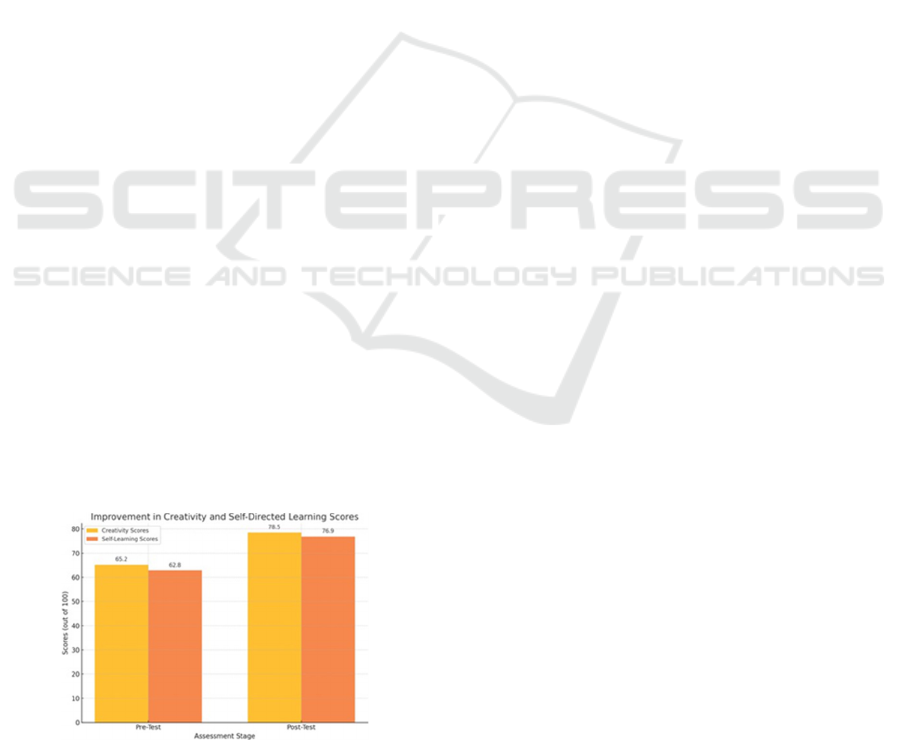
notable improvement in scores, with an average pre-
test score of 65.2, escalating to 78.5 post-intervention.
The statistical study validated this enhancement as
highly significant (p < 0.01), demonstrating that the
model efficiently promoted creativity. The Self-
Directed Learning Readiness Scale (SDLRS) results
indicated a significant enhancement in self-directed
learning ability, with average scores rising from 62.8
to 76.9. This improvement was statistically
significant (p < 0.01), corroborating the model's
efficacy. The research performance of students was
evaluated based on their study proposals and
presentations. Faculty mentors observed a 40%
enhancement in the quality of research proposals,
notably in clarity, creativity, and problem
formulation. Post-intervention presentations
demonstrated improved articulation, logical
organization, and creative methodologies relative to
the pre-intervention baseline.
Responses from students and professors
highlighted the model's efficacy. Students
predominantly acknowledged the significance of peer
mentoring sessions, with 85% asserting that these
sessions were crucial in enhancing their
comprehension of research themes. Moreover, 78%
of students valued the organized mentorship offered
by academics, identifying it as crucial in enhancing
their confidence and research abilities. Faculty
members observed that the model positively
influenced students by promoting collaboration and
accountability. This collaborative environment led to
improved participation and excitement for research
efforts. The findings underscore the efficacy of the
interpersonal learning paradigm in overcoming
obstacles and markedly improving students'
creativity, self-directed learning, and research
proficiency in scientific inquiry.
3.2 Discussion
This study's findings offer strong evidence for the
efficacy of the interpersonal learning paradigm in
enhancing creativity, self-directed learning, and
student research performance. This section analyzes
the data comprehensively, elucidating their
ramifications, emphasizing probable mechanisms,
and correlating them with previous literature. The
qualitative findings identified significant obstacles
encountered by students, such as diminished
confidence in their research skills, restricted
collaborative learning opportunities, and insufficient
mentorship (Liedtka, 2015). These constraints
correlate with prior research highlighting the
challenges students often experience when shifting
from theoretical education to autonomous scientific
inquiry (Magolda,2024). Addressing these
ICHELS 2024 - The International Conference on Humanities Education, Law, and Social Science
488
limitations, the interpersonal learning approach
immediately responds to students' needs through
structured peer and faculty mentorship and hands-on
research engagement (Richards et al., 2020).
The identified themes—peer collaboration, faculty
mentorship, and active participation— highlight
essential mechanisms by which the model attained
its objectives (Gutierez, 2021). Collaborative
engagement among peers cultivated mutual support
and enhanced problem-solving abilities, enabling
kids to explore and refine ideas within a nurturing
setting. Faculty mentorship offered expert direction
and constructive criticism, enabling students to
navigate intricate research processes adeptly. These
findings align with previous research highlighting the
significance of mentorship and collaborative learning
in higher education. The quantitative findings
indicated statistically substantial enhancements in
creativity and self-directed learning readiness (Tang,
2020). The increase in creativity ratings implies that
the model successfully provided an environment
where students could think innovatively and approach
challenges with uniqueness. This corresponds with
collaborative learning theories, which assert that
exposure to many perspectives in group environments
fosters innovative thinking (Rasku-Puttonen et al.,
2002). The enhancements in self-directed learning
readiness suggest that students were more assured and
proficient in overseeing their learning processes. This
advancement may arise from the integration of
organized support and independence afforded by the
model. Although academic mentorship provided
direction, peer mentoring and active research
involvement enabled students to assume
responsibility for their educational experience
(Muñoz et al., 2022). These findings align with self-
determination theory, which posits that autonomy,
competence, and relatedness are crucial for
cultivating intrinsic motivation and self-directed
learning.
Figure 1: Improvement in creativity and self-directed
learning scores.
The assessment of research performance
revealed substantial improvements in the caliber of
students' research proposals and presentations. These
enhancements indicate that the approach advanced
theoretical comprehension and facilitated practical
skills. The structured mentorship and active
participation elements undoubtedly contributed
significantly to this outcome. Students received
continuous feedback on their work, facilitating
iterative enhancements in clarity, creativity, and issue
formulation. Furthermore, the noted enhancements in
presentation skills—articulation, logical
organization, and creative methodologies—
underscore the model's capacity to equip students for
authentic academic and professional problems. These
competencies are essential for academic achievement
and correspond with the graduate traits employers
desire, including critical thinking, communication,
and innovation. The exceptionally favorable student
and staff responses reinforce the model's efficacy.
Students regarded the peer mentorship sessions as
essential for enhancing their comprehension of
research themes. This discovery indicates that peer
interactions enhanced learning and fostered a sense of
community and collective responsibility. Faculty
mentors noted increased collaboration and
involvement among students, demonstrating the
model's ability to enhance the research learning
environment (Tang et al., 2022). These findings align
with prior research that underscores the significance
of structured mentorship and collaborative learning in
enhancing engagement and motivation. That 85% of
students saw peer mentoring as essential, and 78%
attributed their confidence to teacher assistance
illustrates the comprehensive influence of the
concept.
4
CONCLUSION
The interpersonal learning paradigm effectively
overcame critical obstacles to creativity and self-
directed learning, significantly enhancing students'
research skills and performance. The methodology
included organized mentorship, collaborative
learning, and active involvement, cultivating an
environment conducive to invention, confidence, and
practical skills. These findings highlight the
significance of comprehensive methodologies in
research education and provide a framework for
cultivating creativity and independence in student
learning across various educational settings (Nowell,
2022).
Advancing Students’ Creativity and Self-Learning in Scientific Research in University: Designing an Interpersonal Learning Model
489

REFERENCES
Creswell, J. W. (2012). Educational research. pearson.
Gutierez, S. B. (2021). Collaborative lesson planning as a
positive ‘dissonance’to the teachers’ individual
planning practices: characterizing the features through
reflections-on-action. Teacher Development, 25(1),
37-52.
Holmes, A. G. D. (2023). Fostering Learner Autonomy in
Higher Education through Coaching and Mentoring for
Non-Traditional Learners. Shanlax International
Journal of Education, 11(4), 69-76.
https://doi.org/10.34293/education.v11i4.6185
Jeffery, K. A., & Bauer, C. F. (2020). Students’ responses
to emergency remote online teaching reveal critical
factors for all teaching. Journal of Chemical
Education, 97(9), 2472-2485.
Liedtka, J. (2015). Perspective: Linking design thinking
with innovation outcomes through cognitive bias
reduction. Journal of product innovation management,
32(6), 925-938.
"López, U. H., Vázquez-Vílchez, M., & Salmerón-Vílchez,
P. (2024). The Contributions of Creativity to the
Learning Process within Educational Approaches for
Sustainable Development and/or Ecosocial
Perspectives: A Systematic Review. Education
Sciences, 14(8), 824.
Magolda, M. B. B., & King, P. M. (Eds.). (2023). Learning
partnerships: Theory and models of practice to
educate for self-authorship. Taylor & Francis.
McNair, T. B., Albertine, S., McDonald, N., Major Jr, T.,
& Cooper, M. A. (2022). Becoming a student- ready
college: A new culture of leadership for student
success. John Wiley & Sons.
Muñoz, J. L. R., Ojeda, F. M., Jurado, D. L. A., Peña, P. F.
P., Carranza, C. P. M., Berríos, H. Q., Molina, S. U.,
Farfan, A. R. M., Arias-Gonzáles, J. L., & Vasquez-
Pauca, M. J. (2022). Systematic review of adaptive
learning technology for learning in higher education.
Eurasian Journal of Educational Research, 98(98),
221-233.
Nowell, L. (2022). Beyond tradition: innovative mentorship
models for higher education. Papers on Postsecondary
Learning and Teaching, 5, 1-8.
Rasku-Puttonen, H., Eteläpelto, A., Häkkinen, P., &
Arvaja, M. (2002). Teachers' instructional scaffolding
in an innovative information and communication
technology-based history learning environment.
Teacher Development, 6(2), 269-287.
Richards, J. B., Hayes, M. M., & Schwartzstein, R. M.
(2020). Teaching clinical reasoning and critical
thinking: from cognitive theory to practical
application. Chest, 158(4), 1617-1628.
Tang, K. N. (2020). The importance of soft skills
acquisition by teachers in higher education
institutions. Kasetsart Journal of Social Sciences,
41(1), 22-27.
Tang, Y. M., Chau, K. Y., Kwok, A. P. K., Zhu, T., & Ma,
X. (2022). A systematic review of immersive
technology applications for medical practice and
education-trends, application areas, recipients, teaching
contents, evaluation methods, and performance.
Educational Research Review, 35, 100429.
Velida Dzino-Silajdzic. 2018. Practical Guide, Focus
Group Discussions.
https://www.crs.org/sites/ default/fles/tools
research/fgds_april_24_fnal_lo_ res_.pdf [3 September
2019].
ICHELS 2024 - The International Conference on Humanities Education, Law, and Social Science
490
