
15-Minute City: Future Urban and Transportation Development
Mode
Chenrui Wang
a
School of Traffic and Transportation Engineering, Central South Universit, Changsha, China
Keywords: 15-Minute City, Transportation, City Development, Sustainability, Review, Comparison Between Paris and
Shanghai.
Abstract: With the rapid expansion of cities today, more and more environmental, traffic, human settlement and safety
issues have emerged. To better solve the problems and reorganize the urban layout, the 15-minute city
development model came into being. This paper deeply analyzes and summarizes the application and impact
of the 15-minute city concept in environmentally sustainable development, intelligent traffic control and
human settlement environment. Through case analysis, this paper interprets the development and application
of the 15-minute city model in cities such as Paris and Shanghai and compares the similarities and differences
in different countries and policy backgrounds. After research, the 15-minute city model is becoming a
blueprint and guiding strategy for the future development of more and more large cities. Under the current
situation of highly concentrated and expanded urban scale, the 15-minute city concept reshapes the urban
pattern from a new perspective. The development of the transportation field is crucial in the 15-minute model,
so the research results of this paper will re-examine and define the future development direction of cities at
multiple levels.
1 INTRODUCTION
With the acceleration of urbanization, many cities are
going through a phase of rapid expansion and
development, which has led to the distribution of
living facilities such as schools, hospitals and
supermarkets becoming irrational and unable to meet
the needs of citizens. To reach these facilities, citizens
often need to spend a lot of transportation time and
cost, which not only aggravates traffic congestion but
also causes frequent environmental pollution and
geological disasters, seriously hindering the
development of cities. In addition, in the context of
the current epidemic, especially during the COVID-
19 epidemic, people are more likely to choose
walking or cycling to reach as many living
infrastructures as possible within 15 minutes to
reduce the risk of virus exposure. To address this issue,
urban planners need to reassess the layout of
amenities to ensure that they are reasonably
distributed near residential areas.
Therefore, the concept of a 15-minute city is
gradually being adopted and practised in more and
a
https://orcid.org/ 0009-0008-9470-6149
more areas. The concept of a 15-minute city can be
used to alleviate the growing problem of urban
development by rationally planning transportation
facilities so that citizens can reach places within 15
minutes by slow transportation. The concept of a 15-
minute city can be analyzed more efficiently,
comprehensively and systematically from the
perspective of transportation.
The concept of a 15-minute city was first
proposed by French urbanist Carlos Moreno. With the
acceleration of global urbanization and the
improvement of residents' quality of life in recent
years, the transportation systems of more and more
cities are facing unprecedented challenges. In this
context, a 15-minute city is gradually becoming the
focus of academic attention and a hot topic of
discussion. Carlos Moreno and others emphasized the
vital role and potential of 15mc in promoting urban
sustainable development, enhancing urban resilience
and shaping local characteristics (Moreno, 2021).
Kostas Mouratidis analyzed several major problems
and hidden dangers in the implementation of this
concept: including sustainability, fairness, livability
294
Wang, C.
15-Minute City: Future Urban and Transportation Development Mode.
DOI: 10.5220/0013329500004558
In Proceedings of the 1st International Conference on Modern Logistics and Supply Chain Management (MLSCM 2024), pages 294-300
ISBN: 978-989-758-738-2
Copyright © 2025 by Paper published under CC license (CC BY-NC-ND 4.0)
and spatial analysis (Mouratidis, 2024). The analysis
of these issues provides a more diverse perspective in
the process of practicing this concept. Zaheer Allam
and others further explored the theoretical basis and
technical support of various models in a 15-minute
city and emphasized the various benefits of this
concept in terms of environment, society and
economy (Allam, 2022). This study reveals that
intelligent transportation systems achieve 15mc and
sustainable urban development by optimizing traffic
flow, improving traffic efficiency and reducing traffic
congestion. Thomas Papasa and his team explored the
relationship between the 15-minute city model and
the evolution of the urban transportation system from
a broader perspective, and how urban planners can
use the model to improve urban resilience (Papas,
2023). Both studies emphasize that the urban
transportation system, as an important part of urban
infrastructure, plays a key role in promoting the
realization of the 15-minute city (Bocca, 2021).
In summary, 15-minute cities, smart
transportation and sustainable transportation are
inseparable topics. As an important means to achieve
community accessibility, transportation is an
important means to achieve 15mc. By regulating and
optimizing various parameters in the transportation
process, people can effectively increase
transportation efficiency and reduce environmental
pollution, which plays a vital role in the physical and
mental health of citizens and urban development
(Abdelfattah, 2022).
This paper will analyze the concept of a 15-minute
city and its application scenarios. This paper mainly
takes Paris, France and Shanghai, China as examples
to discuss the concrete practice and application of 15-
minute city. It compares and summarizes the
similarities and differences in the application of 15mc
in different countries under different development
statuses, and the characteristics of its implementation
in China. Therefore, this paper will take a 15-minute
city as the background to study the application of
sustainable transportation development and
intelligent traffic control and analyze the concept of a
15-minute city and its practical cases from the
perspective of transportation.
2 15-MINUTE CITY CONCEPT,
PRINCIPLES AND MEANS OF
TRANSPORTATION
The concept of a 15-minute city was first proposed by
Carlos Moreno, a professor at Sorbonne University in
2016. The 15-minute city aims to improve the quality
of life by enabling residents to easily reach the
required public places within 15 minutes through a
reasonable layout of urban facilities. This model can
promote sustainable urban development, reduce
urban traffic congestion and pollution index, and
increase citizens' happiness and convenience of life.
The scope of the community under this concept is
defined as 15 minutes based on the walking speed of
people and the moving speed of bicycles in the city.
Within 15 minutes, the average walking speed of
citizens can reach a radius of one kilometer, while the
average cycling speed can reach a radius of three
kilometers. In this area, the community achieves
comprehensive coverage of living facilities through a
compact layout, which not only saves citizens'
commuting time but also improves land utilization
efficiency (Allam, 2022).
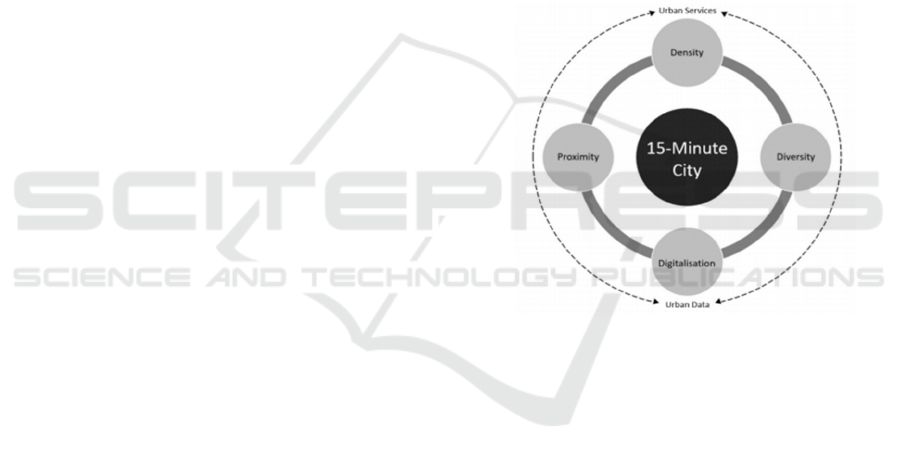
Figure 1: The 15-minute city framework. Adapted
from (Moreno, 2021).
Since the mid-18th century, cities have gone through
several stages of development, which provide
historical background and theoretical support for the
subsequent 15-minute city theory. The mainstream
urban theories that have emerged include compact
cities, new urbanism, and other formal theoretical
foundations of 15mc. Compact urbanism emphasizes
sustainable urban forms and reducing dependence on
motor vehicle travel, and the 15mc theory is the
practice of this concept in a specific microcosm. After
experiencing the large-scale outbreak and blockade of
Covid-19, more and more citizens and urban planners
have discovered the irrationality of the current urban
planning layout and the fragility of the structure. Due
to government blockades and health concerns, people
did not want to reach where they wanted to go through
long distances or closed and intensive commuting
during that time, so walking or cycling to safely and
15-Minute City: Future Urban and Transportation Development Mode
295

quickly reach living facilities near their residences
became mainstream during the epidemic. This also
re-exposed the concept of the 15-minute city (Van
Der Waals, 2000). Today, more and more cities are
beginning to embark on the path of practicing the
15mc concept. The first to start was Paris, France,
which launched the world's first shared bicycle
system as early as 2001. American urban planning is
also abandoning the previous development model of
car-first and returning to the city concept of people-
oriented. There is a common topic in China: the 15-
minute convenient living circle, which is the Chinese
community development concept before 15mc was
formally proposed. Now, after integrating with the
15mc theory, it has also begun to be systematically
implemented in major cities in China. For example,
Shanghai, Shenzhen, Lanzhou and other cities have
successively launched their own 15-minute living
circle experimental communities (Wu, 2021).
The 15-minute city is a conceptualization of the
principles of accessibility and sustainable
development through the 15-minute city approach, in
which the four principles of proximity, diversity,
digitization, and reasonable building density should
be followed in conjunction with the development of
the new digital age (Cui, 2023). Proximity refers to
the short spatial distance between places at the
architectural level, which is measured in terms of the
travel time of residents, meaning that pedestrians can
reach the public facilities or places they need in their
lives within 15 minutes by walking or cycling. This is
a core and one of the objectives of the 15-minute city
concept. In realizing the 15-minute city concept, the
need to select appropriately scoped and well-laid-out
neighborhoods are the foundation of the concept.
Overemphasis on density is not a permanent solution;
even if the density is too high for residents to reach at
a certain time, it is still empty talk. Therefore, rational
transportation and urban layout that enables travellers
to reach their destinations within 15 minutes is the
core. Diversity refers to both spatial and temporal
diversity (Manakina, 2020). Spatially, residents can
reach different functional facilities and places within
15 minutes, and this diversity meets the differentiated
needs of citizens, making community life more
convenient and community ties closer. The
differentiation of workplaces is also a form of spatial
diversity, especially the online office that became
popular during the epidemic is one of the most
important ways to realize the 15-minute city because
most of the necessary commuting is for work
purposes. Home-based or free-space offices can
effectively reduce long-distance commuting while
reducing the various costs and environmental
pollution generated by transportation. Spatial
diversity also includes a variety of transportation
options: within a 15-minute neighbourhood, residents
can choose to walk, bike, etc.; within a larger 30-
minute or even 45-minute living area, they can choose
to use public transportation such as buses, subways,
and other modes of transportation.
Diversity in time can be understood as the same
building or site serving different purposes under
different time conditions. For example, the school
playground can be used as a place for student
activities and teaching during the school year.
However, during vacation time, most students and
teachers are not in the school for teaching activities,
so the schoolyard can be used as a venue for large-
scale activities or as a parking lot, which greatly
increases the usability of buildings with tidal
properties. A deeper practice of temporal diversity for
urban participants is the variability of working hours.
Unlike workplace diversity, time diversity means that
people with different jobs travel to their workplaces
at different times, a policy that is being implemented
in many major cities such as Beijing and Los Angeles.
This measure allows the transportation system to
avoid peak traffic and increase operational efficiency,
resulting in shorter commute times and reduced urban
loads.
In the process of practicing the 15-minute city,
digitalization and intelligent technology have also
gradually become indispensable components.
Combined with the traffic control realized by
intelligent technology, digitalization can improve the
efficiency and accuracy of urban management.
Strengthening the construction of the information city
and promoting the improvement of information
technology infrastructure can significantly improve
the accessibility of the city, and effectively improve
the city's existing problems and pitfalls, such as traffic
congestion, carbon emissions, and so on. Although
the 15-minute city theory does not overly emphasize
the concept of digitization, incorporating
digitalization into the 15-minute city concept is
certainly a more efficient and accurate way of
practising it in this day and age.
As mentioned earlier, the pursuit of density in
building layouts is not the best solution. Many large
cities in developing countries, such as New Delhi in
India and Cairo in Egypt, have large populations of
more than 20 million people. However, due to uneven
economic development and poor urban layout, the
distribution of urban infrastructure is extremely
uneven, resulting in significant differences between
communities. This has led to increased fragmentation
and uneven distribution of resources within cities,
MLSCM 2024 - International Conference on Modern Logistics and Supply Chain Management
296

leading to more pollution and waste of resources.
Uneven regional development will ultimately
undermine the development of the city as a whole, so
it is more important to have a balanced distribution of
amenities. It is also important to pay attention to not
only the infrastructure and living space but also the
population density to ensure the comfort of living in
the community and the sustainability of the land.
Sustainable transportation is closely related to the
topic of achieving a green, environmentally
sustainable 15-minute city. Sustainable transportation
can also be understood as green transportation, such
as walking, cycling, using clean energy cars or public
transportation. They all share the common feature of
not polluting the environment as much as possible,
and building a network of urban transportation
systems by saving fossil energy, reducing air
pollution and increasing the health index of the
population. This coincides with the concept of a 15-
minute city. Intelligent traffic control takes the
intelligent transportation system as the carrier and
realizes the diversified management of spatialized
temporalization of traffic flow through
informatization, and artificial intelligence technology,
which provides a guarantee for fast, safe and efficient
commuting. Highway unmanned toll collection
systems, intelligent parking system, real-time signal
light deployment systems are all part of this field. An
intelligent transportation system is exactly part of the
digital proposition in the concept of a 15-minute city,
in the age of technology today, the use of the Internet
and AI technology is undoubtedly an important
means of realizing the 15-minute city, and from the
perspective of intelligent transportation into can be
more systematic and efficient to land the project to
promote. The government and institutions can collect
travel behaviour data, accurate analysis and through
processing and analysis to get the most in line with
the local situation of the traffic solution, is traffic
control in the 15-minute city plays an important role.
In Hangzhou, China, the government cited a city
brain project in the field of transportation, which can
detect the traffic flow of more than 2,000
intersections in Hangzhou, and through deep learning
and other methods to predict the traffic flow of each
time and real-time traffic light timing to slow down
traffic congestion and tailpipe emissions.
To sum up, sustainable transportation and
intelligent traffic control are important means of
transportation to realize 15-minute cities, and the
author will analyze concrete examples of 15-minute
cities around the world in the following.
3 ANALYZING THE 15-MINUTE
CITY DEVELOPMENT MODEL
WITH EXAMPLES FROM
PARIS AND SHANGHAI
The 15-minute city has been adopted and acted upon
by an increasing number of city governments around
the world, and this paper will analyze a few
representative examples.
3.1 Paris, France
After World War II, Paris experienced rapid
urbanization, accompanied by a dramatic increase in
the number of motor vehicles, leading to serious
traffic congestion and air pollution. Against this
background, the concept of the 15-minute city
gradually sprouted in Paris and was practiced through
a series of policies.
As early as 2001, the world's first bike-sharing
system landed in Paris, and the Paris city government
began to gradually shift from developing urban
transportation centered on motor vehicles to one led
by public transportation. Since the 1990s, with the
French government strengthened the travel
restrictions on private cars and environmental
standards have been issued Loi sur l'Air et
l'Utilisation Rationnelle de l'Energie, LoiAURE and
the Loi Solidarité et Renouvellement Urbain. The city
government of Paris actively corresponds to the
policy and vigorously develops public transportation.
As of 2017, Paris has built a total mileage of 206
kilometers, bus routes of up to 1,511, and bike lanes
of up to more than 1,100 kilometers of Europe's most
extensive and complex public transport system. This
has effectively reduced motor vehicle ownership and
travel in the Paris region. In the highly economically
developed French society, motor vehicle ownership in
the Paris region made a rare downward inflection
point in 2018. 2016 Paris Mayor Anne Hidalgo's re-
election continued to increase the 15-minute city
landing in Paris. Public transportation, as well as
slow-moving traffic, has gained a large amount of
public support in Paris, with the number of people
travelling via self-propelled trips in the city rising by
54% in 2019 alone. Paris is in the process of
transforming more of its streets into low-speed streets
with a focus on walking, and cycling. The 2024
Olympics Paris has added almost another 400
kilometers of new cycling lanes. The center of gravity
of car ownership in Paris is shifting from the city
center to the outskirts, and the city's traffic congestion
index is decreasing and the pollution index is under
15-Minute City: Future Urban and Transportation Development Mode
297

control. From the example of Paris, people can see
that the traffic management of large cities is not
without solutions, try to return the heart of the city to
the people themselves, abandon the car as the center
of development, the city will be divided into their
centers but closely linked 15-minute neighbourhoods,
it seems to be an effective way to solve the problem
of urban development.
3.2 Shanghai, China
Shanghai is the city with the highest GDP output
value, the largest population size and structural
volume in mainland China. As of 2020, Shanghai's
population has reached more than 24 million, and the
number of motor vehicles has reached about 5.37
million, making it a veritable supercity. Along with
this are the various common problems brought about
by the large size of the city, including traffic
congestion, pollution relief, and urban land shortage.
In the process of rapid urbanization, Shanghai has
gradually developed a huge transportation
infrastructure. However, as the city size expands,
traffic congestion and pollution problems have
become more serious.
In response to these challenges, Shanghai took the
lead in proposing the concept of a 15-minute living
community in 2014 and actively promoted it through
a series of measures. Shanghai has laid out 1,600 15-
minute urban communities throughout the city, and
each community adopts a 1+N service point layout
model. A core name is Bailefang, which is a
comprehensive place covering government affairs,
entertainment, mother and baby, food, and other
services to provide convenience for residents within
the 15-minute community circle. There are many
independent facilities scattered in the community
called Liuyi Pavilion, which provide citizens with rest,
drinking water, toilets and other convenient facilities.
Shanghai is more inclined to provide diversified
infrastructure in the block to meet the differentiated
needs of the community. As a major country in
science and technology development, China also
needs to combine smart technology in the field of
transportation. The evolution of Shanghai's smart city
in the past 11 years can be divided into three stages,
namely exploratory advancement, continuous
deepening and efficiency improvement. Shanghai
uses technologies such as the Internet of Things,
cloud computing, and big data collection to predict
traffic flow and optimize the behaviour of traffic flow
on urban arterial roads through real-time regulation of
lanes and traffic lights. Optimize the density of
subway and bus schedules. Intervention and timely
handling of driving and pedestrian accidents, etc.
Based on algorithm prediction, virtual simulation and
other technologies, various traffic data can be
collected, model analysis of concentrated problems
can be carried out, and intervention factors such as
policies, measures, and regulations can be added to
find the most suitable development and improvement
model for the local 15-minute community, and this
will support the realization of the 15-minute city step
by step, providing a solid foundation for building a
green and sustainable development city concept.
3.3 Case Comparison Between
Shanghai and Paris
Based on the 15mc cases of Shanghai and Paris,
people can get some similarities and differences
between the two: In terms of developing slow traffic,
Paris is more inclined to prioritize the development of
slow travel, including walking and cycling, when
developing 15mc communities. Since 2001, Paris has
vigorously built more than 1,000 kilometers of
bicycle lanes and pedestrian paths. Shanghai, on the
other hand, focuses more on building public facilities
that meet community requirements and the
development of public transportation, so there is still
room for improvement in the field of slow traffic
development. In terms of housing and social
integration, Western cities, led by Paris, tend to pay
more attention to the impact of housing prices on
projects. Paris has introduced many policies to
promote affordable housing and try to eliminate the
barriers and differences between so-called wealthy
and poor communities, to promote urban integration.
However, it can be concluded from the above cases
that local governments have actively adopted the
advanced urban concept of 15-minute communities to
cope with the various problems brought about by the
growing expansion of cities. Therefore, more and
more cities and regions are gradually recommending
the application of 15-minute cities.
4 CHALLENGES TO THE
IMPLEMENTATION OF 15-
MINUTE CITIES IN CHINA
The 15-minute city was first proposed by Western
countries. When this development concept was
introduced to China, it needed to be developed
following the special conditions of the local country.
First of all, as a country with a large population, China
has been most concerned about the ageing of its
MLSCM 2024 - International Conference on Modern Logistics and Supply Chain Management
298

population in recent years. When developing the
concept of community construction in Europe and the
United States, more attention was paid to issues such
as racial segregation and community housing prices,
while China should pay more attention to the obvious
age differences. The infrastructure in the community,
including service points, and transportation facilities
should fully consider the age distribution when they
are built. Secondly, many Chinese cities have been
built too fast in the early stage and lack reasonable
planning, which makes many later engineering
reconstructions particularly difficult. For example,
many communities built in the 1980s have very
narrow passages, but they gather a large number of
residents. The construction of green travel passages
in 15-minute communities cannot be transformed
here, and a large number of old communities do not
have the conditions to add community service points,
which requires local planners to spend more energy
to find a 15mc model suitable for local development.
Third, China's unique household registration system
and a large number of newborns have resulted in the
government forcing the schooling of children within
designated residential areas. This suggests that when
implementing 15mc in China, schools can be used as
an entry point. However, at the same time, the
reasonable construction of schools and ensuring the
safe passage of students in the community is one of
the major challenges.
5 CHALLENGES
At present, the challenges faced by 15-minute cities
mainly include uneven development situations,
solidified travel habits, and uncoordinated multi-
sectoral work.
First of all, in the process of promoting 15mc in
Shanghai, it is obvious to see the unbalanced
development situation. In Jing'an, Huangpu,
Changning and other city centers, hospitals,
convenience stores, schools and other facilities are
well equipped, but not in Fengxian, Jinshan and other
remote areas. A large number of communities do not
have comprehensive facilities in or around their
neighborhoods, making it difficult to promote 15-
minute communities.
Secondly, many areas are very densely populated,
but due to the lack of good urban planning and a
developed economy, the urban infrastructure is
relatively poor. This makes retrofitting very difficult,
and municipal officials often need to make extensive
changes or add new facilities to meet the 15-minute
city standard. But the need for new neighborhoods
and transportation is often urgent in these areas,
where neighborhood segregation, development
inequities, and safety hazards abound. So getting
policy off the ground in these areas will be a major
challenge for that government.
In addition, the core of the 15-minute concept is
to get to the infrastructure needed to live quickly in a
greener way. This will require citizens to change their
travel habits to adapt to the new policy, but for
reasons that are notoriously difficult and time-
consuming to change, it will be a challenge for the 15-
minute city to get more residents to change and
respond to the 15-minute concept.
Finally, in the process of transforming a
community into a 15-minute city, a large number of
facilities and buildings need to be renovated and laid
out. This involves both multi-sectoral coordination
and huge financial support. Multi-sectoral means
more interests, so cooperation becomes a huge task
with many variables to mediate. If the government is
not so open-minded, it will be even more difficult to
move the project forward.
6 CONCLUSION
Nowadays, more and more cities are suffering from
uneven resource distribution, environmental
pollution, traffic jams and other problems due to the
rapid expansion of their scale, which seriously
hinders the development of cities and even countries
or regions. This study found that the concept of a 15-
minute city seems to be able to solve many
development problems within cities and is becoming
the future development form of many cities. The 15-
minute city has become the focus and emphasis of
urban construction in many places in Europe,
America and Asia. For example, Paris in France and
Amsterdam in the Netherlands have benefited from
their good urban construction foundation such as
perfect bicycle lanes or reasonable community layout
and high population quality, which makes the concept
of a 15-minute city quickly and well responded to in
the local area. Nowadays, many large cities in Europe
are approaching green goals such as carbon neutrality.
Due to its special national conditions, American cities
are more inclined to live in suburban areas far away
from the city center, so it is more popular to travel by
car. The implementation of a 15-minute city is more
difficult, and local urban and rural and transportation
planners need to reconsider the application and layout
of 15-minute city. Even so, Portland and Seattle have
given us a relatively satisfactory result. Asian regions
such as China, Japan, and Singapore are actively
15-Minute City: Future Urban and Transportation Development Mode
299

implementing 15-minute city projects. The common
characteristics of Asian cities are that their population
density and population base are extremely large.
Under high-density living conditions, the
development of 15-minute cities is simpler but also
more urgent. Many cities in the world that are
developing 15-minute community projects are setting
examples for more regions, such as reducing the
waiting time of motor vehicles through intelligent
traffic control to optimize traffic density to improve
urban circulation and reduce pollutant emissions. The
same situation can be applied to public transportation.
Japan's Tokyo metropolitan area is the most populous
metropolitan area in the world, but with its well-
connected subway system, it has successfully made
the city just orderly and rarely has traffic jams. The
development of recyclable transportation will be
implemented in the 15-minute city project. The
purpose and implementation methods of the two are
very similar. Both guide residents to commute by
green transportation or slow transportation. This will
not only achieve sustainable development of the city
and help improve climate conditions but also promote
residents' health and community integration. In
summary, the 15-minute city is the future blueprint
for urban development, and transportation
development is the backbone and soul of the 15-
minute city.
The scope of this article is relatively narrow. At
present, it only compares and studies many regions
that have implemented the 15-minute city project.
However, this is only a minority of cities in the world.
Many more cities are still in a period of confusion and
chaos in their development. I hope that more and
more governments can implement the 15-minute city
project in specific cities in a more appropriate manner.
Making cities more livable, accessible, and green
rather than blindly pursuing economic development
should be the key consideration and construction goal
in the future.
REFERENCES
Abdelfattah, L.; Deponte, D.; Fossa, G. 2022. The 15-
minute city: interpreting the model to bring out urban
resiliencies. Transportation Research Procedia 60, 330-
337.
Allam, Z.; Bibri, S.E.; Chabaud, D.; Moreno, C. 2022. The
Theoretical, Practical, and Technological Foundations
of the 15-Minute City Model: Proximity and Its
Environmental, Social and Economic Benefits for
Sustainability. Energies 15, 6042.
Allam, Z.; Bibri, S.E.; Chabaud, D. et al. 2022. The ‘15-
Minute City ’ concept can shape a net-zero urban
future. Humanit Soc Sci Commun 9, 126.
Bocca, A. 2021. Public space and 15-minutes city. A
conceptual exploration for the functional
reconfiguration of the proximity city. Tema. Journal of
Land Use, Mobility and Environment 14 (3), 395-410.
Papas, T.; Basbas, S.; Campisi, T. 2023. Urban mobility
evolution and the 15-minute city model: from holistic
to bottom-up approach. Transportation Research
Procedia 69, 544-551.
Moreno, C.; Allam, Z.; Chabaud, D.; Gall, C.; Pratlong, F.
2021. Introducing the 15-Minute City: Sustainability,
Resilience and Place Identity in Future Post-Pandemic
Cities. Smart Cities 4, 93-111.
Mouratidis, K. 2024. Time to challenge the 15-minute city:
Seven pitfalls for sustainability, equity, livability, and
spatial analysis. Cities 153, 105274.
Van Der Waals, J. 2000. The compact city and the
environment: a review. Tijdschrift voor economische
en sociale geografie 91, 111-121.
Wu, H.; Wang, L.; Zhang, Z.; Gao, J. 2021. Analysis and
optimization of 15-minute community life circle based
on supply and demand matching: A case study of
Shanghai. PLoS ONE 16 (8), e0256904.
Cui, Q.; Chen, R.; Wei, R.; Hu, X.; Wang, G. 2023. Smart
Mega-City Development in Practice: A Case of
Shanghai, China. Sustainability 15, 1591.
Manakina, A.; Nikolaeva, V. 2020. IOP Conf. Ser.: Mater.
Sci. Eng. 890, 012179.
MLSCM 2024 - International Conference on Modern Logistics and Supply Chain Management
300
