
EX-DSS: An Explorative Decision Support System for Designing and
Deploying Smart Plug Forecasting Pipelines
Giulia Rinaldi, Lola Botman, Oscar Mauricio Agudelo and Bart De Moor
KU Leuven, Department of Electrical Engineering (ESAT), STADIUS Center for Dynamical Systems, Signal Processing and
Data Analytics, Kasteelpark Arenberg 10, 3001 Leuven, Belgium
Keywords:
Decision Support System, Smart Plug Forecasting, Artificial Intelligence Pipeline.
Abstract:
Artificial Intelligence pipelines are increasingly used to address specific challenges, such as forecasting smart
plug loads. Smart plugs, which remotely control various appliances, can significantly reduce energy consump-
tion in commercial buildings by about 20% when effectively scheduled using AI techniques. Designing these
AI pipelines involves numerous steps and variables, requiring collaboration and shared knowledge among de-
signers. A Decision Support System (DSS) can facilitate this process. This paper introduces the Explorative
Decision Support System (EX-DSS), which extends the classical DSS framework. The EX-DSS integrates an
Explorative Management Subsystem to provide project-specific recommendations and a Data Quality (DQ)
module to validate user inputs, ensuring clarity and enhancing information sharing. The EX-DSS architec-
ture framework was tested through a software prototype designed to create AI pipelines for forecasting smart
plug loads. The study found that using the EX-DSS improves the quality of suggestions, making them more
problem-specific and resulting in a more personalized and meaningful user experience, with a significant po-
tential to reduce energy consumption in commercial buildings.
1 INTRODUCTION
Designing an Artificial Intelligence (AI) pipeline in-
volves multiple steps, from data cleaning to imple-
menting machine learning methods. This process can
be complex and time-consuming, especially when try-
ing to find the most efficient combination. In the con-
text of smart plug forecasting, this challenge is sig-
nificant, as plug loads account for over 40% of total
energy consumption in commercial buildings, exclud-
ing lighting, HVAC, and water heating (Chia et al.,
2023). Smart plugs, which remotely monitor and
control electrical appliances, can save up to 20% of
electricity through effective scheduling, making AI
forecasting and scheduling methods promising solu-
tions (Botman et al., 2024).
A Decision Support System (DSS) can expedite
the design of these AI pipelines. A DSS is a flexi-
ble software tool that assists in decision-making pro-
cesses and allows for shareability and reproducibility
among users, necessitating collaboration functionali-
ties and ways to evaluate user input.
This paper introduces an experimental Explorative
Decision Support System (EX-DSS) aimed at design-
ing and deploying industrial smart plug pipelines to
solve forecasting problems. The novel contributions
of this research include:
• Extending the conventional DSS with the Explo-
rative Management Subsystem, offering project-
specific insights and recommendations.
• Integrating a Data Quality (DQ) module to as-
sess the quality of user inputs, ensuring reliable
AI pipeline design.
• Maintaining a human-in-the-loop approach, giv-
ing users maximal control over every feature in
the EX-DSS.
• Providing a practical demonstration of the EX-
DSS through a software prototype for smart plug
forecasting, validating the system’s capabilities
and showcasing its effectiveness in real-world ap-
plications, thereby highlighting its potential im-
pact on reducing energy consumption in commer-
cial buildings.
This paper is structured as follows. Section 2
presents related works. In Section 3, the EX-DSS
architecture framework is introduced. Section 4 de-
scribes the application of this framework in the design
of smart plug forecasting AI pipelines via a software
prototype. In Section 5, results are discussed, and fi-
Rinaldi, G., Botman, L., Agudelo, O. and De Moor, B.
EX-DSS: An Explorative Decision Support System for Designing and Deploying Smart Plug Forecasting Pipelines.
DOI: 10.5220/0012925800003838
Paper published under CC license (CC BY-NC-ND 4.0)
In Proceedings of the 16th International Joint Conference on Knowledge Discovery, Knowledge Engineering and Knowledge Management (IC3K 2024) - Volume 3: KMIS, pages 197-205
ISBN: 978-989-758-716-0; ISSN: 2184-3228
Proceedings Copyright © 2024 by SCITEPRESS – Science and Technology Publications, Lda.
197

nally, in Section 6, conclusions are drawn, and future
research lines are presented.
2 BACKGROUND
A Decision Support System (DSS) is software that
helps users analyze data and make decisions. It gen-
erates insights and suggestions through a structured
framework (Gonzalez-Andujar, 2020). The classi-
cal DSS includes a Data Management Subsystem,
which stores and handles data; a Model Manage-
ment Subsystem, which manages models for DSS
tasks; a Knowledge Management Subsystem, which
provides information to users; and a User Interface,
which connects users with DSS subsystems (Turban
et al., 2010).
DSS supports semi-structured or unstructured de-
cisions, requiring evaluations beyond mathematical
modeling (Duan and Xu, 2009). For example, buy-
ing a new tool (Jacquet-Lagreze and Shakun, 1984)
or deciding on stock market entry/exit (Chandra et al.,
2007). These systems use rule-based models and
AI to predict scenarios and derive insights (Phillips-
Wren, 2013).
DSS applications are used in various fields like
business, healthcare, and agriculture. They can help
medical staff plan and monitor medications (Sloane
and J. Silva, 2020) and manage production costs in
agriculture (Rupnik et al., 2019). Tools like Rapid-
miner
1
and Knime
2
support the design of AI pipelines
but lack assistance during the configuration phases.
The problem considered in the EX-DSS software
prototype involves forecasting the load of electrical
appliances, monitored and controlled by smart plugs
to optimize energy consumption (Chia et al., 2023).
Smart plugs can significantly reduce energy usage in
commercial buildings by scheduling appliance oper-
ations. Accurate load forecasting is crucial for cre-
ating effective schedules. Current methods, including
time series analysis and AI-based techniques like neu-
ral networks and ensemble methods (Botman et al.,
2024), are time-consuming and complex to imple-
ment. This underscores the need for a robust DSS
framework like EX-DSS to streamline the process and
improve accuracy.
This paper introduces a knowledge-driven DSS
framework that incorporates detailed domain knowl-
edge. This makes it especially useful for complex
decision-making processes that require specific ex-
pertise. Specifically tailored for time series forecast-
1
https://altair.com/altair-rapidminer
2
https://www.knime.com/
ing, this framework focuses on input quality assess-
ment and fosters a collaborative research community
by enabling users to share insights, models, and re-
sults.
3 EX-DSS FRAMEWORK
As mentioned in Section 2, a traditional Decision
Support System (DSS) has three subsystems and a
User Interface (UI). The new Explorative Decision
Support System (EX-DSS) adds a Data Quality (DQ)
Module (Fig.1C) and an Explorative Management
Subsystem (Fig.1D.4). The DQ Module (Fig.1C) im-
proves data quality and promotes information sharing.
The Explorative Management Subsystem (Fig.1D.4)
provides project-specific insights for better analysis.
The EX-DSS architecture framework has two lev-
els: the User (Fig.1A) and the EX-DSS (Fig.1B). The
User interacts with the system to solve problems using
semi-automated steps. The EX-DSS analyzes prob-
lems, provides extra information, and helps create the
AI pipeline. A Graphical User Interface (Fig.1E) fa-
cilitates these interactions.
The EX-DSS has two main parts: the DQ
Module (Fig.1C) and the Pipeline Design Mod-
ule (Fig.1D). The DQ Module includes the Intake
Phase (Fig.1C.1) for uploading data and the As-
sessment Phase (Fig.1C.2) for evaluating data qual-
ity by generating a report. The Pipeline Design
Module (Fig.1D) has four subsystems: Data Man-
agement (Fig.1D.1), which stores essential informa-
tion; Model Management (Fig.1D.2), which man-
ages the pipeline structure (Fig.1D.2.a), configuration
(Fig.1D.2.b) and training (Fig.1D.2.c); Knowledge
Management (Fig.1D.3), which provides general in-
formation; and Explorative Management (Fig.1D.4),
which derives project-specific insights from the key-
words extracted from the DQ report (Fig.1D.4.a).
The general knowledge in the Knowledge Man-
agement Subsystem (Fig.1D.3) is not tied to specific
problems. For example, it answers questions like
“What is forecasting?”. Project-specific knowledge in
the Explorative Management Subsystem (Fig.1D.4) is
detailed and tailored to specific projects, like “What
are the best methods for forecasting smart plugs?”.
The DSS is called “explorative” because it helps users
dive into and explore specific problems, such as fore-
casting smart plugs for energy savings in buildings.
By adding an extra subsystem, the EX-DSS im-
proves modularity, maintainability, and reusability. It
separates general knowledge from project-specific in-
formation, allowing better customization and system
performance.
KMIS 2024 - 16th International Conference on Knowledge Management and Information Systems
198

Interface (E)
Explorative Decision Support System (B)
Pipeline Design Module (D)
Explorative Management System (4)
Keyword Elaborator (a)
Knowledge
Management
System (3)
Model
Management
System (2)
Data Management
System (1)
Data Quality Module (C)
Guidelines
Assessment
(d)
Report
Generator (e)
Assessment Phase (2)Intake Phase (1)
Upload DATA (a)
Upload METADATA (b)
Upload PROBLEM
DESCRIPTION (c)
USER INPUT (1):
Data
Metadata
Probem Description
EX-DSS OUTPUT (2):
Assessment Report Pipeline Pipeline Results
USER (A)
USER FEEDBACK (3):
Block Choice
Configuration
Modification Requests
Human-in-the-loop
Suggestions
Modification
Requests
User
Feedback
User Input
Assessment
Report
Assessment
Report
User Input
Topological
Entity(a)
Hyperparameter
Entity(b)
Pipeline/
Pipeline Results
Deployment
Entity(c)
Pipeline/
Pipeline Results/
Suggestions
User
Feedback
Assessment
Report
User Input
Suggestions
Figure 1: EX-DSS architecture framework. This illustrates the proposed EX-DSS framework. (A) User-level input and
outputs. (B) Blocks composing the EX-DSS: (C) Block to assess the quality of the user’s input and (D) Block to aid the users
in designing, configuring, and deploying the pipeline. (E) User Interface that allows the user to dialogue with the EX-DSS.
The arrows represent the flow of information inside the systems.
4 EX-DSS FOR SMART PLUG
FORECASTING PIPELINES
This Section presents the application of the Explo-
rative Decision Support System (EX-DSS) frame-
work in the design of a smart plug forecasting AI
pipeline via a software prototype. Section 4.1 de-
scribes the use case and the context to implement
such EX-DSS, while Section 4.2 discusses in detail
the EX-DSS implementation.
4.1 The Context
The EX-DSS framework described in Section 3
addresses the design of Smart Plug Forecasting
pipelines. Smart plugs are devices that fit between
appliances’ power cords and wall sockets, enabling
remote control. Smart plugs convert standard appli-
ances into smart ones. Various appliances like print-
ers, copiers, and TVs are monitored. Studies show
that plug loads (excluding lighting, HVAC, and water
heating) account for over 40% of total energy con-
sumption in commercial buildings, and that this con-
sumption is increasing over time (Chia et al., 2023;
Tuttle et al., 2020). Smart plugs can significantly re-
duce energy consumption by automatically determin-
ing if a plug is idle or active and forecasting its usage.
This allows scheduling devices to turn on or off ac-
cordingly, leading to potential electricity savings of
up to 20%, optimizing building energy efficiency.
AI is crucial for determining plug usage, forecast-
ing consumption, and scheduling devices (Botman
et al., 2024). However, finding the best-performing
method is time-consuming. The software prototype
proposed in this paper aims to guide researchers in de-
signing pipelines for smart plug usage forecasting and
scheduling, thereby optimizing building energy con-
sumption. The trained model from the design phase
can also be downloaded for further use.
4.2 Description of the Software
Prototype
The EX-DSS software prototype is a web applica-
tion written in Python, implemented using the Dash
framework
3
. It assists users by providing descrip-
tions and suggestions for configuring each block of
the AI pipeline, based on issue-specific keywords for
the Smart Plug problem described in Section 4.1 and
listed in the Appendix. Additionally, a chatbox al-
lows users to ask general questions. It is integrated
with the Natural Language Processing (NLP) model
developed by Cohere
4
.
3
https://dash.plotly.com/
4
https://cohere.com/
EX-DSS: An Explorative Decision Support System for Designing and Deploying Smart Plug Forecasting Pipelines
199

The functionalities of the EX-DSS software proto-
type are illustrated through an experiment using meth-
ods and datasets collected by Botman et al. (2024).
While Botman et al. (2024) proposed many alterna-
tives
5
, a subset of these methods is included in this
prototype. After configuring the pipeline, the EX-
DSS connects to an external server for workflow man-
agement using the Airflow platform
6
.
4.2.1 New Dataset
The EX-DSS software prototype’s experiment began
with uploading a new dataset (Fig.1C.1). The user
provided a title, data source, and a short description
(Fig.1C.1.b) to facilitate understanding and improve
support in subsequent phases. Next, the user selected
keywords from a set proposed by the EX-DSS (see
Appendix for the full list). These keywords are cru-
cial for the Explorative Management Subsystem to
generate insights and target specific pipeline charac-
teristics. Finally, the user submitted the main data
file (Fig.1C.1.a) and could also upload supplemen-
tary files such as metadata or additional information
(Fig.1C.1.b).
For this experiment, the input was based on the
work proposed by Botman et al. (2024)::
• Title: Smart Plug Data,
• Data Source: “https://gitlab.esat.kuleuven.be/
Lola.Botman/smart-plug-pipeline/-/tree/main/
Dataset”
• Data Description: “The dataset is collected
through smart plug sockets between the wall plugs
and the electric appliance as detailed in Chia et al.
(2023). Smart plugs from Best Energy Reduc-
tion Technologies (BERT) are deployed in fif-
teen buildings on the campus of the University of
California, San Diego (UCSD). The power level
of each appliance is recorded in mW at fifteen-
minute intervals. The dataset consists of 169
high-quality smart plug time series spanning 498
days, from November 18
th
, 2021, to March 31
st
,
2023. The 169 plug loads include 146 printers, 16
copiers, 4 TVs, and 3 fax machines. This dataset
is openly accessible; see Botman et al. (2024) for
more details.”
• Keywords Selected: “Smart Plugs, High Perfor-
mance, Non-intrusive”
• Main File: “SmartPlugPreprocessedData.csv”
• Additional Metadata Files: [“SmartPlugMeta-
Data.csv” “SmartPlugHolidayData.csv”]
5
https://gitlab.esat.kuleuven.be/Lola.Botman/
smart-plug-pipeline
6
https://airflow.apache.org/
Table 1 shows a snapshot of the main dataset,
“SmartPlugPreprocessedData.csv.” Rows indicate the
time at which power values are recorded, and columns
represent monitored electrical appliances with power
values in mW. The goal is to predict these power val-
ues. In the illustrated subset, recordings start at 11:45
on the 18
th
of November 2021 until 17:00 on the 31
st
,
2023, capturing the power load of 169 smart plugs at
fifteen-minute intervals.
4.2.2 Assessment Report
The Assessment Phase (Fig.1C.2) begins once the
system receives the data and the complementary in-
put. In this phase, the Data Quality module in EX-
DSS runs an internal analysis to assess the quality of
the inputs used in subsequent steps to generate sug-
gestions based on the work by Rinaldi. et al. (2023).
Although the Assessment Phase can be set up to
run different guidelines, for the software prototype,
three guidelines were chosen (Fig.1C.2.d):
• FAIR Paradigms (Wilkinson et al., 2016): The
system checks dataset uniqueness and corrects
saving (findability), attempts to open the dataset
in a pandas dataframe
7
(reusability), evaluates
data encoding (interoperability), and audited se-
curity rules (accessibility).
• Data Quality Analysis: This included check-
ing for missing values (completeness), assessing
value types (consistency), measuring distance be-
tween input and reference datasets (accuracy), and
verifying if the data is up-to-date (timeliness).
• Data Cleaning Automation: This involved rou-
tines like evaluating missing values, identifying
columns with a single value, and checking for row
duplication.
The clarity of the dataset description is also evalu-
ated. At the end of this phase, the system provides two
scores: one for data quality analysis and another for
data cleaning assessment, as shown in Rinaldi. et al.
(2023).
Although this analysis is done in the background,
users could configure it manually. They can choose
whether to analyze only the main file or include meta-
data files, select the weight of each quality metric, and
decide if any analysis should be skipped. All this
information is compiled into a report (Fig.1C.2.b),
which users can download.
Listing 1 shows a summary of the report that con-
tains the analysis with the above-mentioned guide-
lines.
7
https://pandas.pydata.org/
KMIS 2024 - 16th International Conference on Knowledge Management and Information Systems
200

Table 1: Smart Plugs Preprocessed Dataset snapshot. The dataset contains power loads of 169 smart plugs.
Timestamp Plug 0 Plug 1 Plug 2 ... Plug 167 Plug 168
2021-11-18 11:45:00 NaN NaN NaN ... NaN NaN
... ... ... ... ... ... ...
2021-11-18 13:15:00 NaN 10.413 19.656 ... NaN NaN
... ... ... ... ... ... ...
2023-03-31 17:00:00 55.809 10.03 19.44 ... 2.64 4.176
Listing 1: Extract of the JSON report containing the find-
ings of the DSS after analyzing the information uploaded
by the user.
1 {”SCORES” {
2 ” D at a Q u a l i t y ” : 0 . 5 6 ,
3 ” D at a C l e a n i n g ” : 0 . 9 9 } ,
4 ”FAIR” {
5 ” R e u s a b i l i t y ” : ” The d a t a s e t was
r i g h t l y c o n v e r t e d t o a
d a t a f r a m e . ”
6 ” D a t a d e s c r i p t i o n c l a r i t y s c o r e ” :
” I n p u t t e x t c l a r i t y s c o r e :
85%” , . . . } ,
7 ”DATA QUALITY” {
8 ” T i m e l i n e s s ” : ” The d a t a s e t i s n o t
up t o d a t e −> p a r a m e t e r i s
0 . The u s e r s e t up t h e
t h r e s h o l d t o 0 y e a r s . ” . . . } ,
9 ”DATA CLEANING” {
10 ” Time Column ” : ” I d e n t i f i e d . ”
11 ” S i n g l e Columns ” : ” Th e r e a r e no
co lum ns w it h o n l y one v a l u e . ”
. . . }
4.2.3 New Project
The user needed to define the project’s title and de-
scription, upload any additional documents that could
help understand the project’s final goal, and select the
most pertinent keywords from a subset proposed by
the EX-DSS (see Appendix for the full keywords list).
These keywords assist in formulating proper sugges-
tions and clarifying the research intention. An exam-
ple of a new project record is as follows:
• Title: Smart Plug Project,
• Project’s Description: “This project implements
smart plug active operating mode detection, plug-
level load forecasting, and a plug scheduling
methodology. A pipeline integrates the detected
operating modes with forecasting and scheduling,
aiming at reducing building energy consumption
(Botman et al., 2024)”
• Additional Documents: “No additional descrip-
tion documents”
• Keywords Selected: “High Performance, Non-
intrusive”
4.2.4 Pipeline Configuration and the EX-DSS
Guidance
When a project is initialized, the user can start the de-
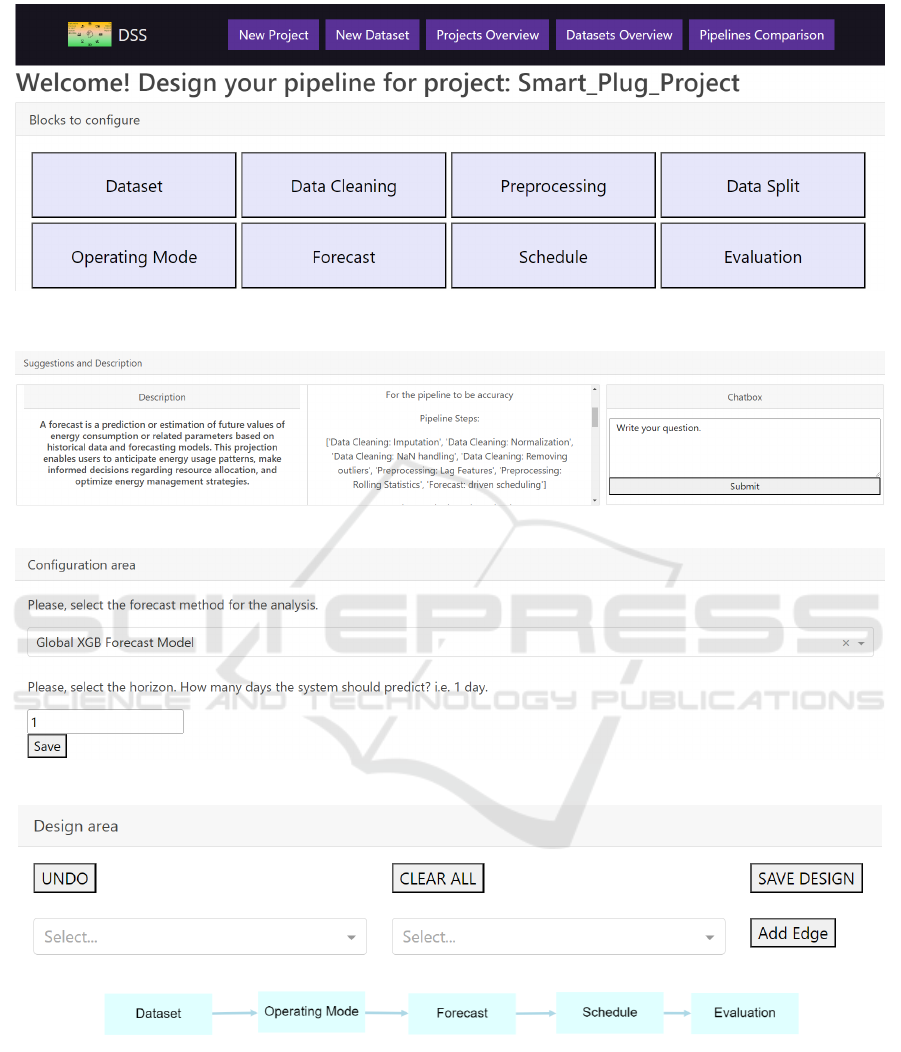
sign and configuration of the pipeline. Figure 2 shows
a screenshot of the configuration page of the EX-
DSS prototype software. Figure 2a lists the available
blocks developed in the EX-DSS software prototype,
while Figure 2b displays the suggestions generated by
the Knowledge Management Subsystem with support
from the Explorative Management Subsystem.
A suggestion consists of a block’s description, in-
sight generated by the Explorative Management for
the specific project, and a chatbox for communication
with the Knowledge Management Subsystem. The
Explorative Management Subsystem (Fig.1D.4) uses
the project’s keywords to find the closest matching
dataset and generate suggestions based on stored ex-
pert knowledge. These suggestions include a list of
blocks and methods, such as the appropriate forecast-
ing method or technique to preprocess the dataset.
This modular approach provides accurate and special-
ized knowledge, which can be modified to enhance
specific subject knowledge or reused for other pur-
poses.
The Knowledge Management Subsystem
(Fig.1D.3) maintains a general knowledge view.
In the EX-DSS software prototype, it uses a Gen-
erative AI model developed by Cohere
8
. The
system connects to the Cohere platform via an API,
sends a request with a question, and displays the
AI-generated response to the user. Additionally, it
ensures the correct interconnections between blocks,
such as preventing the “Forecast” block from being
followed by the “Dataset” block.
Additionally, the Knowledge Management Sub-
system ensures that the interconnections between
blocks are correct. For example, in the EX-DSS soft-
ware prototype, the “Forecast” block could not be fol-
lowed by the “Dataset” block. Figure 2c represents
the configuration area, where users choose methods
and configure parameters. For example, in the “Fore-
cast” block, users can select the forecasting method
and the prediction horizon. In the example shown
8
https://cohere.com/
EX-DSS: An Explorative Decision Support System for Designing and Deploying Smart Plug Forecasting Pipelines
201

(Fig. 2c), “Global XGBoost” was chosen with a pre-
diction horizon of “1” day.
Figure 2d shows the area where the user can orga-
nize and connect the chosen blocks. In the example,
the tasks were organized as follows: “Dataset” for se-
lecting the dataset, “Operating Mode” for determin-
ing the appliance’s operating mode, “Forecast” for
predicting the appliance loads, “Schedule” for plan-
ning when the appliances should be turned on or off,
and “Evaluate” for assessing the performance of the
other blocks. “Data Cleaning” and “Preprocessing”
were excluded since the dataset was already prepro-
cessed
Once the configuration for each block is saved, the
pipeline is ready for training.
4.2.5 Pipeline Training and Results
Once the pipeline is ready, the user initiates the Model
Management Subsystem (Fig.1B.2), specifically the
Deployment Entity (Fig.1B.2.C), to launch the de-
ployment process. In the EX-DSS software proto-
type, this was implemented by an external server run-
ning Airflow
9
, a platform designed for executing and
monitoring a chain of tasks. The Deployment Entity
transferred the necessary files to the Airflow server.
Figure 3 displays the pipeline’s runtime, which took
9 minutes and 24 seconds to train and generate results.
Upon completion, the Airflow server communi-
cates the results back to the EX-DSS, and users can
download these results through the EX-DSS inter-
face. Additionally, users can download the forecast-
ing model, operating mode model, predictions, and fi-
nal schedule. Table 2 provides an example of the final
schedule. Additionally, Table 3 displays the numer-
ical values of the metrics used to assess smart plug
scheduling following the application of the “Global
XGBoost” method.
Listing 2: Example of static suggestion stored inside the
EX-DSS software prototype.
1{” P i p e l i n e S t e p s ” {
2” D at a C l e a n i n g ” ” I m p u t a t i o n ”
3” D at a C l e a n i n g ” ” N o r m a l i z a t i o n ”
. . . } ,
4” O p e r a t i n g Mode D e t e c t i o n ” {
5” Method ” ”GMM”
6” Method ” ” Ense mb le ”
7” F o r e c a s t i n g ” {
8” Method ” ” G l o b al XGBoost ”
9” Method ” ” G l o b al FNN”}
9
https://airflow.apache.org/
Table 2: Schedule Overview. The table provides an exam-
ple of the schedule for plugs 0 and 168. Both plugs are off
at night and turn on in the morning, with plug 0 turning on
earlier. Plug 0 turns off around lunch while plug 168 turns
off later in the afternoon. The schedule can be summarized
with the turn-on and turn-off times: Plug 0: {2023-01-13
05:15:00: ”Turn on”; 2023-01-13 12:30:00: ”Turn off”},
Plug 168: {2023-01-13 09:30:00: ”Turn on”; 2023-01-13
16:45:00: ”Turn off”}
Timestamp Plug 0 ... Plug 168
2023-01-12
00:00:00
OFF ... OFF
... ... ... ...
2023-01-13
05:15:00
ON ... OFF
... ... ... ...
2023-01-13
09:30:00
ON ... ON
... ... ... ...
2023-01-13
12:30:00
OFF ... ON
... ... ... ...
2023-01-13
16:45:00
OFF ... OFF
... ... ... ...
Table 3: Forecasting Evaluation. The table illustrates how
the chosen forecasting method performed in the pipeline.
Global XGBoost
Schedule
Number of violations (%) 3.27
Missed chances (%) 27.67
Energy saved (%) 25.84
Number of turn on/off
commands per plug per day
3.33
Energy Efficiency (%) 47.92
5 RESULTS AND DISCUSSION
The study’s findings indicate that the Explorative De-
cision Support System (EX-DSS) architecture frame-
work enhances the design and implementation of DSS
for designing smart plug pipelines, optimizing data
forecasting, and, consequently, aiding in reducing en-
ergy consumption. By extending the classical Deci-
sion Support System (DSS) framework, the EX-DSS
incorporates a module for assessing user input quality,
facilitating collaboration among users, and promoting
reproducibility. This prevents the repetition of previ-
ous errors and accelerates the pipeline creation pro-
cess.
The EX-DSS allows users to upload new datasets,
along with descriptions and additional documents,
providing a comprehensive overview. The system in-
ternally evaluates these inputs and generates a report
KMIS 2024 - 16th International Conference on Knowledge Management and Information Systems
202
(a)
(b)
(c)
(d)
Figure 2: Configuration page screenshots. They were taken from the EX-DSS software prototype. (a) The list of the blocks
developed inside the EX-DSS software prototype. (b) The structure of the suggestions provided to the user by the system. (c)
This part of the page is dedicated to configuring the blocks. In the image, it is possible to visualize the configuration for the
Forecast block. (d) This is the design area where the user can add and connect the blocks.
EX-DSS: An Explorative Decision Support System for Designing and Deploying Smart Plug Forecasting Pipelines
203
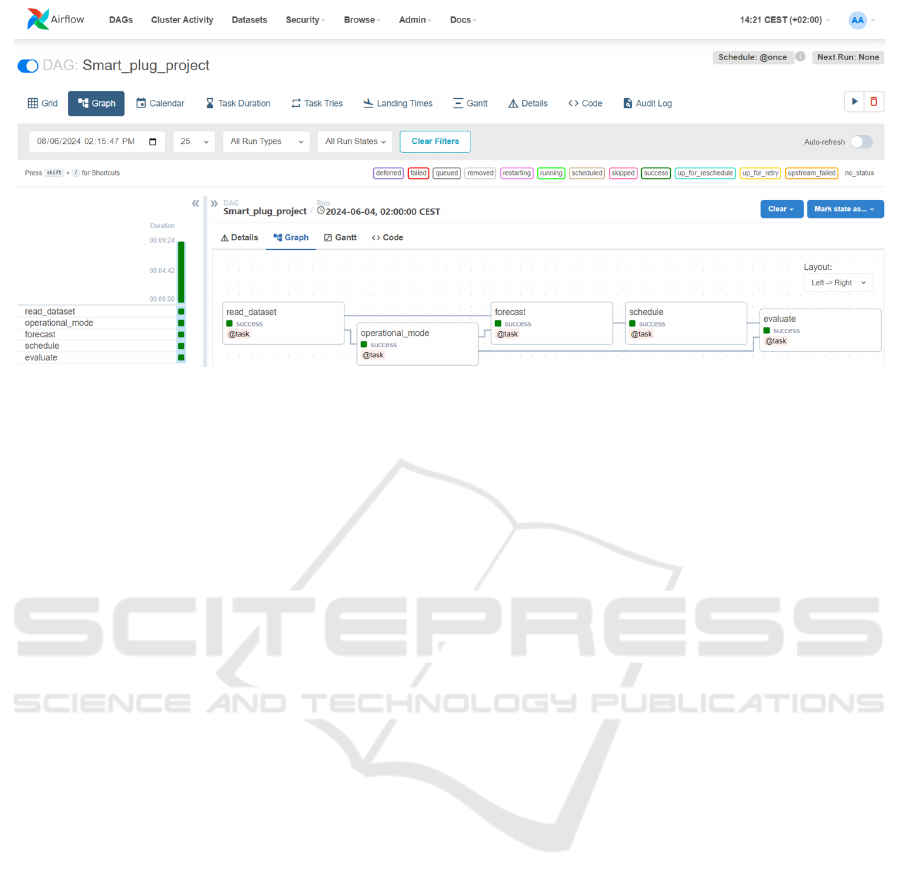
Figure 3: Screenshot of the Airflow server. The image shows the service used by the EX-DSS to run the pipeline.
on data quality and description clarity. By maintain-
ing the essential human-in-the-loop characteristic of
a DSS, users retain control over the types of analyses
the system should perform, ensuring that the informa-
tion received is of high quality and increasing the like-
lihood of high-performance outcomes from the de-
ployed pipeline.
A key innovation in the EX-DSS is the inclusion
of the Explorative Management Subsystem, which
supports the Knowledge Management Subsystem by
analyzing user inputs and providing relevant insights.
By using a system of keywords tailored to the smart
plug forecasting problem, the EX-DSS offers spe-
cialized support while maintaining general intelli-
gence within the Knowledge Management Subsys-
tem, thanks to the integration of the Cohere generative
AI model. This dual support (general and specific)
significantly aids users in designing and configuring
forecasting pipelines, allowing for customization and
catering to various needs and requirements.
The study has shown that the pipeline design, con-
figuration, and deployment process can be carried
out without coding, making it accessible to a broader
range of users. However, future work should include
extensive testing with diverse datasets to further vali-
date the system’s robustness and flexibility. Addition-
ally, user feedback should be collected to refine the in-
terface and improve the overall user experience. Inte-
grating real-time data processing and adaptive learn-
ing capabilities could also enhance the EX-DSS, mak-
ing it more responsive to changing conditions and
user needs.
6 CONCLUSIONS
The Explorative Decision Support System (EX-DSS)
framework, implemented through a software proto-
type, has proven effective in designing pipelines for
scheduling smart plugs to reduce building energy
consumption. By extending the classical DSS with
the Explorative Management Subsystem, the EX-DSS
provides specialized suggestions alongside general
support, enhancing the design process.
The introduction of the data quality module has
enabled the EX-DSS to assess the quality of input
information, providing users with a clear overview
of data status and ensuring higher performance when
training models. The system also promotes the share-
ability of pipeline information and dataset knowl-
edge by requiring users to describe new projects and
datasets, thus promoting reproducibility and avoiding
duplication.
Despite its benefits, the study faced limitations.
The software is not production-ready and was devel-
oped for demonstration purposes only. Additionally,
the study included only the methods proposed by Bot-
man et al. (2024), and the development relied on input
from a single expert due to time constraints and lim-
ited availability of specific profiles.
Future work should focus on investigating the in-
teraction between the Knowledge Management Sub-
system and the Explorative Management Subsystem
to optimize their integration. Extending the soft-
ware prototype to include result visualization directly
within the EX-DSS would improve the user experi-
ence. Additionally, developing functionality to com-
pare the results of similar pipelines would help iden-
tify the best-performing ones. Transitioning the soft-
KMIS 2024 - 16th International Conference on Knowledge Management and Information Systems
204

ware from a prototype to a production-ready system
is essential, as is conducting extensive testing with
diverse datasets and gathering user feedback to re-
fine the interface and enhance overall usability. These
steps will help validate the EX-DSS’s robustness, im-
prove its flexibility, and ensure it meets the needs of
various users.
ACKNOWLEDGEMENTS
This research received funding from • KU Leuven:
Research Fund (projects iBOF/23/064, C3/20/117,
C3I-21-00316), Industrial Research Fund and sev-
eral Leuven Research and Development bilateral
industrial projects; • Flemish Government Agen-
cies: ◦ FWO: SBO project S005319N, TBM Project
T001919N; FWO PhD Grant 11K5623N; ◦ EWI: the
Flanders AI Research Program; ◦ VLAIO: CSBO
(HBC.2021.0076) Baekeland PhD (HBC.20192204);
• EU: This project has received funding from the Eu-
ropean Research Council (ERC) under the European
Union’s Horizon 2020 research and innovation pro-
gramme (grant agreement No 885682). Views and
opinions expressed are however those of the author(s)
only and do not necessarily reflect those of the Eu-
ropean Union or ERC. Neither the European Union
nor the granting authority can be held responsible for
them.
REFERENCES
Botman, L., Lago, J., Fu, X., Chia, K., Wolf, J., Kleissl, J.,
and De Moor, B. (2024). Building plug load mode de-
tection, forecasting and scheduling. Applied Energy.
Chandra, A., Krovi, R., and Rajagopalan, B. (2007). Risk
visualization: A mechanism for supporting unstruc-
tured decision making processes. The International
Journal of Applied Management and Technology.
Chia, K., Lebar, A., Agarwal, V., Lee, M., Ikedo, J., Wolf,
J., Trenbath, K., and Kleissl, J. (2023). Integration of
a Smart Outlet-Based Plug Load Management System
with a Building Automation System. 2023 IEEE PES
Grid Edge Technologies Conference and Exposition,
Grid Edge 2023.
Duan, Y. and Xu, M. (2009). Decision support systems in
small businesses. IGI Global - Business and Informa-
tion Systems Research Centre (BISC).
Gonzalez-Andujar, J. (2020). Introduction to Decision Sup-
port Systems, pages 25–38.
Jacquet-Lagreze, E. and Shakun, M. F. (1984). Decision
support systems for semi-structured buying decisions.
European Journal of Operational Research.
Phillips-Wren, G. (2013). Intelligent Decision Support Sys-
tems.
Rinaldi., G., Crema Garcia., F., Agudelo., O. M., Becker.,
T., Vanthournout., K., Mestdagh., W., and De Moor.,
B. (2023). A framework for a data quality module in
decision support systems: An application with smart
grid time series. In Proceedings of the 25th Interna-
tional Conference on Enterprise Information Systems
- Volume 1: ICEIS. INSTICC, SciTePress.
Rupnik, R., Kukar, M., Vra
ˇ
car, P., Ko
ˇ
sir, D., Pevec, D., and
Bosni
´
c, Z. (2019). Agrodss: A decision support sys-
tem for agriculture and farming. Computers and Elec-
tronics in Agriculture.
Sloane, E. B. and J. Silva, R. (2020). Artificial intelli-
gence in medical devices and clinical decision support
systems. In Iadanza, E., editor, Clinical Engineering
Handbook (Second Edition). Academic Press, second
edition edition.
Turban, E., Sharda, R., and Delen, D. (2010). Decision
Support and Business Intelligence Systems. Prentice
Hall Press, 9th edition.
Tuttle, R., Trenbath, K., Maisha, K., and LeBar, A. (2020).
Assessing and reducing plug and process loads in of-
fice buildings. Technical Report.
Wilkinson, M. D., Dumontier, M., Aalbersberg, I. J., Apple-
ton, G., Axton, M., Baak, A., Blomberg, N., Boiten,
J., Santos, L. O. B. d. S., Bourne, P. E., Bouwman,
J., Brookes, A. J., Clark, T. W., Crosas, M., Dillo, I.,
Dumon, O., Edmunds, S., Evelo, C. T., Finkers, R.,
Gonz
´
alez-Beltr
´
an, A., Gray, A. J. G., Groth, P., Goble,
C., Grethe, J. S., Heringa, J., Hoen, P. A., Hooft, R.,
Kuhn, T., Kok, R., Kok, J. N., Lusher, S. J., Mar-
tone, M. E., Mons, A., Packer, A. L., Persson, B. L.,
Rocca-Serra, P., Roos, M., Schaik, R. v., Sansone,
S., Schultes, E., Sengstag, T., Slater, T., Strawn, G.,
Swertz, M. A., Thompson, M., Lei, J. v. d., Mulligen,
E. M. v., Velterop, J., Waagmeester, A., Wittenburg,
P., Wolstencroft, K., Zhao, J., and Mons, B. (2016).
The fair guiding principles for scientific data manage-
ment and stewardship. Scientific Data.
APPENDIX
Keywords used to define datasets and projects: time
series, energy, smart plugs, fast, high speed, less
computation, accuracy, high performance, precise,
reliable, user convenient, minimal disruption, user-
friendly, non-intrusive.
EX-DSS: An Explorative Decision Support System for Designing and Deploying Smart Plug Forecasting Pipelines
205
